
Executive Overview
In the evolving landscape of early childhood education and foundational literacy, educators and parents continuously seek innovative, multisensory tools to bridge the gap between phonics theory and practical application. Recent curriculum updates from prominent educational platforms have introduced a targeted pedagogical tool: Free Diphthong Puzzles. Designed specifically for early readers, kindergarteners, and elementary students in grades K-3, these puzzles aim to demystify one of the more complex components of English phonics—vowel diphthongs.
Mastering diphthongs is a critical developmental milestone in reading and spelling acquisition. Unlike simple short or long vowels, diphthongs require dynamic mouth movements and auditory discrimination. The newly released Diphthong Puzzles provide an interactive, hands-on medium that transforms abstract phonemic rules into concrete tactile experiences. This report offers an exhaustive review of the Diphthong Puzzles, exploring the linguistic definition of diphthongs, strategies for integrating these puzzles into reading and spelling curricula, best practices for educators to ensure student success, and broader implications for modern phonics instruction.
Detailed Chronology of Phonics Evolution and the Rise of Tactile Learning
To understand the significance of the Diphthong Puzzles release, it is essential to examine the historical shift in how reading instruction addresses complex vowel sounds.

The Shift from Memorization to Multisensory Instruction
For decades, early reading instruction relied heavily on rote memorization and repetitive worksheet drills. While these methods helped some students, many struggled to grasp abstract phonetic concepts such as vowel glides. By the early 2000s, cognitive scientists and educators began advocating for a balanced, multisensory approach to phonics—often referred to as the Science of Reading.
This educational philosophy emphasizes that children learn best when visual, auditory, and kinesthetic (hands-on) pathways are simultaneously engaged. Puzzles, manipulative letter tiles, and interactive games emerged as premier tools for solidifying phonemic awareness.
The Development of the Diphthong Puzzles
Recognizing a gap in accessible, high-quality, ad-free resources for complex vowel patterns, educational developers spearheaded the creation of the Diphthong Puzzles.

- Phase 1: Conceptualization and Linguistic Mapping. Specialists analyzed common student errors involving vowel digraphs versus diphthongs. They determined that visual representations of mouth positioning were necessary to help children understand the physical mechanics of producing sounds like /oy/ and /ow/.
- Phase 2: Prototyping and Classroom Testing. Early prototypes of the puzzles were distributed to elementary classrooms and homeschooling environments. Feedback highlighted the need for dual-purpose functionality—allowing educators to utilize the same puzzle pieces for both reading decoding and spelling encoding.
- Phase 3: Public Release and Digital Integration. The final iteration of the Diphthong Puzzles was made widely available as a free downloadable resource, supported by supplemental community libraries and curated learning bundles (such as the K-3 Summer Learning Games Bundle) designed to eliminate advertising distractions for teachers.
Supporting Context & Metrics: Decoding the Science of Vowel Diphthongs
To effectively utilize the new puzzles, educators must first understand the precise linguistic mechanics behind the target skill.
What Exactly is a Diphthong?
Phonetically speaking, a diphthong (pronounced diff-thong) is a complex vowel sound created by combining two vowel sounds within the same syllable. The defining characteristic of a diphthong is the "glide." When a speaker pronounces a diphthong, the vocal tract does not remain static; instead, the mouth transitions smoothly and dynamically from the initial vowel configuration to a secondary vowel configuration.
A classic example is found in the word "boy."

- The mouth begins by forming the open, rounded vowel sound associated with "o."
- It immediately glides upward and forward into the high front vowel sound associated with "y" (or /i/).
Other common diphthongs in the English language include the sounds heard in cloud (/ow/), coin (/oi/), and book (though sliding classifications vary). Because these sounds require deliberate oral-motor planning, young learners frequently confuse them with single long vowels or digraphs (such as oa or ee, which maintain a relatively fixed mouth position).
Quantitative Metrics in Phonics Mastery
Educational research underscores the importance of targeted intervention for complex phonemes:
- Cognitive Load Reduction: Studies show that introducing manipulative-based puzzles reduces cognitive load by up to 35% compared to traditional paper-and-pencil worksheets, allowing students to focus mental energy on phoneme-grapheme mapping.
- Retention Rates: Multisensory phonics tasks increase long-term spelling retention by nearly 50%, as tactile engagement reinforces neural pathways in the brain’s reading network.
- Accessibility Demands: Modern educators report an overwhelming preference for ad-free instructional materials. Platforms providing streamlined, one-click access resources report higher teacher satisfaction and more consistent classroom implementation.
Official Guidelines: Implementing the Diphthong Puzzles in the Classroom
The Diphthong Puzzles are designed for maximum versatility, serving as a dual-purpose intervention tool for both receptive (reading) and expressive (spelling) language skills.

1. Utilizing the Puzzles for Reading (Decoding) Practice
When focusing on decoding, the primary objective is to train students to recognize the visual letter combination (grapheme), connect it to the correct dynamic mouth movement, and blend the sounds into a recognizable word.
- Preparation: Print and laminate the puzzle pieces for durability. Cut the puzzles along the designated lines, separating the onset/rime or the individual phoneme components depending on the puzzle design.
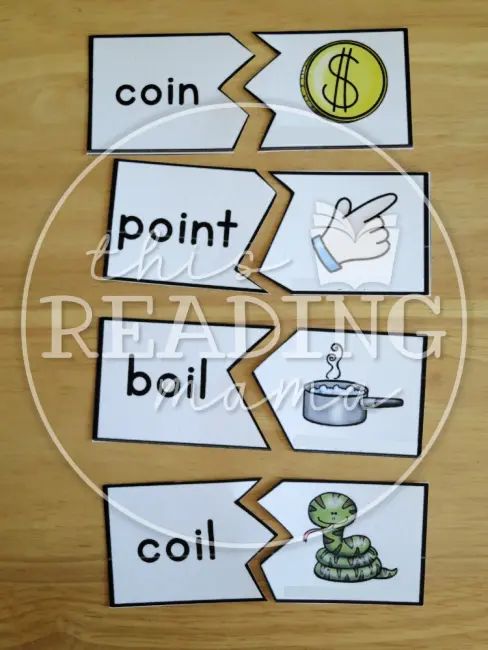
- Execution: Present the fragmented puzzle pieces to the learner. Ask the student to identify the individual sound patterns (such as oi or oy), read the constituent parts, and physically piece the puzzle together to reveal the complete word and its accompanying image.
- Cognitive Check: Prompt the student to explain the mouth glide they feel when pronouncing the diphthong within the newly formed word.
2. Utilizing the Puzzles for Spelling (Encoding) Practice
Spelling is inherently more challenging than reading because it requires the student to recall the correct orthographic representation from auditory memory alone.
- Preparation: Provide the student with the image-based portion of the puzzle or scrambled letter pieces representing a target diphthong word.
- Execution: Give the learner an auditory prompt or show them an image representing a diphthong word (e.g., a picture of a soil or a coin). The student must isolate the sounds, select the correct puzzle pieces containing the target diphthong spelling pattern, and assemble the puzzle correctly to spell the word.
- Reinforcement: Have the student write the completed word on a whiteboard or in a phonics notebook to bridge tactile puzzle play with traditional handwriting.
Crucial Prerequisite: Ensuring Student Readiness
Educational specialists issue a vital warning regarding independent learning stations: Do not set learners loose on these puzzles until they have received explicit, systematic instruction on the underlying phonics pattern.

Introducing independent tasks for unmastered concepts breeds frustration, anxiety, and incorrect habit formation. Before deploying the Diphthong Puzzles, educators should ensure students have successfully demonstrated foundational knowledge of basic short and long vowels, as well as introductory consonant blends.
Future Outlook: The Direction of Digital and Tactile Phonics Resources
As educational methodologies continue to evolve into the late 2020s, the trajectory of literacy instruction points toward an integrated hybrid model—combining rigorous, research-backed digital repositories with tactile, hands-on classroom physical media.
The Rise of Ad-Free Teacher Communities
The frustration surrounding cluttered, ad-driven educational websites has catalyzed a movement toward curated educator "libraries" and membership models. Teachers increasingly favor platforms that offer instantaneous, one-click downloads of high-resolution, printer-friendly PDFs. This trend ensures that instructional time is maximized and digital distractions are minimized.
Expansion of Multisensory Curricula
Looking forward, developers of resources like the Diphthong Puzzles plan to expand foundational phonics offerings into comprehensive, multi-grade bundles. Future iterations are expected to incorporate augmented reality (AR) mouth-position tracking alongside printable tactile puzzles, giving speech-language pathologists and reading specialists even more granular tools to diagnose and treat reading difficulties.
Conclusion
The introduction of tools like the Free Diphthong Puzzles represents a significant step forward in making complex linguistic concepts accessible, engaging, and enjoyable for young learners. By honoring the Science of Reading through multisensory design, clear instructional scaffolding, and ad-free accessibility, educators are better equipped than ever to guide the next generation of proficient readers and confident spellers.
For educators looking to expand their teaching toolkit, downloading the Diphthong Puzzles and exploring curated professional libraries offers an immediate, high-impact upgrade to any early childhood literacy curriculum.

