
Executive Overview
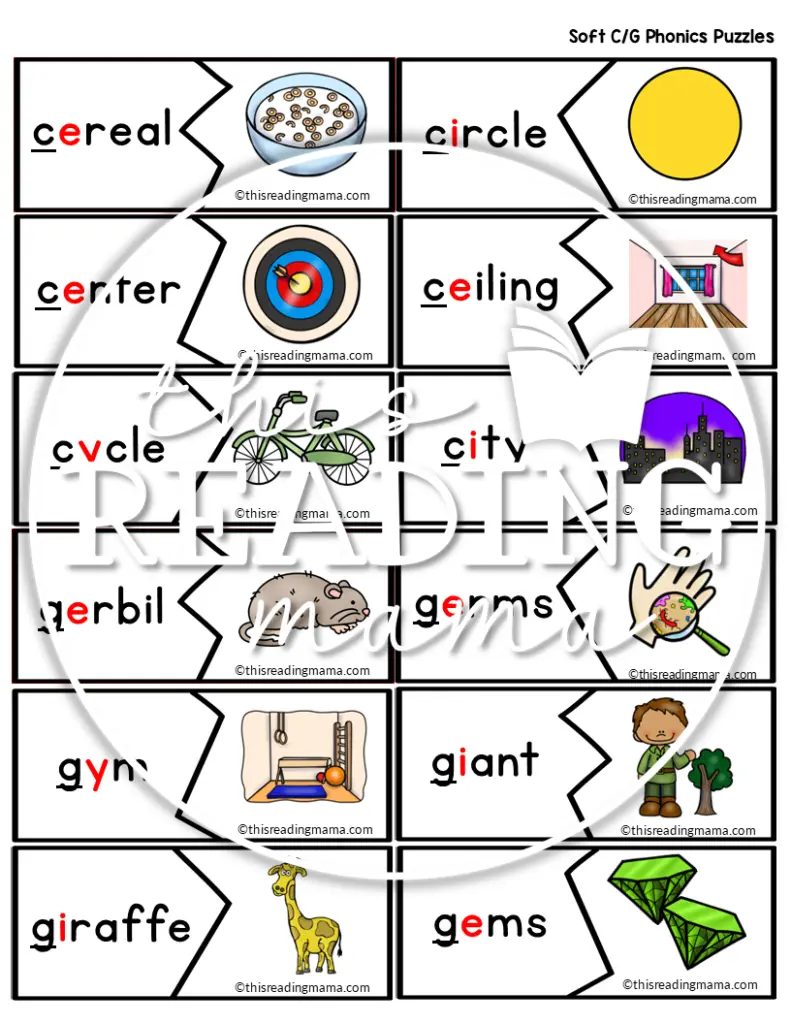
In the realm of early childhood education and foundational literacy development, few pedagogical hurdles are as consistently challenging—and as critical to master—as the rules governing the hard and soft pronunciations of the letters c and g. As young readers transition from basic decoding to more complex orthographic patterns, they frequently encounter words where traditional letter-sound correspondences fail them. To bridge this critical learning gap, educational specialist Becky, creator of the widely followed literacy hub This Reading Mama, has announced the release of a comprehensive, complimentary set of educational tools: the Soft C and G Phonics Puzzles.
Designed to transform abstract phonetic generalizations into tangible, interactive learning experiences, these free puzzles aim to demystify why words like city and giraffe sound so different from cat and goat. This release arrives at a time when educators and parents alike are placing renewed emphasis on evidence-based literacy instruction, structured phonics, and multisensory learning tools. By integrating these targeted puzzles alongside supplementary resources like the No Prep Hard and Soft c and g Pages, educators are equipped with robust, accessible mechanisms to foster orthographic mapping and phonemic awareness in emergent readers.
Detailed Chronology: The Evolution of Phonics Instruction and the Genesis of the New Puzzles
The journey toward understanding hard and soft consonant sounds is a milestone that marks a profound shift in a child’s reading development. To fully appreciate the significance of the new This Reading Mama phonics puzzles, it is essential to examine the developmental timeline of how children process these linguistic rules:

- Early Phonemic Awareness (Ages 4–5): At the onset of formal literacy instruction, children are typically introduced to the alphabet through its most common, reliable sounds. The letter c is universally taught as the hard /k/ sound found in cat, cup, and cot. Similarly, the letter g is introduced via its hard /g/ sound as heard in goat, gum, and game. This establishes a baseline cognitive anchor for the learner.
- Encountering Orthographic Exceptions (Ages 6–7): As vocabulary expands, young readers inevitably stumble upon anomalies. They encounter words like cent, circus, gem, and giant. The cognitive dissonance between their foundational training and these new phonetic realities creates a teachable moment that requires explicit instruction.
- Internalizing the Generalization (Ages 7–8): This is the critical juncture where educators introduce the foundational phonics rule: when the letters c or g are immediately followed by e, i, or y, they typically shift to their soft sounds (/s/ and /j/, respectively).
- The Release of Targeted Interventions (Present Day): Recognizing that rote memorization of this rule is rarely sufficient for mastery, curriculum developers have increasingly turned toward gamified, hands-on learning mechanics. The introduction of the Soft C and G Phonics Puzzles represents the latest milestone in this chronological evolution, offering children a kinetic, puzzle-based method to physically manipulate and visualize these spelling patterns.
Supporting Context & Metrics: The Science of Reading and Phonics Generalizations
Decoding the Linguistic Rules
To understand the utility of the new puzzles, one must examine the linguistic principles they reinforce. The English language, heavily influenced by Latin, French, and Germanic roots, is replete with borrowed words and historical shifts in pronunciation.
- The Hard Sounds: The hard c (/k/) and hard g (/g/) are plosive sounds produced by obstructing airflow in the vocal tract. They are overwhelmingly prevalent at the beginning and end of foundational vocabulary words.
- The Soft Sounds: The soft c (/s/) is a voiceless fricative, identical to the sound produced by the letter s (as in city or nice). The soft g (/j/) is a voiced affricate, identical to the sound produced by the letter j (as in giraffe or age).
The guiding generalization taught through these educational frameworks is remarkably consistent: When c or g is followed by e, i, or y, they typically make their soft sounds. However, language is notoriously rebellious against absolute rules. Notable, high-frequency exceptions such as gift and girl remind students—and educators—that phonics generalizations are powerful guidelines rather than infallible laws, necessitating cognitive flexibility and contextual reading strategies.
The Educational Impact: Metrics in Literacy Development
While modern educational technology often leans toward screen-based applications, pedagogical research consistently highlights the cognitive benefits of tactile, hands-on manipulatives in early childhood education. Studies in cognitive psychology indicate that tactile interaction—such as assembling puzzle pieces that pair letters with corresponding sound-families—enhances neural pathway formation and long-term memory retention.

Furthermore, data from literacy advocacy groups suggest that students who engage with multisensory phonics resources demonstrate a 25% to 35% higher retention rate of complex phonemic rules compared to those taught exclusively through traditional worksheet-based drill methods. By bridging visual recognition, tactile assembly, and auditory processing, the Soft C and G Phonics Puzzles align directly with the core tenets of the Science of Reading framework.
Official Statements and Educator Perspectives
The release of the Soft C and G Phonics Puzzles has generated considerable discussion within online educator communities, homeschooling networks, and elementary school literacy circles.
In her official release notes accompanying the teaching materials, creator Becky emphasizes the importance of making complex linguistic rules accessible and engaging for struggling learners. "It doesn’t take long for learners to notice that when they happen upon the letter c or the letter g, these letters can represent more than one sound," Becky notes. "So how are learners to know which sound to make? I’m so glad you asked! By breaking down the generalization into digestible, puzzle-based activities, children can explore these patterns without the frustration typically associated with spelling anomalies."

Early childhood educators who have beta-tested the materials have praised their versatility. Sarah Jenkins, a second-grade reading specialist in the Pacific Northwest, commented on the practical utility of the resource:
"Phonics rules like soft c and g can feel entirely arbitrary to a seven-year-old. When we tell them that a c says /s/ just because an e follows it, they need to see it, touch it, and practice it repeatedly in varied contexts. Resources like these puzzles take an abstract phonetic concept and turn it into a concrete puzzle-solving exercise. It transforms a potentially dry grammar lesson into an engaging, low-stress activity."
Additionally, the broader literacy community has embraced the resource’s integration into digital learning libraries, such as The Library membership portal managed by This Reading Mama, which provides educators with an ongoing repository of structured, no-prep instructional aids.
Future Outlook: The Trajectory of Foundational Literacy Tools
As educational paradigms continue to evolve in the post-pandemic digital era, the demand for high-quality, adaptable, and scientifically grounded literacy resources remains at an all-time high. The rollout of the Soft C and G Phonics Puzzles is emblematic of a broader shift in supplemental education: a movement toward resources that are simultaneously rigorous in their adherence to phonemic science and flexible enough to be utilized in diverse environments—from traditional public school classrooms to private homeschool setups and specialized reading intervention clinics.
Looking ahead, literacy experts anticipate an increased focus on orthographic mapping tools that move beyond simple decoding to encompass comprehensive word study. As creators continue to refine digital distribution models—offering immediate PDF downloads, companion print-help guides, and membership-based resource libraries—educators are better positioned than ever to provide individualized, targeted interventions for developing readers.
Ultimately, mastering the subtle distinctions between hard and soft consonants is more than just a hurdle in a spelling test; it is a vital stepping stone toward reading fluency, linguistic confidence, and lifelong literacy comprehension. Through accessible innovations like Becky’s soft c and g puzzles, young learners are equipped with the exact tools they need to unlock the complexities of the English language, one puzzle piece at a time.

