
EXECUTIVE OVERVIEW
In an era defined by rapid technological advancement and complex problem-solving, the methodologies we use to conceptualize, build, and refine solutions are more critical than ever. Whether designing next-generation aerospace components, software architectures, or simply scrambling to prepare a meal with limited pantry resources, engineers and innovators rely on a standardized, cyclical framework known as the Engineering Design Process (EDP).
Far from being an abstract academic theory, the EDP is a systematic, step-by-step methodology deployed by multidisciplinary engineering teams to navigate challenges, mitigate risks, and optimize creations. At its core, the process relies on the seamless integration of mathematics, physical sciences, and iterative testing.
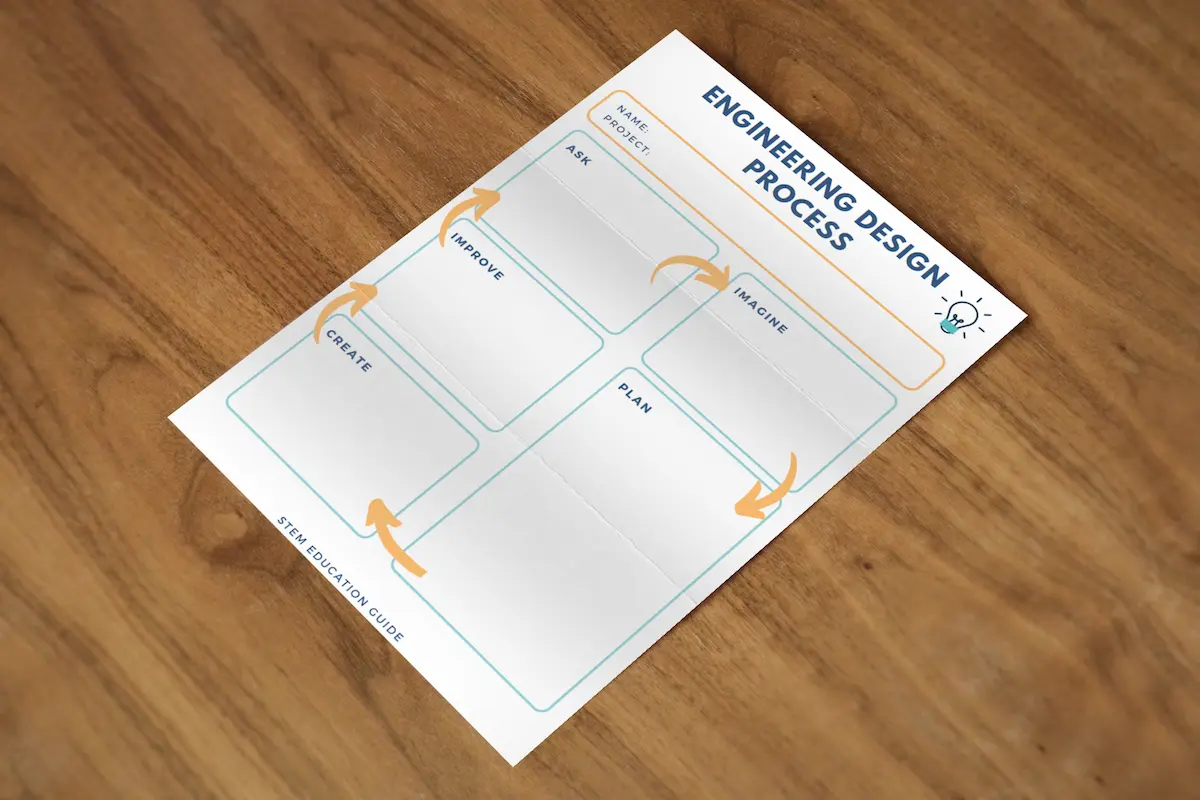
While advanced industrial applications may expand the lifecycle into a dozen or more granular milestones, foundational frameworks consistently boil the framework down to five core phases: Ask, Imagine, Plan, Create, and Improve.
Crucially, the EDP is not a linear trajectory with a definitive end; rather, it operates as a continuous loop. Once a solution is executed, evaluators analyze its performance, identify flaws, and cycle back through the framework to implement enhancements. To demystify this critical STEM (Science, Technology, Engineering, and Mathematics) framework for students, educators, and industry professionals alike, this report examines how the five-step design cycle operates in both high-stakes industrial environments and everyday scenarios, while contrasting its objectives with the traditional Scientific Method.
DETAILED CHRONOLOGY: THE FIVE-PHASE LIFECYCLE IN ACTION
To fully grasp the mechanics of the Engineering Design Process, it is most effective to observe it deployed in real time. Consider a common, high-pressure household scenario: preparing a family dinner with zero advanced planning, sparse ingredients, and strict time constraints. By breaking this domestic challenge down into the five formal stages of the EDP, we uncover the universal logic that underpins all professional engineering projects.
Step 1: Ask — Defining the Scope and Constraints
Every engineering project begins by identifying a core problem or unsatisfied human need. In our domestic case study, a rushed family meeting in the kitchen reveals a collective problem: everyone is hungry, nobody planned or shopped for dinner, and existing resources must be audited.
In professional engineering, this phase is equivalent to writing the project charter and establishing design constraints. Engineers must ask critical questions:
- What problem are we solving?
- Who are the end-users?
- What are our limitations regarding budget, time, materials, and safety?
By clearly articulating these parameters before writing a single line of code or cutting a piece of metal, teams avoid costly misdirections later in the lifecycle.
Step 2: Imagine — Brainstorming and Conceptualization
Once the parameters are established, the team transitions into creative ideation. With a family of six looking over available kitchen inventory, brainstorming commences. A traditional roasted meat dish is quickly dismissed: it takes too long to cook, and the oven will superheat the house on an already warm day.
However, a surplus of garden-fresh vegetables donated by grandparents presents an opportunity: a vegetable stew. To elevate the nutritional value, a protein source must be integrated. The family utilizes digital resources—conducting rapid internet research—to identify compatible protein sources that pair well with garden vegetables.
In industrial engineering, this is the conceptual design phase where sketching, whiteboarding, and preliminary feasibility studies take center stage. Teams generate dozens of divergent ideas, deliberately suspending judgment to explore unconventional pathways before converging on the most viable option.
![What is the Engineering Design Process? [Plus, a Free Worksheet] - STEM Education Guide](https://stemeducationguide.com/wp-content/uploads/2020/04/enginereering-design-process-worksheet.png)
Step 3: Plan — Drafting Blueprints and Specifications
Ideation must give way to structured execution. The family jots down an official bill of materials (a list of approved vegetables: potatoes, carrots, tomatoes, zucchini, summer squash, turnips, green beans, beets, and peas) alongside potential protein options (dried kidney beans, tofu, and eggs).
Because stakeholder preferences diverge—not everyone agrees on a single protein source—the plan must adapt. The design is scaled to incorporate multiple parallel branches: three separate pans of stew to accommodate distinct protein preferences.
In professional practice, this phase involves drafting detailed computer-aided design (CAD) blueprints, creating mathematical models, establishing risk management protocols, and sequencing project milestones.
Step 4: Create — Prototyping and Fabrication
With a solid plan in place, the team moves into the physical creation phase—building the prototype. Division of labor is established based on skill level and safety considerations. Younger participants handle low-risk tasks like shelling peas, snapping green beans, and cutting soft ingredients with table knives, while parents manage high-density vegetables requiring sharp blades.
The family splits into three specialized execution teams, each taking ownership of a distinct prototype (pot of soup). Teams introduce water, dried herbs, and spices, combining their chosen vegetables and protein sources while reserving sensitive ingredients—such as eggs—for later stages of the thermal cycle.
In a corporate or laboratory setting, this is where prototypes are physically assembled, printed via additive manufacturing (3D printing), or coded into functional software builds.
Step 5: Improve — Testing, Evaluation, and Iterative Refinement
An initial prototype rarely survives first contact with reality without revealing flaws. As cooking aromas fill the kitchen, evaluation uncovers two distinct engineering failures:
- The tofu cubes are breaking apart and turning mushy due to over-saturation and excessive heat exposure.
- The red beets are leaching pigments, turning the broth, potatoes, and turnips an unintended shade of pink.
Immediate engineering adjustments are required. The intervention is swift: the beets are extracted from the pot before further color degradation occurs, set aside for alternative use, and replaced with carrots. Meanwhile, a team member uses a slotted spoon to fish out the failing tofu; a parent then stir-fries a fresh batch of tofu cubes separately until golden brown, reintroducing them to the stew at a later, safer juncture of the cooking process.
Similarly, eggs are cracked into their designated pot near the conclusion of the heating cycle, rapidly solidifying to trap their yolks. Taste tests are conducted across all three teams. While two pots are finalized and removed from the heat source, the third pot—containing dried kidney beans—requires extended thermal processing because the legumes remain too firm.
This phase epitomizes the iterative nature of the EDP. Testing exposes performance gaps; engineering teams analyze the root cause, redesign the failing component, and retest until quality thresholds are met.
SUPPORTING CONTEXT & METRICS: ENGINEERING VS. SCIENCE
As the family sits down to enjoy their hearty meal of customized stews and bread, a broader educational discussion naturally arises at the dinner table: How does the Engineering Design Process differ from the Scientific Method?
While both frameworks represent systematic approaches to human inquiry and problem-solving, their ultimate goals, methodologies, and outputs diverge significantly.
![What is the Engineering Design Process? [Plus, a Free Worksheet] - STEM Education Guide](https://stemeducationguide.com/wp-content/uploads/2020/04/Engineering-Design-Process.png)
| Metric / Dimension | Scientific Method | Engineering Design Process |
|---|---|---|
| Primary Objective | To discover foundational truths and explain natural phenomena. | To create new products, technologies, or structural solutions. |
| Starting Point | An inquisitive question about the natural or physical world. | A human need, operational challenge, or design problem. |
| Core Mechanism | Forming hypotheses, running controlled experiments, analyzing data. | Brainstorming, prototyping, building, and iterative testing. |
| Handling of Failure | Failure disproves a hypothesis, advancing theoretical knowledge. | Failure exposes structural flaws, driving immediate prototype redesign. |
| Primary Output | Peer-reviewed academic papers, scientific journals, and theories. | Tangible consumer products, patented tech, infrastructure, or software. |
The Scientist’s Pursuit vs. The Engineer’s Creation
Scientists operate primarily within the realm of discovery. They observe nature, formulate hypotheses, and design controlled experiments to uncover how the universe works. Upon concluding their research, scientists typically publish their findings in academic journals, contributing to the global repository of human knowledge.
Conversely, engineers are pragmatic innovators. They leverage the scientific truths discovered by researchers to invent novel products, construct infrastructure, or optimize existing technologies. When an engineer encounters a flaw—such as mushy tofu or bleeding beet pigments—they do not write a research paper; they redesign the artifact. The ultimate deliverable of an engineer is a functional, scalable solution deployed in the real world.
Intersecting Disciplines: The Case of the Beet
To understand how these two worlds intertwine, consider the humble beet once more. Through the lens of the Engineering Design Process, your family determined that whole beets were ill-suited for a mixed vegetable stew unless you intentionally desired pink-hued broth and tubers (not unlike the traditional Eastern European soup known as borscht).
However, a family member shares a recent scientific discovery encountered in a health publication. Scientists, utilizing the Scientific Method, conducted controlled clinical trials to evaluate the physiological benefits of concentrated beet juice. Their empirical research proved that the human body metabolizes naturally occurring nitrates in beet juice into nitric oxide molecules. This biological reaction significantly enhances blood flow to the brain and muscles while measurably lowering high blood pressure.
Thus, science explains why the beet possesses specific biochemical properties, while engineering utilizes those insights to design functional dietary products, optimize agricultural output, or—in the case of our kitchen challenge—determine optimal ingredient selection for human nutrition.
OFFICIAL STATEMENTS & EDUCATIONAL INSIGHTS
Educational authorities and STEM curriculum developers emphasize that introducing children and young adults to structured design frameworks fosters critical cognitive skills that extend far beyond the laboratory or kitchen.
"The Engineering Design Process teaches students that failure is not a terminal grade, but rather an essential data point," notes a leading STEM curriculum specialist. "When a prototype fails—whether it’s a bridge model buckling under weight or tofu dissolving in a stew—it provides the exact diagnostic information needed to build a superior version. Cultivating this resilience is the hallmark of modern engineering education."
Furthermore, educators stress that hands-on, cross-curricular challenges—such as culinary engineering, robotics construction, or architectural modeling—demystify complex scientific concepts by grounding them in tangible, real-world utility. By utilizing downloadable worksheets and structured design logs, students learn to articulate constraints, document iterations, and collaborate effectively within multidisciplinary teams.
FUTURE OUTLOOK: THE EVOLUTION OF DESIGN THINKING
As we look toward the future, the boundaries between the Engineering Design Process, software architecture, and everyday problem-solving continue to blur. Emerging technological paradigms—including artificial intelligence, generative design algorithms, and advanced sustainable materials—are fundamentally transforming how engineers approach each phase of the EDP.
In the Ask and Imagine phases, AI-driven language models and generative CAD tools can now assist engineering teams in brainstorming thousands of potential design iterations in seconds, bypassing human cognitive bottlenecks. In the Create phase, automated additive manufacturing and smart robotics allow for rapid prototyping with unprecedented precision.
Yet, despite these technological leaps, the foundational humanity of the process remains unchanged. Whether programming an autonomous vehicle, engineering a carbon-capture facility, or troubleshooting a family dinner recipe, the core imperative of the innovator is identical: identify the human need, brainstorm viable concepts, build a prototype, embrace constructive failure, and relentlessly improve until the challenge is met.

