

Executive Overview
In the rapidly evolving landscape of artificial intelligence, the industry’s focus is quietly shifting away from the pursuit of monolithic, all-knowing "frontier" models and toward specialized, highly collaborative ecosystems. Marking a significant milestone in this paradigm shift, Nvidia officially released Nemotron 3.5 Lightning on August 11. Rather than positioning this new offering as another general-purpose answer engine designed to dazzle users with conversational trivia, Nvidia has engineered Nemotron 3.5 Lightning to serve as a high-speed, hyper-efficient workhorse embedded deep within long-running autonomous AI agent systems.
At its core, Nemotron 3.5 Lightning is a 30 billion-parameter mixture-of-experts (MoE) model that activates a mere 3 billion parameters per token. This lean architectural design allows the model to support massive context windows of up to 1 million tokens while delivering output speeds up to four times faster than similarly sized competitors. To accelerate ecosystem adoption, Nvidia is distributing the model with open weights, complete training data, and recipes under its permissive OpenMDW-1.1 license.
However, the hardware and software giant’s latest announcement extends far beyond the release of a single open-source weights file. Nemotron 3.5 Lightning represents a foundational component in a broader architectural shift: the transition from isolated, single-prompt AI interactions to complex, multi-model agent systems. By pairing Lightning with NeMo Switchyard—a newly introduced open-source routing library—Nvidia is championing an enterprise framework where model selection becomes a dynamic, runtime decision. In this emerging vision, heavy reasoning models handle complex planning and high-level decision-making, while specialized speed demons like Lightning execute the thousands of repetitive tool calls, validations, and formatting steps required to bring those plans to life.
Detailed Chronology: The Evolution of Agentic Workflows and the Path to Lightning
To fully understand the strategic significance of the Nemotron 3.5 Lightning release, one must examine the chronological evolution of modern enterprise AI workloads over the past several years.

Phase One: The Monolithic Prompt-Response Era
In the immediate aftermath of the generative AI boom, the industry was dominated by massive, general-purpose frontier models. Developers treated these models as black-box oracles: a user submitted a single prompt, and the model generated a comprehensive response. While these systems excelled at creative writing, summarization, and basic code generation, they hit severe scaling bottlenecks when applied to complex, multi-step business processes. Relying on a single heavyweight model for every micro-task—such as checking a database, formatting a JSON payload, or validating a syntax string—proved prohibitively expensive and agonizingly slow.
Phase Two: The Rise of Autonomous Agents
As foundational capabilities matured, the industry pivoted toward autonomous AI agents. Instead of stopping at a single response, modern agents are designed to autonomously decompose complex objectives into executable workflows, invoking external tools, writing code, querying databases, and iterating on their own outputs over dozens or even hundreds of sequential steps.
While transformative, this architectural evolution exposed a glaring inefficiency: routing every single step of a multi-thousand-step agentic loop through a massive frontier reasoning model creates unacceptable latency spikes and inflates inference costs to unsustainable levels. A model optimized for deep philosophical reasoning or advanced mathematical deduction is grossly overqualified—and economically inefficient—for verifying whether an API response returned a 200 OK status code.
Phase Three: The August 11 Release and the "System of Models" Paradigm
Recognizing this enterprise bottleneck, Nvidia spent months developing an alternative architecture. On August 11, the company crystallized this vision with the release of Nemotron 3.5 Lightning. Rather than forcing organizations to choose between raw intelligence and operational velocity, Nvidia designed Lightning specifically to operate as the engine room of an agentic workflow.
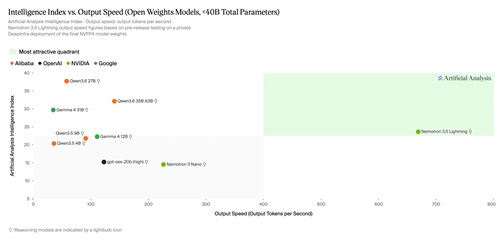
Simultaneously, Nvidia introduced NeMo Switchyard, an open-source routing library engineered to solve the operational headache of managing disparate model fleets. By bridging the gap between high-level orchestration and low-level execution, the August 11 release established a blueprint for how enterprise AI applications will be built, deployed, and scaled moving forward.
Supporting Context & Metrics: Under the Hood of Nemotron 3.5 Lightning
The technical specifications of Nemotron 3.5 Lightning reveal a deliberate engineering compromise: trading absolute maximum intelligence on niche academic benchmarks for raw, unadulterated execution speed and computational efficiency.
Architectural Breakdown: Mixture-of-Experts (MoE)
Nemotron 3.5 Lightning is built on a 30 billion-parameter mixture-of-experts architecture. In an MoE setup, the network is divided into multiple "expert" neural networks, and a router mechanism dynamically selects a subset of these experts for each incoming token.
- Total Parameters: 30 Billion
- Active Parameters per Token: 3 Billion
- Maximum Context Window: Up to 1,000,000 (1 Million) tokens
By activating only 3 billion parameters per token while retaining the collective capacity of a 30-billion-parameter network, Lightning achieves the sweet spot between representational capacity and inference speed. This design allows the model to ingest massive documents, entire code repositories, or extensive conversational histories via its 1-million-token context window without buckling under memory bandwidth constraints.

Efficiency Enhancements: Speed Over Raw Intellect
Nvidia did not rely solely on an MoE architecture to achieve its performance targets. The engineering team integrated several advanced optimization techniques to maximize throughput:
- Multi-Token Prediction: Allowing the model to predict multiple future tokens simultaneously, drastically reducing the number of sequential forward passes required during generation.
- Speculative Decoding: Employing a smaller draft model to propose token sequences that the larger model can verify in parallel, yielding massive speedups in generation latency.
- NVFP4 Quantized Checkpoint: Utilizing advanced 4-bit floating-point quantization to compress the model footprint, enabling high-density deployments on modern enterprise hardware without sacrificing numerical precision.
According to internal Nvidia benchmarks, these combined optimizations allow Nemotron 3.5 Lightning to deliver up to four times the output speed of standard, non-optimized models of comparable parameter sizes.
Official Statements and Industry Vision: The System of Models
Nvidia’s go-to-market messaging surrounding Nemotron 3.5 Lightning centers on a fundamental philosophical shift: moving away from the "one model to rule them all" mentality and embracing a "system of models" approach.
In its official enterprise announcements, Nvidia articulated this shift clearly:

"Modern agents increasingly operate as model ensembles, with different models specializing in different work. Raw capability remains one factor, but latency, inference cost, deployment location, and task specialization become part of the same decision. A model that is not the strongest choice for difficult reasoning may still make sense for a large volume of narrower tasks if it can complete them more quickly and with sufficient accuracy."
The Role of NeMo Switchyard
To operationalize this vision, Nvidia released NeMo Switchyard alongside Lightning. NeMo Switchyard is an open-source routing library designed to sit at the architectural heart of enterprise AI deployments.
In a traditional setup, application code is hardcoded to call a specific endpoint (e.g., querying a single proprietary API for every single user interaction). With NeMo Switchyard, incoming requests are dynamically intercepted and routed based on real-time operational constraints, including:
- Quality Requirements: Does this specific task require a frontier reasoning model, or can a specialized workhorse handle it?
- Latency Constraints: Is the user waiting on a real-time chat interface, or is this an asynchronous background task?
- Inference Cost: How can the organization minimize token expenditure without violating Service Level Agreements (SLAs)?
Crucially, Nvidia designed Switchyard to act as an abstraction layer. Organizations can seamlessly route work across a hybrid mix of open-source weights, proprietary models, and Nvidia-optimized endpoints without needing to rewrite the underlying application code that makes the requests. This flexibility shields development teams from vendor lock-in and allows them to continuously optimize their model mix as new checkpoints are released.

Future Outlook: The Runtime Decision Revolution
The release of Nemotron 3.5 Lightning and NeMo Switchyard points toward a profound transformation in how software engineers conceptualize AI application architecture.
From Platform Choice to Runtime Orchestration
Historically, building an enterprise AI application involved a major upfront platform decision: choose a provider (such as OpenAI, Anthropic, or Google), integrate their proprietary SDK, and optimize your prompts exclusively for their specific model’s behavioral quirks.
Nvidia’s latest architecture signals the obsolescence of that rigid model. As AI applications mature into autonomous agent swarms, model selection is shifting from a static, one-time platform choice to a dynamic runtime decision.
When a multi-agent system initiates a complex workflow in the near future, the orchestration layer will constantly evaluate the optimal routing path on a per-token basis. For instance:

- The Strategic Phase: A user submits a complex logistics query. A heavy reasoning model plans the global shipping route and identifies potential regulatory bottlenecks.
- The Execution Phase: The orchestration layer hands off the plan to an agentic loop. As the agent generates thousands of API calls to verify customs documentation, track vessel coordinates, and format database entries, NeMo Switchyard dynamically routes these repetitive sub-tasks to high-speed models like Nemotron 3.5 Lightning.
- The Validation Phase: A specialized security model quickly scans the generated payloads for vulnerabilities or hallucinations before final execution.
Evaluating Workflow-Level Performance
For development teams, this paradigm shift demands a new approach to evaluation and testing. Teams will no longer evaluate an AI application based solely on the benchmark scores of a single standalone model. Instead, they will evaluate the performance of the entire workflow—measuring how effectively an ensemble of specialized models collaborates, how efficiently routing decisions minimize latency, and how successfully cost parameters are managed across millions of daily inferences.
Open-Source Momentum and the OpenMDW-1.1 License
By releasing Nemotron 3.5 Lightning with open weights, full training data visibility, and recipes under the OpenMDW-1.1 license, Nvidia is deliberately fueling the open-source community’s ability to build and refine agentic infrastructure. As enterprises increasingly demand data sovereignty, security, and cost control, the availability of high-performance, specialized open models ensures that organizations are not entirely dependent on black-box commercial APIs for their core operational workloads.
Conclusion
Nvidia’s Nemotron 3.5 Lightning is more than just another checkpoint release in an overcrowded AI market. It is a calculated architectural response to the operational bottlenecks of autonomous agents. By proving that high-speed, low-parameter mixture-of-experts models can shoulder the heavy lifting of agentic workflows—and by providing the open-source routing tools needed to orchestrate them—Nvidia has laid the groundwork for the next generation of enterprise AI systems. As organizations transition from static prompt-response apps to dynamic, multi-model agent ecosystems, the ability to balance speed, cost, and specialization at runtime will define the market leaders of tomorrow.

