
Executive Overview
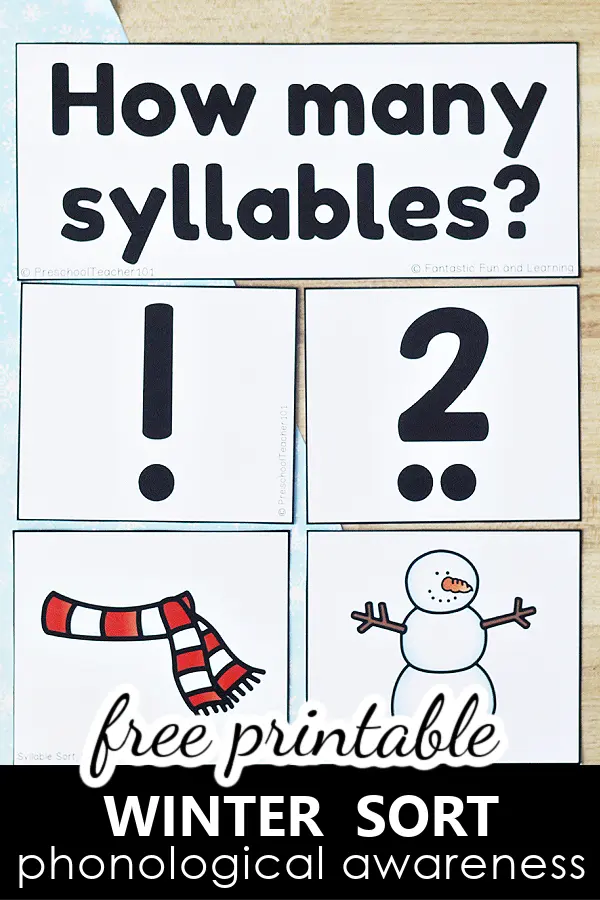
As the academic calendar winds down toward the close of the year, educators and parents continually seek dynamic, hands-on strategies to sustain student engagement. The transition into the winter months presents a unique educational opportunity: leveraging seasonal curiosity to reinforce foundational literacy skills. A prime example of this pedagogical shift is the newly released Winter Syllable Sort activity, an interactive phonological awareness tool tailored for preschool and kindergarten learners.
Designed to bridge the gap between playful exploration and rigorous literacy instruction, the curriculum-aligned resource offers an innovative approach to decoding language. By encouraging young learners to segment words through physical motions—such as clapping and tapping—the activity transforms abstract linguistic concepts into tangible, multisensory experiences. This report provides an exhaustive analysis of the Winter Syllable Sort, examining its structural framework, pedagogical significance, integration into modern literacy centers, and broader implications for early childhood education standards.
Detailed Chronology of the Educational Resource
The development and deployment of early childhood literacy aids like the Winter Syllable Sort follow a meticulous design timeline aimed at maximizing cognitive retention and classroom usability.

Phase 1: Conceptualization and Pedagogical Alignment
The initiative began with an assessment of phonological awareness gaps commonly observed in early childhood development. Educators recognized that while traditional flashcard drills teach vocabulary, they often fail to cultivate the auditory discrimination necessary for reading readiness. Specialists designed a framework focused on syllabification—the ability to hear, isolate, and count the distinct parts of a spoken word. By anchoring this exercise to familiar winter motifs (such as snowflakes, mittens, and sleds), developers ensured that cognitive load remained balanced between new literacy concepts and recognizable imagery.
Phase 2: Material Development and Prototyping
The resulting educational toolkit was structured into several modular components to accommodate diverse learning environments, ranging from structured classrooms to homeschooling pods:
- Syllable Counting Cards: Designed for tactile sorting tasks, allowing students to physically group words by their syllable counts.
- Large Colorful Word Cards: Crafted with vibrant visuals to enhance vocabulary acquisition and maintain sustained visual engagement.
- Black and White Response Worksheets: Provided as optional independent practice sheets to solidify understanding and offer a paper-based record of student progress.
- Comprehensive Answer Keys: Developed to streamline grading and empower peer-to-peer or independent verification during literacy center rotations.
Phase 3: Digital Distribution and Educator Adoption
With the resource finalized, platforms specializing in early childhood instruction began digital distribution, making the print-and-play materials widely accessible. Educators rapidly integrated the tool into existing literacy centers, take-home homework packets, and seasonal thematic units. The emphasis on low-preparation, high-impact design allowed teachers to deploy the activity with minimal friction during one of the most demanding periods of the academic year.

Supporting Context & Metrics in Early Childhood Literacy
Phonological awareness is widely recognized by educational researchers as a primary indicator of future reading success. According to developmental literacy metrics, children who master phoneme segmentation, blending, and syllable counting in pre-kindergarten and kindergarten exhibit stronger decoding skills in later elementary grades.
The Science of Syllabification
Syllables act as the foundational "building blocks" of words. When children learn to clap or tap out the rhythm of a word, they are engaging in motor-enforced auditory processing. This multisensory approach—combining auditory input (hearing the word), visual processing (viewing the picture card), and kinesthetic movement (clapping)—strengthens neural pathways associated with language processing.
| Literacy Component | Pedagogical Objective | Target Age Group | Primary Delivery Method |
|---|---|---|---|
| Phonological Awareness | Auditory discrimination and word segmentation | Pre-K & Kindergarten | Multisensory games (clapping, tapping) |
| Vocabulary Acquisition | Contextualizing seasonal terminology | Pre-K & Kindergarten | Visual association via thematic cards |
| Independent Practice | Reinforcing concepts through application | Kindergarten | Optional response worksheets and sorting trays |
The Seasonal Curriculum Advantage
Integrating thematic units—such as winter, spring, or autumn—into core subjects like language arts enhances cognitive mapping. When children explore vocabulary related to their immediate environment or seasonal experiences, information retrieval rates improve significantly. The Winter Syllable Sort capitalizes on this psychological phenomenon by pairing foundational phonics with relatable cold-weather imagery.

Official Statements and Pedagogical Perspectives
Early childhood education specialists emphasize that play-based learning is not a departure from rigorous academic standards, but rather the most effective vehicle for achieving them.
"When we ask young children to sit passively and memorize word structures, we often encounter resistance and cognitive fatigue," notes an early literacy curriculum specialist. "However, when you introduce a hands-on sorting game that allows them to move their hands, clap out rhythms, and interact with bright winter illustrations, literacy stops being a chore and becomes an engaging discovery process."
Furthermore, educators underline the necessity of vocabulary front-loading before independent execution. Best practices dictate that teachers introduce the target winter vocabulary words prior to the sorting activity. This ensures that errors made during the sorting process stem from syllable counting confusion rather than a lack of familiarity with the depicted objects.

Additional insights from preschool administration frameworks highlight the efficiency of comprehensive thematic lesson plans. By pairing activities like the Winter Syllable Sort with broader cross-curricular projects—such as weather tracking, science explorations of ice and snow, and winter-themed math centers—schools can create a cohesive, immersive learning ecosystem that sustains student focus through winter transitions.
Future Outlook: The Evolution of Play-Based Literacy Tools
As educational technology and printable pedagogical resources continue to evolve, the demand for high-quality, adaptable literacy materials is projected to grow. Several key trends are shaping the future of early childhood literacy instruction:
1. Hybrid Learning Integration
While physical manipulatives like tactile sorting cards and paper worksheets remain vital for fine motor skill development, modern educational frameworks increasingly blend print-and-play resources with digital tracking tools. Future iterations of phonological awareness modules may incorporate augmented reality (AR) components, allowing students to scan winter word cards and interact with animated 3D syllable counters.

2. Universal Access and Differentiation
The push toward equitable education places a premium on resources that can be easily scaled for diverse learners, including English Language Learners (ELL) and students with special educational needs. Visual-heavy sorting activities provide an innate scaffolding mechanism for non-native speakers, enabling them to connect spoken language with visual cues without getting bottlenecked by complex text.
3. Comprehensive Curricular Bundling
Educators are moving away from isolated worksheets in favor of fully integrated thematic lesson plans. Resources that offer complete packages—spanning literacy, math, science, and art under a single seasonal umbrella—will continue to dominate early childhood classrooms. By saving teachers precious preparation time, these comprehensive lesson sets allow educators to focus on individualized student engagement and targeted intervention.
Conclusion
The introduction of specialized tools like the Winter Syllable Sort underscores a broader, positive shift in early childhood education: the marriage of rigorous academic standards with playful, joyful instruction. By transforming phonological awareness into an interactive winter-themed game, educators can successfully capture children’s imaginations while building the critical literacy foundations necessary for a lifetime of reading achievement. Whether implemented in a bustling preschool classroom, a specialized literacy center, or a home-schooling environment, these hands-on learning models prove that education can—and should—be both effective and profoundly engaging.

