

Executive Overview
In the ever-evolving landscape of modern education, instructional planning remains the bedrock of student achievement. Yet, for both novice pre-service teachers and seasoned veterans navigating shifting educational standards, constructing a coherent, engaging, and rigorous unit of instruction can often feel like an intimidating endeavor. Recognizing this systemic challenge, educational platforms and pedagogical experts are pushing back against ad-hoc lesson creation, advocating instead for a disciplined, predictable, and highly effective framework: backward design.
This article explores a comprehensive, step-by-step methodology for building units of instruction from scratch. Developed through years of classroom trial and error, empirical research, and interviews with leading education experts, this approach serves as the foundational cornerstone for the newly launched professional development course, Mastering the Lesson Plan. By redefining the relationship between standards, curricula, and individual lessons, educators are equipped to move away from reactive, night-before planning and step toward intentional, outcome-driven instruction that guarantees student success.
Detailed Chronology: The Evolution of Modern Unit Planning
To understand the mechanics of effective unit design, one must first trace the evolution of how educators conceptualize curriculum development. Historically, lesson planning often suffered from a reactive workflow: teachers would present a series of loosely connected daily topics based on textbooks or immediate whims, and only at the conclusion of the instructional block would they construct a "final test" to measure student retention. This traditional paradigm frequently resulted in a disconnect between what was taught and what was ultimately evaluated.
The paradigm shift occurred decisively in 1991 with the publication of Understanding by Design by education theorists Grant Wiggins and Jay McTighe. Their framework—universally known as backward design—inverted the traditional planning sequence. Instead of starting with daily activities, backward design dictates that educators must begin with the end in mind.
The three-phase chronology of this modern workflow unfolds systematically:

- Defining the Destination (Standards and Objectives): Educators begin by meticulously clarifying what students need to know, understand, and be able to do. This involves translating broad educational standards into concrete, measurable learning objectives.
- Establishing the Evidence (Assessments): Before drafting a single daily lesson plan, the instructor designs a rigorous summative assessment that directly targets the established objectives. This ensures alignment and eliminates ambiguity regarding what constitutes mastery.
- Engineering the Path (Daily Lessons): Only after the objectives and assessments are firmly established does the teacher curate daily learning activities, lectures, and interactive experiences designed to bridge the gap between the students’ current knowledge and the final assessment goals.
By breaking this planning philosophy down into digestible, sequential stages, modern professional development initiatives are demystifying the art of curriculum design, making it accessible to educators across all grade levels and disciplines.
Supporting Context & Metrics: Unpacking Standards, Curriculum, and Units
Before an educator can successfully execute a backward design model, a firm grasp of pedagogical terminology is required. Miscommunications regarding the definitions of "standards," "curriculum," and "units" frequently lead to disjointed instructional delivery.
Defining the Instructional Ecosystem
To ground these concepts in a practical context, consider a hypothetical community education initiative: an eight-week adult foundational cooking course titled Cooking Fundamentals.
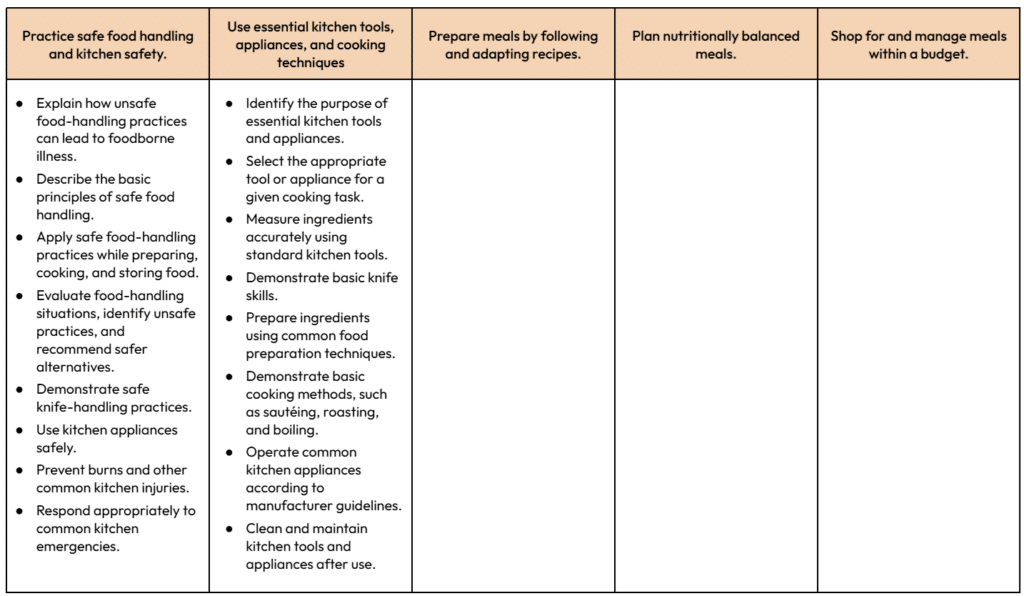
- Standards (The Goals): These are the broad learning targets dictated by governing bodies, local districts, or course creators. In the cooking course, an example of a broad standard is: "Practice safe food handling and kitchen safety." This single goal can be further unpacked into a matrix containing dozens of specific sub-topics, tools, and techniques.
- Curriculum (The Roadmap): A curriculum organizes and sequences all the disparate standards into logical collections. It outlines how topics are grouped and paced across a semester or academic year.
- Units (The Modules): A unit represents a specific cluster of knowledge and skills taught together over a timeframe ranging from a few days to several weeks. In our cooking course example, the broad discipline is segmented into six distinct units: food safety, kitchen tools and appliances, food prep and cooking techniques, everyday meal preparation, nutrition, and grocery shopping and budgeting.
A Deep Dive into Step 1: Setting Measurable Objectives
Focusing specifically on the shortest unit within the cooking curriculum—a three-to-four-day module on Safe Food Handling—the instructor initiates Step 1 of backward design by writing precise, observable learning objectives.
An effective objective must avoid vague mental processes (such as "students will understand food safety") and instead mandate observable student behavior. For the food handling unit, the objectives are articulated as follows:
- By the end of this unit, students will be able to distinguish between safe and unsafe internal cooking temperatures for various meats.
- Students will be able to identify and prevent cross-contamination risks in a standard kitchen workspace.
- Students will be able to demonstrate proper handwashing and sanitization protocols prior to food preparation.
Coupled with a compelling title ("Safe Food Handling") and an overarching essential question ("How do your choices in the kitchen affect the safety of the food you prepare?"), these objectives elevate the unit from a random collection of health tips to a cohesive, purpose-driven learning experience.
Step 2: Designing the Summative Assessment
With clear objectives established, Step 2 requires the instructor to determine how mastery will be proven. For a brief, three-day unit, a time-intensive project is impractical. Consequently, the instructor constructs an open-response scenario-based test. Students are presented with real-world vignettes depicting individuals preparing meals while committing subtle food safety infractions. To demonstrate mastery, students must identify the errors, explain the underlying biological or procedural risks, and prescribe corrective actions.
This assessment avoids the pitfalls of "teaching to the test" (in the pejorative sense) because the test itself is an authentic, high-quality measure of genuine application rather than rote memorization.
Step 3: Planning Daily Lessons
The final phase of the framework involves orchestrating the daily learning activities. Armed with explicit objectives and a clear target assessment, the instructor crafts daily lessons that systematically scaffold the required knowledge, ensuring that every minute of instructional time moves students closer to autonomous success.
Official Statements and Expert Perspectives
Pedagogical experts emphasize that structured unit planning is not merely a bureaucratic requirement, but a vital equity and engagement tool.
"When teachers plan backward, they eliminate busywork and create a transparent pathway for student success. The guesswork is removed from the classroom, allowing both the instructor and the learner to focus entirely on genuine mastery of concepts," notes curriculum development specialists.
Furthermore, experienced educators note that mastering the fundamentals of unit design acts as a powerful professional anchor. Even for teachers with decades of classroom experience, returning to foundational planning methodologies serves to reinforce successful instructional habits while identifying and repairing pedagogical drift that may have accumulated over years of teaching.
By framing unit design as an ongoing, iterative craft rather than a static administrative chore, educational leaders hope to foster a culture of continuous improvement among faculty members worldwide.
Future Outlook
As educational institutions increasingly embrace flexible, hybrid, and competency-based learning models, the demand for robust instructional design frameworks will only accelerate. The shift toward digital, self-paced professional development resources—exemplified by comprehensive training modules like Mastering the Lesson Plan—signals a new era where teachers have on-demand access to elite pedagogical strategies.
Looking ahead, the future of unit planning lies in the seamless integration of backward design principles with adaptive learning technologies. As educators leverage data-driven insights to refine their diagnostic, formative, and summative assessments, the capacity to construct hyper-targeted, highly differentiated instructional units will become the defining characteristic of master educators. By mastering the fundamental trinity of standards, curricula, and backward-designed units, teachers are not only securing immediate classroom efficiency—they are laying the groundwork for enduring, impactful student learning for generations to come.

