
Executive Overview
As artificial intelligence rapidly permeates K-12 classrooms, American education finds itself caught in the crosshairs of a broader cultural and political "techlash." Swept up in a wave of public concern over smartphones in schools, endless social media scrolling, and skyrocketing screen times, the lines separating genuinely transformative educational technology from flashy, addictive distractions have become dangerously blurred.
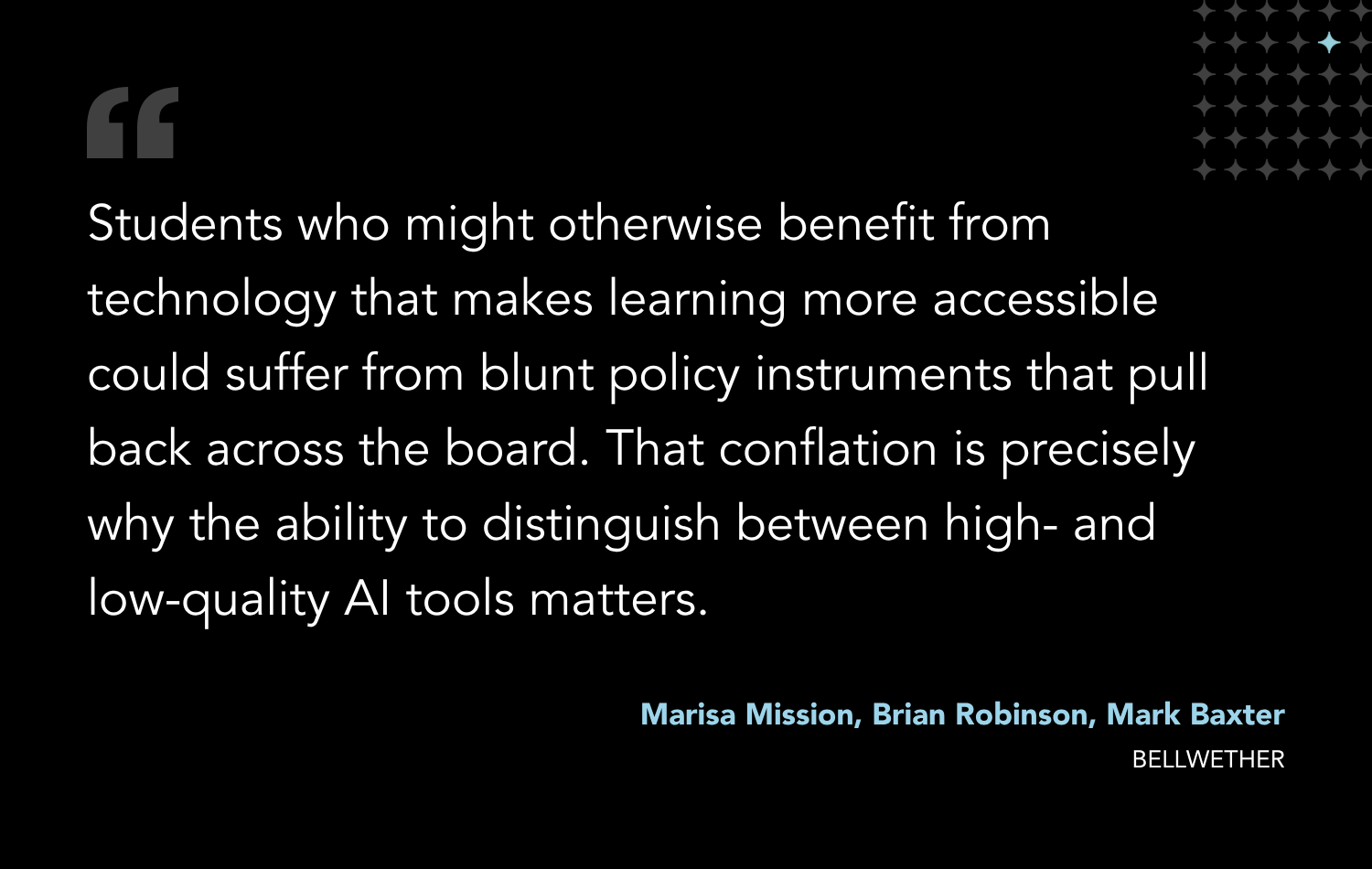
At least eight states have enacted sweeping laws limiting screen time, often treating all digital tools with a blunt brush. While well-intentioned, these blanket restrictions risk lumping a meticulously designed AI reading scaffold for neurodiverse learners into the same category as mindless online scrolling. The collateral damage of this conflation could deprive students of targeted, accessible academic support.
The core challenge facing education leaders is no longer whether to adopt AI, but how to distinguish high-quality tools from low-quality novelties—and how to translate those distinctions into rigorous, student-first procurement processes. While the field has made commendable strides in establishing safety frameworks, data privacy regulations, and bias mitigations, a glaring asymmetry remains: there is a severe lack of quality-oriented frameworks designed to evaluate the pedagogical efficacy, instructional coherence, and long-term sustainability of AI ed tech.
Emerging from the AI Policy Hub—a collaborative initiative between Bellwether and the PIE Network—this special report introduces five foundational signals of quality. Designed to help state leaders, district procurement officers, and education advocates cut through the marketing noise, these signals prioritize genuine student learning over superficial technological features.
Detailed Chronology: The Evolution of AI Ed Tech Scrutiny and Procurement
To understand how the K-12 sector arrived at its current crossroads of skepticism and opportunity, it is necessary to examine the rapid chronology of events shaping educational technology policy over recent years.
Phase 1: The AI Boom and the Safety First Response (2023–2024)
- Early Adoption and Unregulated Growth: Following the public rollout of generative AI models, ed tech vendors flooded the K-12 market with proprietary chatbots, automated grading systems, and personalized tutoring algorithms. Districts rushed to adopt these tools without unified evaluation criteria.
- The Safety Frameworks Emerge: Recognizing the immediate vulnerabilities regarding student data privacy, algorithmic bias, and child safety, sector leaders mobilized. Organizations stepped up with foundational safety guidelines:
- Digital Promise launched its Responsibly Designed AI Product Certification.
- Common Sense Media introduced comprehensive AI Risk Assessments.
- The EdSafe AI Alliance published its SAFE Benchmarks.
- Early Procurement Guidance: In mid-2024, resources such as Opportunity Labs and F3Law’s Procurement Benchmarks for AI in K-12 Education provided the first formal attempts to help school boards navigate legal and operational guardrails for AI tools, though these documents largely served as starting points rather than plug-and-play procurement metrics.
Phase 2: The Ed Tech Backlash and Policy Overcorrection (2025–Early 2026)
- The "Techlash" Confluence: Public frustration over youth mental health, smartphone addiction, and screen time reached a boiling point by early 2026. National education media and federal advisory bodies sounded alarms regarding youth digital consumption.
- Legislative Retrenchment: At least eight states enacted rigid caps on classroom and youth screen time. Simultaneously, state leaders began recognizing that safety compliance alone was insufficient. For instance, a landmark March 2026 California executive order directed state agencies to develop advanced AI vendor certification standards covering civil rights protections and content safety—yet quality and efficacy metrics remained conspicuously absent from statewide mandates.
- The Startup Stability Crisis: The fragility of the ed tech market was underscored by high-profile vendor failures, most notably the sudden collapse of AI startup AllHere in mid-2024. The disruption left the Los Angeles Unified School District scrambling and raised acute alarms regarding abandoned student data repositories and sudden service interruptions.
Phase 3: Shifting Toward Pedagogical Quality (Mid-2026 and Beyond)
- The Bellwether & PIE Network Intervention: Recognizing that educational leaders could readily verify data safety but were flying blind on instructional efficacy, experts began formulating actionable methodologies. The Signals of Quality series was launched to bridge the gap between safety compliance and student-centered learning outcomes.
- Modern Pedagogical Models: Groundbreaking platforms such as Quill and EdLight began demonstrating how AI could be deployed not to bypass student effort, but to actively cultivate cognitive engagement through structured feedback loops and paper-to-digital workflows.
Supporting Context & Metrics: The Asymmetry of Evaluation
The fundamental hurdle in modern ed tech procurement is an asymmetry between safety compliance and pedagogical efficacy.
+-------------------------------------------------------------------+
|               THE ED TECH EVALUATION ASYMMETRY                    |
+---------------------------------+---------------------------------+
|      SAFETY & PRIVACY           |    PEDAGOGICAL EFFICACY         |
|      (Robustly Developed)       |    (Severely Underserved)       |
+---------------------------------+---------------------------------+
| • Digital Promise Certification | • Traditional efficacy studies  |
| • Common Sense Risk Assessments |   take years (AI moves faster)  |
| • EdSafe AI SAFE Benchmarks     | • Overreliance on vanity metrics|
| • State Executive Orders (e.g., |   (logins, time-on-task, NPS)   |
|   CA Trusted AI Procurement)    | • Scarcity of quality frameworks|
+---------------------------------+---------------------------------+
Traditional efficacy research—the gold standard of academic publishing—takes years to design, execute, and peer-review. In the fast-moving ecosystem of generative artificial intelligence, waiting years for a traditional randomized controlled trial renders the findings obsolete before the ink is dry. Consequently, vendors often resort to vanity metrics—such as Net Promoter Scores (NPS), daily logins, or cumulative time-on-task—as proof of quality. However, these engagement metrics reveal nothing about whether a student has actually mastered academic content.
To resolve this dilemma, procurement ecosystems must shift their focus toward five definitive signals of high-quality AI tools.
The Five Signals of Quality in AI-Powered Ed Tech
Signal 1: Emphasis on Learning Outcomes, Not Technology Features
High-quality vendors must be able to articulate a clear theory of change, even if formal longitudinal efficacy studies are not yet available. This theory of change should detail the specific instructional problem being solved, the long-term academic outcomes expected, and the leading indicators being tracked in real time.
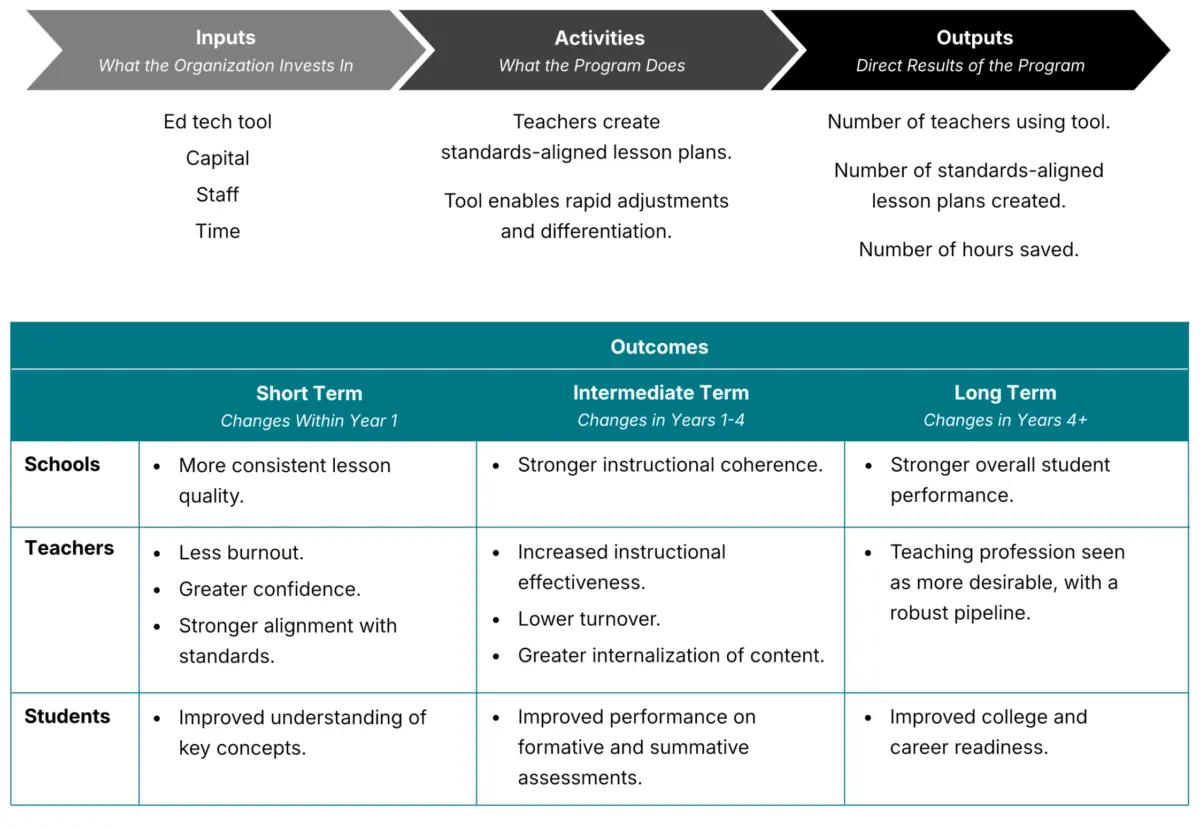
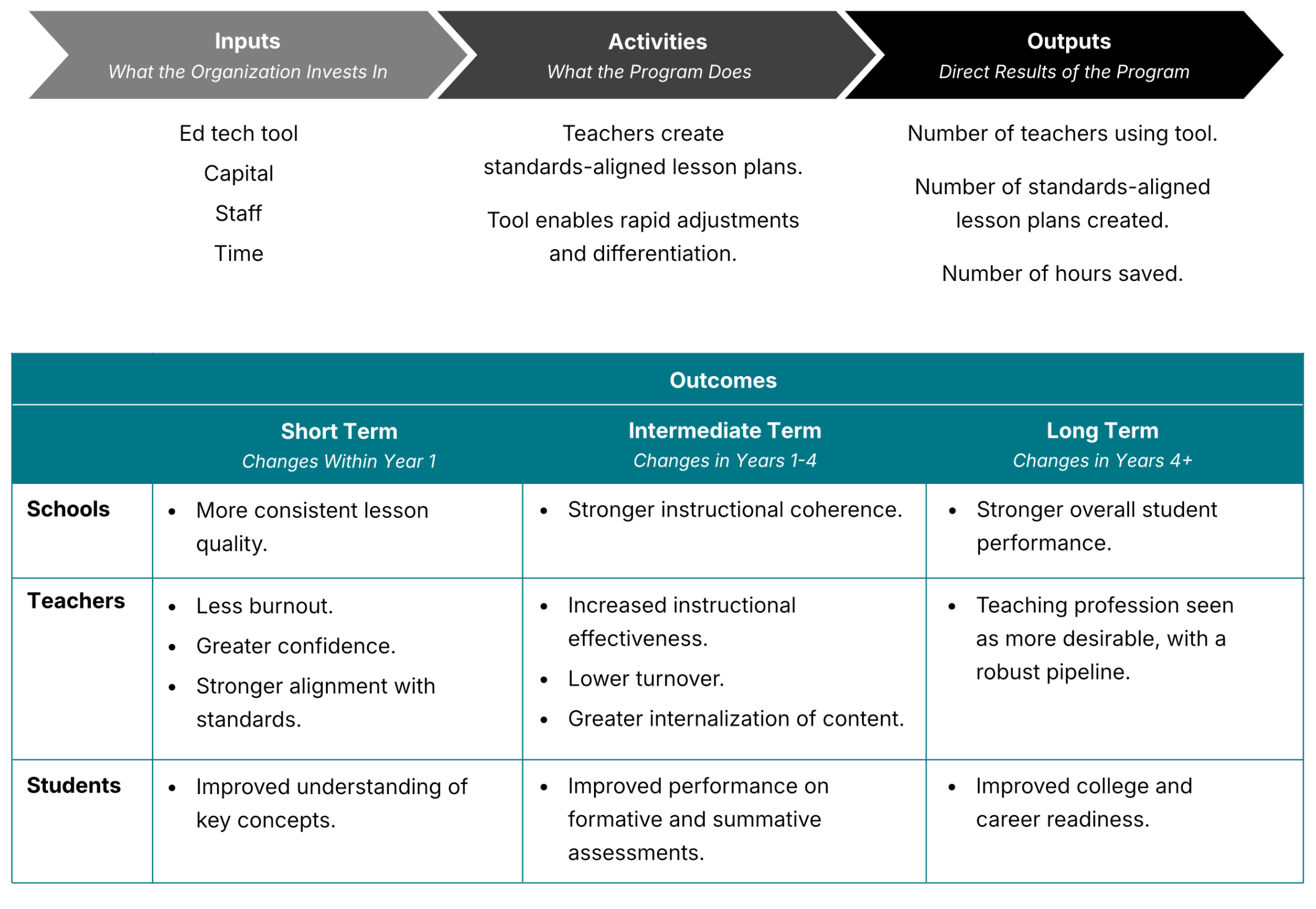
Procurement officers can demand that developers utilize structured logic models. For student-facing tools, a logic model outlines an explicit theory of action connecting features to named academic outcomes—such as measurable gains in algebra proficiency or increased collaborative inquiry skills. For teacher-facing tools, short-term outcomes might focus on reducing lesson-planning friction or accelerating formative assessment generation, while long-term metrics track broader student achievement trajectories.
Signal 2: Productive Struggle as a Primary Pathway for Learning
A pervasive fear among educators is that generative AI will foster "cognitive offloading"—doing the thinking for the student and robbing them of the effort required for deep learning. Genuinely effective AI tools do not bypass student effort; they protect and enhance productive struggle.
- The Quill Model: Quill’s writing platform uses personalized, scaffolded feedback to guide students toward improving their syntax and argumentation. Crucially, the system does not rewrite the essay for the student; it requires the learner to evaluate the feedback and make the final editorial decisions.
- The EdLight Model: In mathematics instruction, EdLight requires students to complete math problems by hand on traditional paper first. Only after the handwritten work is completed does the AI scan the paper, diagnose specific conceptual misconceptions, and provide targeted, scaffolded prompting to assist the student’s independent reasoning.
When thoughtfully calibrated, AI can maintain the optimal level of cognitive friction required for genuine conceptual mastery.
Signal 3: Sound Pedagogy and Coherence with Existing Instructional Practice
Underneath any sophisticated artificial intelligence interface must lie a robust, evidence-based instructional design. High-quality tools are built on established pedagogical best practices—such as timely formative feedback, scaffolding, and alignment with high-quality instructional materials (HQIM)—with generative AI acting merely as the enabling technical infrastructure.
Furthermore, educational leaders must evaluate contextual fit. Introducing an AI tool built around traditional direct instruction into a school utilizing an inquiry-based, constructivist model can severely disrupt the student learning experience. Procurement must account for whether a tool’s underlying pedagogical philosophy harmonizes with the district’s instructional framework.
Signal 4: Technical Configurations Designed to Maximize Quality
While technical architecture can appear opaque to non-technical leaders, a vendor’s structural design choices speak volumes about their commitment to pedagogical integrity.
- Model Architecture: Some vendors rely on a rudimentary "single-shot" AI model, whereas higher-investment developers employ a "pipeline" structure. In a pipeline, multiple specialized models handle discrete tasks (e.g., separate modules for optical character recognition, pedagogical reasoning, and natural language generation), providing both superior accuracy and redundancy against downtime.
- Evaluation Infrastructure: Quality-focused developers maintain rigorous rubric-based benchmarks—often co-developed with subject-matter experts or validated by third-party auditors—to continuously test and audit AI-generated outputs for accuracy and bias.
Vendors committed to student learning must be able to explain these architectural choices—and their inherent trade-offs—in plain, jargon-free language. If a vendor cannot articulate where and why they set strict boundaries on AI deployment (such as refusing to let AI automate high-stakes teacher evaluations), they have likely underinvested in core quality infrastructure.
Signal 5: Attention to Market Sustainability and Long-Term Planning
The rapid influx of early-stage venture-backed AI startups introduces significant market volatility. The collapse of ed tech provider AllHere serves as a cautionary tale regarding what happens when a vendor goes under without adequate governance or data contingency plans.
Conducting due diligence on a vendor’s business model sustainability, financial health, data governance policies, and wind-down procedures is an essential pillar of responsible procurement. While startups often drive the most cutting-edge pedagogical innovations, school systems must vet their operational longevity before embedding them into core district infrastructure.
Official Statements and Expert Perspectives
Education policy experts and advocacy leaders emphasize that the integration of AI requires a fundamental transformation in how local education agencies view technology acquisition.
"The ed tech backlash is entirely understandable given the valid anxieties surrounding screen time and digital distractions," notes a senior policy researcher affiliated with the Bellwether and PIE Network partnership. "However, retreating into blanket prohibitions is a reactionary measure. We must give state leaders and local advocates the precise instruments they need to separate tools that genuinely scaffold student cognition from those designed merely to capture fleeting attention spans."
Education legal and procurement analysts echo these sentiments, stressing that district purchasing committees must move beyond simple compliance checklists:
"Verifying that a vendor protects student data privacy is table stakes," stated a leading educational procurement consultant. "The next frontier of accountability requires school boards to ask vendors: What is your theory of change? How does your tool preserve productive struggle? If a company cannot answer those questions clearly, their contract does not belong in our classrooms."
Future Outlook: Building a Student-First Procurement Ecosystem
As districts look toward the future of digital learning, the path forward relies on bridging the gap between high-level policy guidelines and boots-on-the-ground purchasing decisions. The five signals outlined in this report serve as a foundational compass for school boards, state superintendents, and education advocates who hold the ultimate responsibility for shaping classroom technology environments.
In the subsequent installments of this series, education leaders will be provided with actionable, step-by-step strategies to integrate these quality signals directly into state-level procurement policies. By replacing blunt regulatory overcorrections with nuanced, efficacy-driven standards, the K-12 education sector can foster an ecosystem where technology truly serves its highest calling: empowering educators and accelerating student learning.

