

Executive Overview
The landscape of cloud computing security is undergoing a profound structural transformation. According to the newly released Top Threats to Cloud Computing Survey Report 2026 by the Cloud Security Alliance (CSA)—a premier organization defined by its dedication to defining and raising awareness of best security practices—the foundational paradigms of digital defense have shifted. For years, perimeter-based vulnerabilities, infrastructural flaws, and administrative misconfigurations dominated the anxieties of Chief Information Security Officers (CISOs). Today, those concerns have been eclipsed by vulnerabilities stemming from human-identity ecosystems, software supply chain interdependencies, and the rapid, often unchecked integration of artificial intelligence (AI).
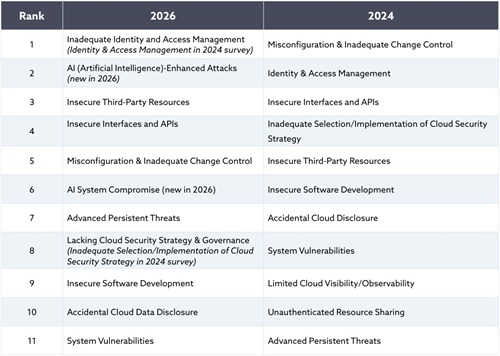
In the CSA’s latest threat assessment, which surveyed 507 qualified cybersecurity professionals and evaluated 23 discrete security issues to formulate a definitive Top 11 list, Identity and Access Management (IAM) has seized the number-one spot. This marks a notable dethroning of misconfiguration and inadequate change control, which held the primary position in the 2024 survey cycle. Simultaneously, AI-related security concerns have made a dramatic debut, securing positions within the elite threat tier for the very first time.
This comprehensive industry shift signals that attackers are no longer simply hunting for unpatched servers or sloppy cloud storage buckets; instead, they are targeting the logical keys to the kingdom—digital identities, application programming interfaces (APIs), third-party partner networks, and the cognitive biases or algorithmic blind spots of emerging AI systems. For enterprise leadership, risk management teams, and compliance officers, the 2026 report serves as both a warning and a strategic roadmap, outlining where organizations must direct their governance investments to survive an increasingly sophisticated threat landscape.

Detailed Chronology: How the Threat Landscape Shifted From 2024 to 2026
To fully understand the gravity of the 2026 findings, one must analyze the trajectory of cloud threats over recent survey cycles. The CSA’s periodic benchmarks offer a rare, longitudinal look at how threat actors have adapted to corporate defensive postures, and conversely, how enterprise priorities have evolved in response to shifting cloud architectures.
The 2024 Baseline: Infrastructure and Configuration
In the 2024 report, the cloud security conversation was still heavily anchored in structural hygiene. Misconfigurations—such as publicly accessible S3 buckets, overly permissive security groups, and inadequate change control frameworks—reigned supreme as the leading threat. Organizations were still struggling with the sheer velocity of cloud migration, often leaving administrative doors unlocked out of simple oversight or operational friction.
At that time, identity management sat at the number-two position. While security teams recognized that compromised credentials were dangerous, the prevailing industry consensus was that an attacker still needed a structural vulnerability or a configuration gap to cause catastrophic lateral movement. Third-party risks hovered around the middle of the pack (No. 5), and Advanced Persistent Threats (APTs) were viewed as a persistent background hum rather than an immediate, top-tier operational crisis (ranking No. 11). Furthermore, generative and traditional artificial intelligence tools were still largely evaluated through the lens of data privacy or shadow IT, rather than classified as standalone enterprise security threats.
The 2026 Paradigm Shift: Identity, AI, and Supply Chains
Fast forward to the 2026 survey results, and the hierarchy has inverted. Identity and Access Management has climbed to the peak of the threat matrix. This ascent reflects the reality of modern enterprise architectures: with zero-trust models breaking down the traditional network perimeter, identity has become the new perimeter. If an adversary can compromise a valid set of credentials—via sophisticated phishing, token theft, or session hijacking—they bypass infrastructural defenses entirely, acting as a legitimate user within the cloud environment.
Furthermore, the 2026 study highlights the arrival of AI as a dual-edged sword. As corporations rush to embed large language models (LLMs), machine learning pipelines, and automated agents into their cloud workflows, they are inadvertently introducing novel attack surfaces. These include prompt injection vulnerabilities, data poisoning, insecure output handling, and excessive AI agency—issues that did not feature prominently in historical threat models.
Another vital shift in the 2026 timeline is the maturation of software supply chain anxieties. Insecure third-party resources jumped from No. 5 to No. 3, demonstrating that organizations are increasingly vulnerable not through their own direct codebases, but through the compromised libraries, vendors, and SaaS integrations that comprise the modern cloud ecosystem. Conversely, traditional infrastructural concerns—such as denial-of-service (DoS) attacks, shared technology vulnerabilities, cloud service provider (CSP) data loss, unauthenticated resource sharing, and limited visibility/observability—have slipped down the priority list, falling entirely outside the Top 11. This does not mean these risks have disappeared; rather, they have been successfully mitigated by hyperscale cloud providers or overshadowed by the tactical urgency of identity and AI threats.

Supporting Context & Metrics: Analyzing the Data
The methodology underpinning the CSA’s 2026 report relies on empirical rigor. The CSA Top Threats Working Group gathered insights from 507 verified cybersecurity professionals, IT executives, risk managers, and compliance experts. These participants evaluated 23 distinct cloud security issues, scoring them based on perceived impact, frequency, and exploitability.
One of the most striking statistical takeaways from the 2026 survey data is the tight clustering of threat scores. Unlike previous years where top-tier threats enjoyed a wide statistical margin over lower-ranked issues, the 2026 scores compressed dramatically:
- The #1 Ranked Issue (Identity and Access Management): Secured a score of 7.95.
- The #11 Ranked Issue: Stood at 7.45.
This narrow delta of just 0.5 points across the entire Top 11 demonstrates that modern security professionals do not view these threats in isolation. Instead, they perceive a highly interconnected risk ecosystem. For instance, a compromised identity (No. 1) can easily lead to an API exploit (part of the top cluster), which in turn exposes third-party resources (No. 3) or triggers configuration drift.

The Displaced Vulnerabilities
It is equally instructive to examine what fell out of the Top 11. Infrastructure-level concerns that once kept network administrators awake at night have been pushed down the priority stack:
- Denial-of-Service (DoS) Attacks: Handled robustly at the cloud provider layer through automated scrubbing centers and elastic bandwidth, DoS no longer commands the primary focus of enterprise security budgets.
- Shared Technology Vulnerabilities: Flaws in the underlying hypervisors or multi-tenant hardware isolation, once a theoretical boogeyman of early cloud adoption, are now managed with extreme diligence by major CSPs (AWS, Microsoft Azure, Google Cloud).
- CSP Data Loss: While catastrophic when it occurs, the sheer reliability and redundant backup architectures of modern cloud providers have driven down the perceived probability of provider-side data loss.
- Limited Visibility and Observability: Although observability remains a challenge in complex multi-cloud environments, the proliferation of Cloud Native Application Protection Platforms (CNAPPs) and advanced Security Information and Event Management (SIEM) tools has improved situational awareness enough to drop this issue below the top threshold.
Official Statements and Industry Implications
The release of the 2026 report has prompted widespread commentary from industry leaders, researchers, and governance authorities. Experts emphasize that the transition from infrastructure security to identity and algorithmic security requires a fundamental retraining of corporate workforces.
"For over a decade, the security industry treated cloud security as an extension of traditional data center security—focusing heavily on network boundaries, firewalls, and server hardening," noted a senior researcher involved with the CSA Top Threats Working Group. "The 2026 data proves that this mindset is obsolete. The cloud has no traditional perimeter. The user is the perimeter. The API is the perimeter. The AI model is the perimeter. Organizations that fail to adapt their governance frameworks to secure these fluid assets will find themselves continuously exposed."

Enterprise risk officers are being advised to review their compliance and governance frameworks immediately. The report is explicitly engineered to support strategic decision-making across multiple tiers of an organization:
- For CISOs and Security Personnel: The analysis of each threat includes specific technical and business impacts, coupled with actionable mappings to CSA security controls and real-world case studies.
- For Executive Management and Board Members: The report provides a clear justification for budget allocation, steering investments away from legacy infrastructure defenses and toward advanced identity governance, continuous AI posture management, and rigorous third-party risk assessments.
- For Compliance and Risk Officers: As regulatory bodies worldwide tighten accountability around cloud operations and AI deployment (such as the European Union AI Act and updated SEC cybersecurity disclosure rules), the CSA report establishes an expert-backed baseline of due care.
Future Outlook: Navigating the 2026 Threat Landscape
Looking ahead, the trajectory of cloud security will be dictated by how swiftly organizations can operationalize the insights contained within the CSA 2026 report. The emergence of AI-driven threats and the dominance of identity-based attacks are not temporary anomalies; they represent the permanent maturation of the cloud ecosystem.
1. The Mandatory Shift to Zero Trust Architecture (ZTA)
With Identity and Access Management holding the top spot, the adoption of rigorous Zero Trust principles is no longer optional. Enterprises must move beyond static passwords and basic multi-factor authentication (MFA). The future belongs to dynamic, context-aware identity verification systems that continuously evaluate user behavior, device health, location, and session activity in real time. Privileged Access Management (PAM) and Just-In-Time (JIT) provisioning will become baseline requirements for cloud administrators.

2. Securing the AI Pipeline (AI Security Posture Management)
As artificial intelligence solidifies its place in the threat rankings, organizations must develop dedicated frameworks for AI Security Posture Management (AISPM). This involves auditing training data for poisoning, implementing strict guardrails against prompt injection, monitoring model outputs for data leakage, and establishing hard limits on the operational autonomy (agency) granted to automated AI workflows.
3. Supply Chain Resilience and API Governance
With insecure third-party resources climbing to number three, businesses must implement continuous monitoring of their software supply chains. Every third-party library, API connector, and SaaS vendor introduces potential blast radius expansion. Automated software bill of materials (SBOM) generation and rigorous API discovery and protection tools will be vital in identifying forgotten, shadow, or improperly secured endpoints before threat actors can weaponize them.
Conclusion
The Cloud Security Alliance’s Top Threats to Cloud Computing Survey Report 2026 marks the definitive end of the infrastructure-centric era of cloud security. By highlighting the supremacy of identity and the nascent danger of artificial intelligence, the CSA has provided a vital compass for an industry navigating unprecedented technological change. Organizations that heed these findings—translating the report’s risk metrics into robust architectural changes, executive oversight, and targeted governance investments—will successfully weather the storms of the next technological frontier. Those that ignore the shift risk finding themselves defenseless against adversaries who have already evolved past the perimeter.

