
Executive Overview
For over a decade, educational technology has marched under the banner of the 1:1 device model—a philosophy dictating that true digital engagement requires every student to have a screen, a keyboard, or a tablet in their hands. Yet, contemporary classrooms present a vastly more complex operational reality. Across school districts worldwide, educators face a fragmented landscape: some schools grapple with severe device shortages, others enforce strict "no-phones" policies that lock personal technology away in backpacks, and many learning environments find that fast-paced, high-stimulus digital games can overwhelm students with developmental delays, special learning needs, or sensory sensitivities.
In response to these diverse hurdles, a profound pedagogical shift is underway. Educators, in close collaboration with Kahoot! Teacher Ambassadors, are proving that the core magic of gamified learning has never been about the hardware; it has always been about the structural design. Clear prompts, visual answer cues, predictable routines, shared anticipation, and joyful feedback can live far beyond a digital interface.
By stripping away the requirement for individual participant devices, innovative educators are transforming traditional learning spaces. From device-restricted secondary schools and early childhood classrooms to specialized special education units, teachers are unlocking high-engagement, low-tech methodologies. This movement demonstrates that true educational innovation lies not in continuously adding more technology, but in adapting existing frameworks thoughtfully to guarantee access for every learner.
Detailed Chronology and Evolution of Offline Play
The transformation of Kahoot! from an exclusively digital, screen-dependent platform into a flexible pedagogical framework didn’t happen overnight. It represents a deliberate evolution born out of classroom necessity and grassroots teacher ingenuity.
Phase 1: The Recognition of the Digital Divide (2018–2021)
As interactive learning software saturated global education markets, teachers in underfunded districts began voicing a recurring frustration: brilliant digital content was locked behind hardware walls. Simultaneously, special education instructors noted that while students loved the competitive aesthetic of quiz-based learning, the rapid-fire individual timers frequently triggered anxiety, sensory overload, or exclusion for learners with cognitive differences.
Phase 2: The Rise of the "Teacher Takeover" and Grassroots Adapting (2022–2024)
Educators began experimenting with unconventional workarounds. Rather than abandoning digital question banks, innovative teachers started projecting games on a main board while students shouted out answers collectively. Physical "Four Corners" variations emerged in elementary gyms and classrooms, turning multiple-choice questions into kinesthetic movement exercises. These unscripted, improvised trials laid the groundwork for standardized offline methodologies.
Phase 3: Institutionalization of Unplugged Modes (2025–Present)
Recognizing the structural viability of these grassroots methods, developers formalized these workarounds into official platform capabilities. The introduction of the Classic Unplugged and Team Tiles Unplugged experiences marked a turning point. By officially decoupling the question bank and the game mechanics from individual student hardware, the platform validated what educators had known for years: engagement is a design principle, not a device feature.
Supporting Context & Methodologies: Five Ways to Play Without Screens
To operationalize this low-tech philosophy, educators have deployed several distinct, highly adaptable instructional formats. These strategies ensure that no learner is marginalized by hardware limitations or sensory barriers.
1. Daily Routine Integration via "Classic Unplugged"
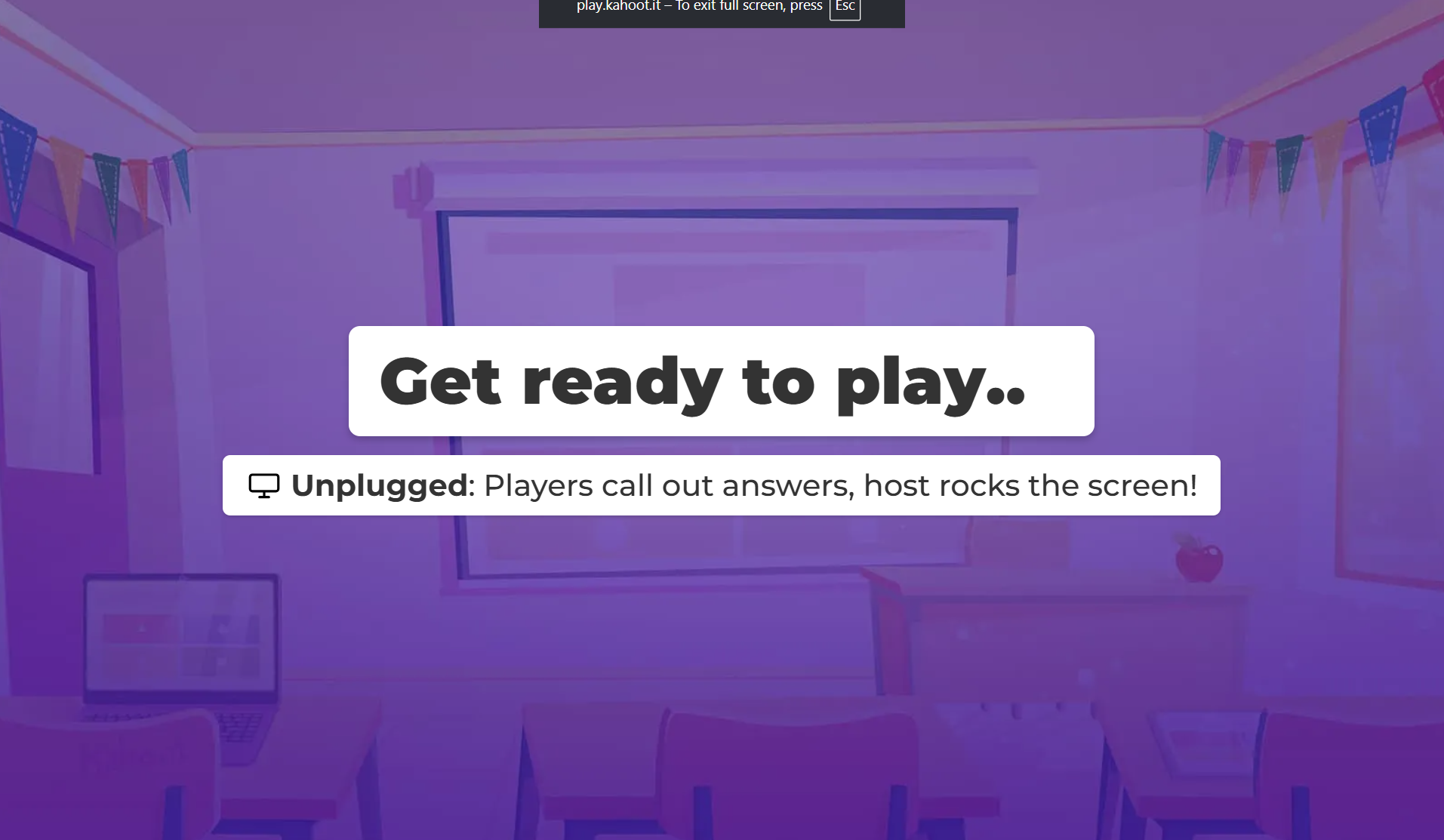
Designed specifically for content review and formative assessment, the Classic Unplugged experience eliminates the anxiety of individual competition. Mirroring self-study learning modes, this format removes the pressure-cooker timer entirely.
- The Flow: The teacher launches the game from the main console. Questions appear on the shared screen, but there are no game PINs and no student devices required.
- The Pedagogy: The cohort tackles questions at a collective pace, fostering rich group discussions before settling on an answer.
- The Celebration: Eschewing individual podiums, the final screen celebrates collective achievement, displaying a cumulative score ratio (e.g., a triumphant 8/10 for the entire group). This builds camaraderie and neutralizes performance anxiety.
2. Collaborative Problem-Solving Through "Team Tiles Unplugged"
The Team Tiles Unplugged experience shifts the paradigm from solitary rivalry to team-based strategic communication.
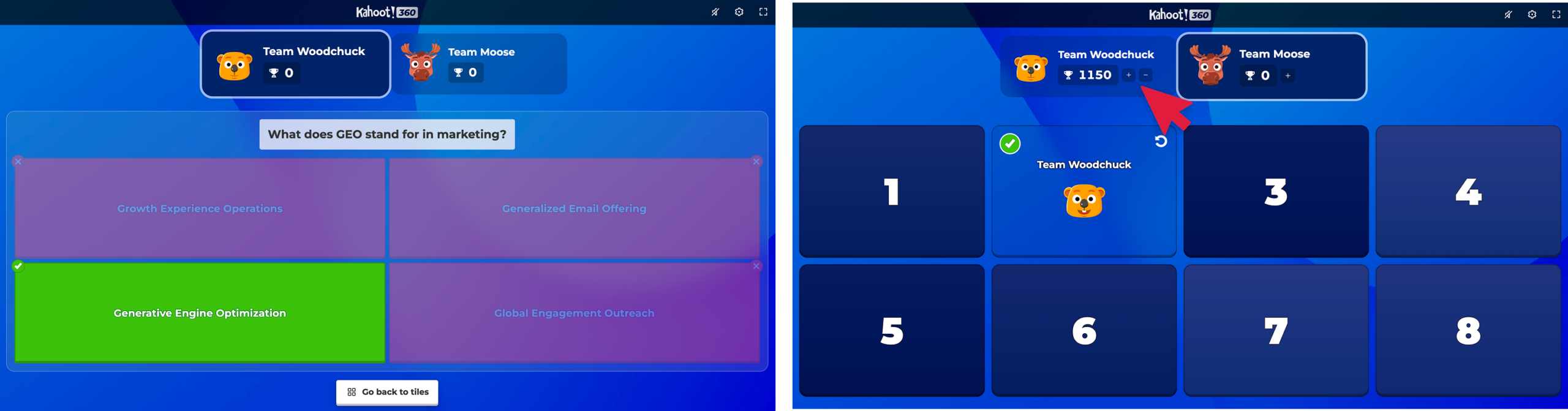
- The Setup: Students are divided into collaborative teams. Teachers can deeply personalize the experience by gathering student input to name teams and assigning distinct animated characters to represent them on the main display.
- The Mechanics: A numbered grid of tiles appears on the projected screen. Teams take turns selecting tiles, revealing randomized questions from the chosen kahoot deck. After collective deliberation, a team spokesperson announces the consensus answer.
- The Engagement Loop: Points escalate dynamically as rounds progress, and scores are intentionally hidden right before the final round to maximize suspense. The game culminates in a dramatic podium reveal celebrating the winning collaborative unit.
3. Kinesthetic Energizers and Whole-Body "Four Corners"
For classrooms desperate to escape sedentary habits, educators are turning the physical room itself into an interactive game board.
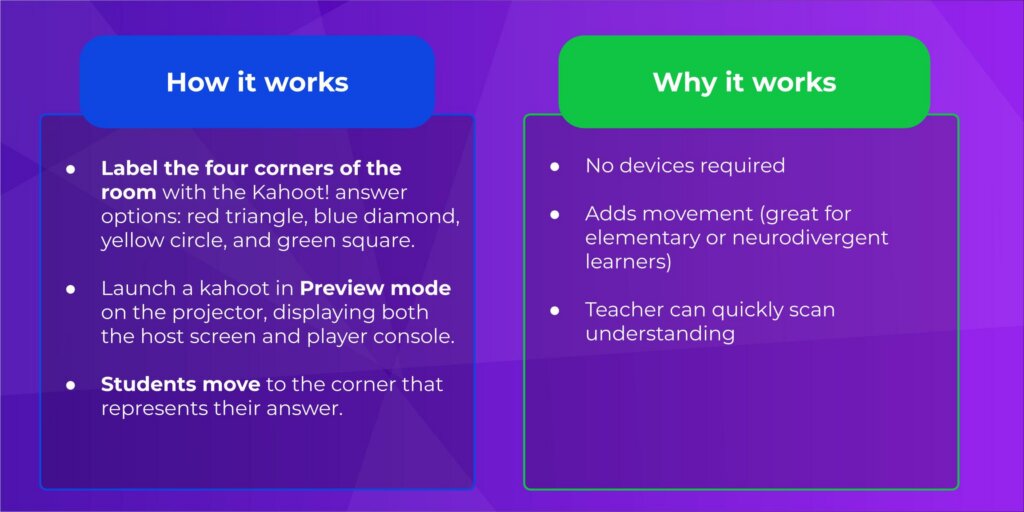
- Execution: Multiple-choice or quiz questions are projected on the main screen, with each corner of the physical classroom designated as a corresponding answer choice (extending up to six options for advanced flexibility).
- The Action: Students physically walk to the corner representing their chosen answer. The corner holding the majority dictates the class’s official selection, which the teacher then logs on the host screen.
- The Benefit: This group-think protocol completely removes individual performance pressure while delivering a vital kinesthetic "brain break," improving physical energy and mental focus.
4. Differentiated Autonomy via the "Gallery Walk"
When curriculum sequencing is flexible and students require self-paced exploration, the Gallery Walk format provides a powerful workshop-style alternative.
- Execution: Teachers print out question cards, visual cues, and answer choices from a digital kahoot deck, posting them at stations around the room.
- The Action: Students—working individually or in pairs—navigate the room at their own pace, analyzing prompts, recording responses on physical sheets, and discussing answers with peers.
- The Outcome: This method yields a permanent physical artifact of student learning, facilitates deep critical discourse, and bridges seamlessly to online digital homework modules for evening reinforcement.
5. Fine-Motor Mastery with DIY Storyboards
Tailored specifically for early childhood education, occupational therapy, and physical education environments, the physical storyboard bridges cognitive learning with sensory-motor development.
- Execution: Teachers or students physically print, cut out, and assemble physical question and answer cards corresponding to a curriculum deck.
- The Dual Benefit: Beyond mastering academic standards, the tactile manipulation, sorting, and arranging of physical cards exercises vital fine-motor skills and executive functioning—maximizing instructional time in packed daily schedules.
Official Statements and Pedagogical Insights
Educational leaders and platform architects emphasize that the democratization of learning tools depends heavily on flexibility rather than technological saturation.
"One of the biggest misconceptions about gamified learning is that it only works in 1:1 device classrooms, and that every student needs a device in their hands for the magic to happen," notes a leading curriculum strategist partnering with Teacher Ambassadors. "In reality, the magic has never been about the device, but about the design. At its core, it is a structure: clear questions, visual answer cues, predictable routines, shared anticipation, and joyful feedback."
Special education specialists have been particularly vocal about the psychological benefits of removing individual timers and hardware constraints. By replacing individual scorecards with collective group goals, classrooms report a marked decrease in test anxiety and a notable increase in participation among neurodivergent learners. When a student who typically shuts down under digital pressure is instead laughing and collaborating with a peer group to solve a Team Tile, the true value of low-tech adaptation becomes undeniably clear.
Future Outlook: The Hybrid Classroom Horizon
As schools look toward the horizon of educational design, the dichotomy between "digital-first" and "traditional" teaching is rapidly dissolving. The future belongs to the hybrid mindset—a pedagogical approach where technology acts as an architectural blueprint rather than an obligatory physical barrier.
The expansion of unplugged classroom tools signals a broader maturation within the ed-tech industry. Companies and educators alike are recognizing that equity in education does not mean forcing every school to mirror a high-budget tech laboratory. Instead, true equity means providing robust structural frameworks that can scale up to high-tech environments or scale down to a single projector and a room full of eager minds.
Moving forward, the integration of physical kinesthetic movement, collaborative team dynamics, and tactile occupational tasks into digital lesson planning will continue to redefine student engagement. By empowering teachers to break out of the digital lobby and into physical space, modern classrooms are proving that the most powerful learning innovation isn’t adding more screens—it’s inspiring deeper human connection.

