
Executive Overview
As educators and parents continually seek innovative methodologies to bridge the gap between physical play and cognitive development, early childhood literacy tools have evolved far beyond traditional flashcards and static worksheets. Entering this dynamic educational landscape is the Football Helmet ABC Scavenger Hunt, a themed, interactive learning resource designed to harness children’s natural affinity for sports—specifically football and the excitement of the Super Bowl season—and channel it into foundational alphabet mastery.
By transforming a standard classroom or living room into an active playing field, this program merges gross-motor movement with letter recognition, phonics, and tactile tracing. Developed as part of a yearlong series focused on active, inquiry-based learning, the scavenger hunt addresses a critical pedagogical need: keeping pre-K and kindergarten-aged children physically engaged while targeting crucial pre-reading skills.
This comprehensive report examines the structural components of the Football Helmet ABC Scavenger Hunt, explores its underlying educational theories, provides practical implementation strategies for both home and school environments, and reviews the scalability offered through its free and complete multi-tier curriculum packs.

Detailed Chronology & Pedagogical Evolution
The conceptualization of the Football Helmet ABC Scavenger Hunt did not happen in a vacuum; it is the product of an ongoing evolution in early childhood education that prioritizes movement-based learning over sedentary instruction.
Phase 1: Identifying the Engagement Gap
For decades, early literacy instruction relied heavily on "drill-and-kill" techniques—relying on repetition via flashcards or rote recitation. However, developmental psychologists and educators have increasingly noted that young children possess high physical energy levels that conflict with prolonged periods of sitting. Recognizing this challenge, curriculum designers sought to integrate kinesthetic learning (learning through physical movement) into alphabet acquisition.
Phase 2: The Thematic Hook
Capitalizing on cultural touchstones has long been a successful strategy in pedagogical design. Football season, culminating in the Super Bowl, offers a universally recognizable theme bursting with vibrant colors, team spirit, and high-energy terminology. Designers mapped the alphabet onto brightly colored football helmets. This visual metaphor bridges the gap between a child’s recreational interests and academic requirements, making alphabet recognition feel less like a chore and more like a game day objective.

Phase 3: Development of the Scavenger Hunt Framework
The activity was structured around a simple yet effective core mechanic:
- Concealment/Placement: Adults hide or display brightly colored, helmet-shaped alphabet cards around a home or classroom.
- The Hunt: Children actively search for the cards, combining visual scanning with physical locomotion.
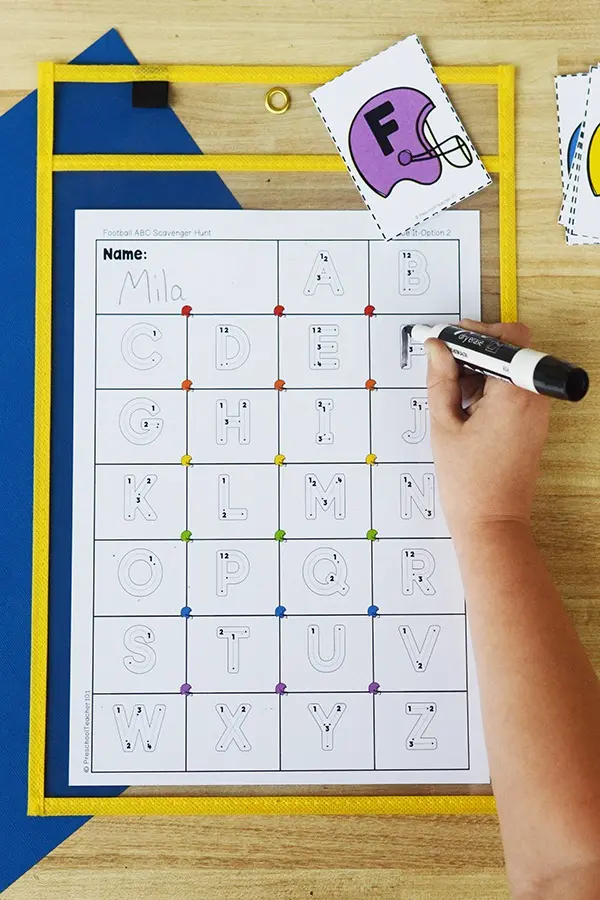
- Recording/Tracing: Upon discovering a letter, children locate it on their specialized trace-it recording sheet and practice proper stroke formation.
Phase 4: Expansion into a Scalable Curriculum
Recognizing that diverse classrooms and home-school environments require varying degrees of complexity, the developers expanded the initial concept into a comprehensive, yearlong series. This included creating options for differentiated learning—separating uppercase and lowercase letter sets, offering multiple recording layouts, and integrating seamlessly with thematic reading lists and cross-curricular physical education elements.
Supporting Context & Metrics: The Science of Kinesthetic Literacy
To understand why the Football Helmet ABC Scavenger Hunt yields high engagement and retention rates, one must examine the intersection of physical activity, cognitive function, and early literacy milestones.

The Role of Kinesthetic Learning in Early Childhood
According to developmental research published by early education authorities, physical movement stimulates the vestibular system, which in turn enhances focus, memory, and cognitive processing. When children physically move to locate hidden letter cards, blood flow to the brain increases, priming neural pathways for information retention.
- Enhanced Recall: Studies indicate that children who associate physical actions with abstract symbols (such as letters) demonstrate superior letter-sound correspondence compared to peers restricted to seated instruction.
- Reduction of Behavioral Fatigue: Incorporating scavenger hunts into the daily routine burns off excess physical energy, resulting in improved attention spans during subsequent focused tasks.
Differentiation: Meeting Every Learner at Their Level
No two children acquire literacy at the exact same pace. A cornerstone of modern educational theory is differentiated instruction, which tailors teaching methods and resource difficulty to individual student needs. The Football Helmet ABC Scavenger Hunt supports differentiation through several built-in metrics:
- Targeted Interventions: Educators do not need to introduce all 26 letters simultaneously. The program allows instructors to isolate specific phonemes or visual targets. Best practice recommends starting with the letters found in the child’s own name, creating an immediate, personal connection to the learning material.
- Tiered Complexity: While the free sample introduces basic uppercase letter recognition, the complete scavenger hunt pack introduces lowercase distinctions, multi-step recording sheets, and varied tracing formats. This ensures that children ranging from early pre-K (just beginning letter identification) to kindergarten (mastering handwriting and phonics) find appropriate challenge levels.
Official Guidelines & Implementation Strategies
Implementing the Football Helmet ABC Scavenger Hunt requires minimal preparation but yields maximum educational value. Below are the official guidelines, tips, and best practices for maximizing the utility of this resource in both home and classroom settings.

How to Play: Step-by-Step
- Preparation: Print out the desired letter cards and recording sheets. For long-term durability and paper conservation, educators recommend laminating the sheets or sliding them into reusable dry-erase pouches.
- Deployment: Scatter or hide the small letter-helmet cards around the designated play area. In optimal weather conditions, the activity can be expanded outdoors to a playground or courtyard.
- The Hunt: Instruct children to search for the letters. As each helmet is discovered, the child matches the letter on the card to their recording sheet.
- Tracing and Reinforcement: The child practices tracing the letter using a dry-erase marker or pencil. Caregivers or educators can prompt further engagement by asking, "What sound does this letter make?" or "Can you name an animal that starts with this letter?"
Pro-Tips for Educators and Parents
- Cross-Curricular Integration: Pair the scavenger hunt with curated reading sessions. Utilizing themed resources like Football Books for Kids helps contextualize the alphabet activity within a broader literacy framework.
- Flexible Grouping: The activity can be executed independently, in pairs, or in small collaborative groups. Group play fosters social-emotional skills such as sharing, turn-taking, and cooperative problem-solving.
- Multi-Use Small Letter Cards: The small helmet cards included in the complete pack can be repurposed for a variety of secondary games, including:
- Alphabet ordering (lining the helmets up from A to Z).
- Spelling simple sight words or CVC (consonant-vowel-consonant) words.
- Matching uppercase cards to lowercase counterparts.
Future Outlook: The Ongoing Evolution of Thematic Learning
As educational frameworks continue to modernize, the demand for play-based, highly adaptable curricula is projected to rise. The success of themed programs like the Football Helmet ABC Scavenger Hunt points toward several key trends in the future of early childhood education:
- Blended Physical-Digital Learning Spaces: While physical printouts and tactile tracing remain paramount for fine-motor development, future iterations of physical scavenger hunts may incorporate augmented reality (AR) elements, allowing children to scan cards with tablets to trigger interactive 3D animations or phonetic audio prompts.
- Expansion of Seasonal and Pop-Culture Integration: Educators are increasingly leaning into cultural events—ranging from football championships to space exploration milestones—to maintain high student motivation. By anchoring core academic standards (such as Common Core literacy requirements) to exciting real-world themes, schools can combat student apathy and foster lifelong positive associations with learning.
- Resource Sustainability and Accessibility: With teachers often dipping into personal funds for classroom supplies, downloadable and reusable printables (such as laminated trace-it sheets) represent a sustainable, cost-effective model that bridges the digital-to-physical divide.
Conclusion
The Football Helmet ABC Scavenger Hunt proves that foundational skill-building does not require tedious repetition. By successfully merging gross-motor play, seasonal excitement, and structured literacy practices, this activity provides a robust framework for pre-K and kindergarten success. Whether deployed as a Super Bowl-themed party game, a daily classroom literacy center, or a rainy-day home preschool activity, it equips young learners with the confidence and cognitive tools they need to score a permanent touchdown in early reading and writing.
For educators and parents looking to expand beyond the free sample, the complete scavenger hunt pack and yearlong series are available for immediate download through official educational marketplaces, offering over 30 complementary playful learning activities designed to fit diverse home and classroom needs.

