
Executive Overview
Medical residency has long been characterized by grueling hours, high-stakes environments, and a relentless firehose of complex clinical information. Coming out of the crucible of the COVID-19 pandemic, physician-educators at HCA Florida Aventura Hospital faced an unprecedented challenge: how to rebuild eroded camaraderie, heal fractured institutional identities, and combat soaring burnout among their resident physicians—all without sacrificing an ounce of academic and clinical rigor.
Their innovative answer to this complex pedagogical problem was the ICUlympics.
Designed by a team of visionary medical educators, the ICUlympics transformed traditional, often passive critical care study sessions into an immersive, multi-stage, gamified competition. Utilizing platforms like Kahoot! alongside high-energy, floor-based elimination games, the initiative was initially conceived as a morale booster. However, a landmark pilot study published in 2025 asked a much harder, scientifically rigorous question: Could an educational game do more than just foster team spirit? Could it fundamentally change long-term knowledge retention?
The results, published to critical acclaim, stunned even the researchers. Residents who fully participated in the multi-day ICUlympics scored substantially higher on rigorous critical care knowledge assessments administered 30 days later compared to their non-participating peers. Beyond cognitive gains, participants reported dramatic drops in perceived burnout, alongside skyrocketing scores in metrics measuring institutional belonging and professional well-being.
What started as an isolated hospital experiment has now burst past its local boundaries. Evolving into a multi-center study spanning the broader Miami and South Florida healthcare regions, the ICUlympics model is proving that joy, play, and high-level medical education are not mutually exclusive. Instead, when executed with clinical precision, gamification represents a powerful, evidence-based teaching strategy for modern graduate medical education (GME).
Detailed Chronology: Anatomy of a Medical Competition
To understand how the ICUlympics achieved such striking cognitive and psychological outcomes, one must examine the meticulous architecture of the competition itself. Far from a casual trivia night, the program was engineered as a multi-layered pedagogical framework aligning directly with core competencies mandated by the American Board of Internal Medicine (ABIM) and the American Board of Emergency Medicine (ABEM).
Phase 1: Building the Foundation and Question Bank
Before launching the games, the research team—led by Dr. Mauricio Danckers, a Pulmonary and Critical Care Medicine fellowship director—constructed a robust, peer-reviewed question bank. Drawing directly from ABIM and ABEM certification blueprints, the questions were vetted and piloted among pulmonary and critical care fellows as well as non-participating residents to ensure appropriate clinical difficulty and validity.
Phase 2: The Three-Day Qualifying Gauntlet
The ICUlympics competition drew participants from a diverse cross-section of hospital departments, including internal medicine, emergency medicine, transitional-year, and preliminary-year residency programs—all of whom regularly rotate through the high-pressure environment of the hospital’s intensive care unit.
The qualifying rounds were structured across three intense days:
- Days 1 and 2 (Digital Strategy via Kahoot!): Leveraging digital interactivity, the first two qualifying days utilized Kahoot! to deliver 100 fast-paced, multiple-choice critical care questions. Points earned by participants carried forward continuously on a shared live leaderboard, stoking competitive fires and real-time engagement.
- Day 3 ("Under Pressure" Physical Elimination): Shifting from digital screens to the physical floor, day three featured a high-stakes, elimination-style game aptly named Under Pressure. Residents were required to physically position themselves in one of four labeled quadrants mapped out on the floor to answer complex clinical prompts. A wrong answer meant immediate elimination from the round, injecting kinetic energy and physical stakes into the exercise.
Phase 3: The Live Jeopardy! Final
Following the rigorous three-day qualifiers, the competition culminated in a live, high-production-value Jeopardy!-style final showdown. The three residents who had accumulated the highest aggregate points across the qualifying rounds battled head-to-head for the ultimate ICUlympics crown.
Crucially, the study defined "full participation" strictly as completing all three qualifying days—not advancing to or winning the final. This structural choice ensured that the data captured the impact of collective, sustained engagement rather than just the isolated brilliance of top-tier finalists.
Supporting Context & Metrics: The Science of Play and Memory Retention
While the competitive spirit and celebratory atmosphere of the ICUlympics provided an immediate psychological lift, the research team was determined to evaluate whether the intervention produced measurable, lasting academic dividends.
The 30-Day Knowledge Gap
Out of a total cohort of 92 eligible residents at HCA Florida Aventura Hospital, 68 completed an initial baseline knowledge test and anonymous survey prior to the start of the competition. Thirty days after the final buzzer, 48 of those residents returned to complete a follow-up assessment.
The statistical findings were definitive:
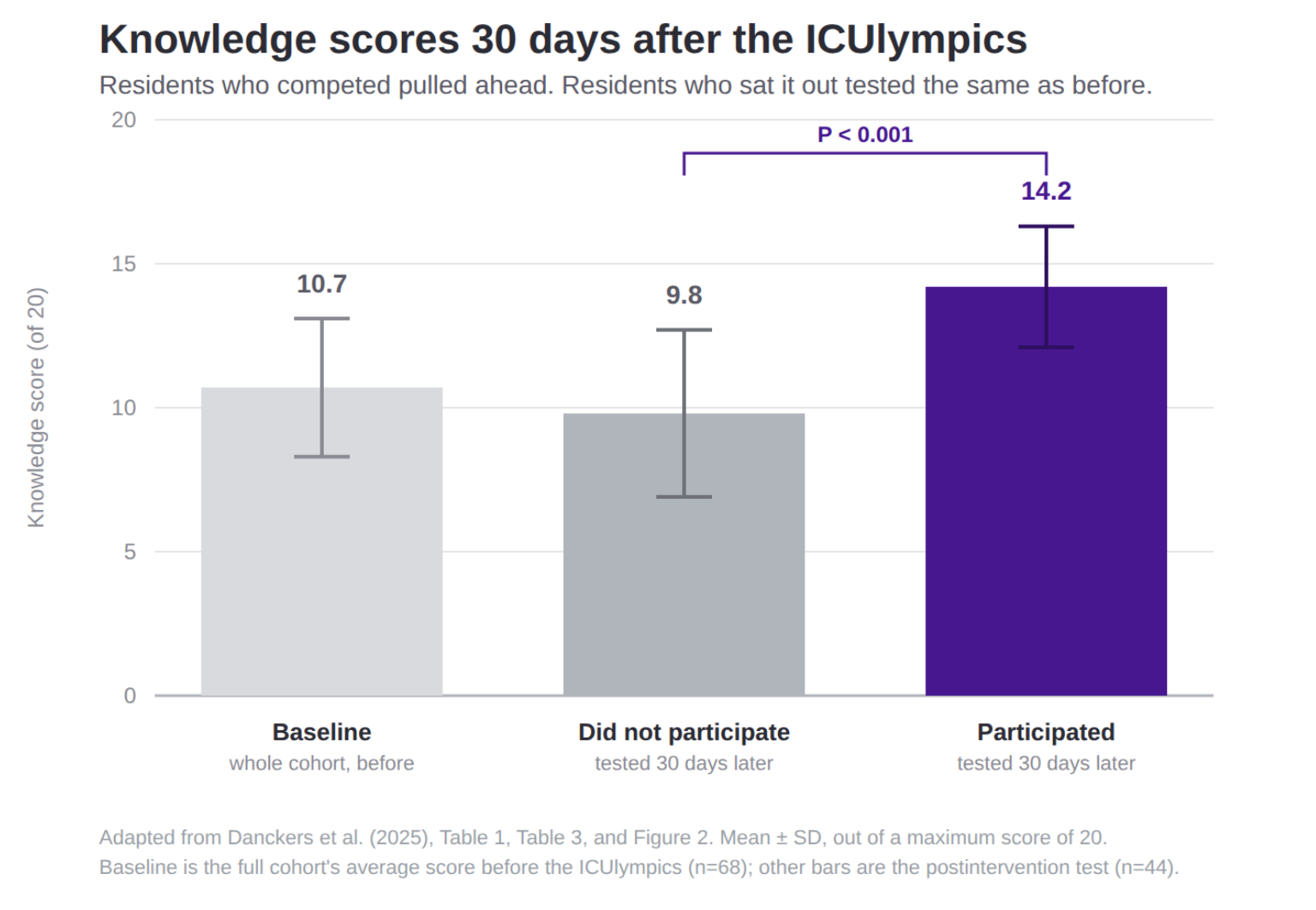
- Baseline Performance: Across the entire initial cohort, the average pre-test score sat at a modest 10.7 out of 20 points.
- The Power of Participation: Residents who fully participated by completing all three qualifying days ($N=19$) achieved an average score of 14.2 out of 20 on the 30-day follow-up knowledge test.
- The Control Group: Conversely, residents who chose not to participate in the games ($N=25$) scored an average of 9.8 out of 20 on the same follow-up test—virtually identical to the cohort’s pre-intervention baseline average.
Because participation was entirely voluntary and surveys remained anonymous, these results reveal a profound, statistically robust association: sustained, gamified engagement directly correlates with superior medium-term knowledge retention.
Unlocking the "Testing Effect"
Why did residents who played games retain complex critical care concepts significantly better a month later than those who presumably relied on traditional study methods?
The answer lies in cognitive psychology: specifically, the testing effect. Traditional medical education often relies on passive re-studying—rereading textbooks, reviewing static slide decks, or listening to lengthy lectures. In contrast, game-based learning forces learners into a state of active recall.
When participants answer rapid-fire questions under conditions of mild time pressure and social accountability (such as a live classroom leaderboard or a physical floor game), they are forced to actively retrieve information from memory. This retrieval process strengthens neural pathways, encoding the clinical knowledge far deeper into long-term memory structures than passive review ever could.
Official Statements and Psychological Impact: Battling Burnout Through Belonging
Beyond test scores, the ICUlympics addressed an equally critical crisis in modern medicine: resident burnout, isolation, and institutional disconnection.
In the post-competition survey, participants and non-participants alike evaluated the efficacy of medical training games. While both groups agreed that educational games are effective overall tools for acquiring new knowledge (participants rating it 4.8 out of 5; non-participants 4.1 out of 5), a massive gulf emerged in metrics concerning emotional well-being and institutional culture.
Participants agreed far more strongly that the games:
- Solidified their sense of belonging to the training program (4.8 vs. 3.9 out of 5).
- Improved their overall well-being during grueling rotations (4.8 vs. 3.8 out of 5).
- Actively counteracted burnout throughout their demanding residency schedules (4.8 vs. 3.8 out of 5).
"Transforming what might otherwise be a passive educational interaction into something participatory, competitive, social, and memorable, while still maintaining the rigor that we expect in graduate medical education."
— Dr. Mauricio Danckers, Pulmonary and Critical Care Medicine Fellowship Director
Dr. Danckers emphasizes that the project’s most vital lesson is that educational gamification does not require institutions to trade academic rigor for student engagement. By anchoring high-level board review questions within a vibrant, celebratory social framework, educators can simultaneously nourish the mind and heal the morale of frontline medical trainees.
Future Outlook: Scaling the ICUlympics Nationwide
What began as a localized pilot study at a single South Florida hospital has rapidly evolved into a movement. Following the publication of their pilot data in 2025, Dr. Danckers and his research team expanded the ICUlympics initiative across multiple hospital networks throughout the greater Miami and South Florida regions.
Currently, the research team is putting the finishing touches on a comprehensive manuscript detailing this expansive multi-center experience. This next phase of research goes beyond clinical knowledge acquisition, exploring how gamified learning platforms perform across diverse learner demographics, institutional environments, and cognitive styles.
Furthermore, the academic ripple effects have exceeded all expectations. Following the dissemination of their original publication and subsequent medical education social media campaigns, educators from across the United States have reached out, inviting the team to bring the ICUlympics framework to regional and national healthcare conferences. This organic, widespread demand underscores a glaring, systemic need within graduate medical education: educators are actively searching for scalable, evidence-based tools that make learning interactive, joyful, and psychologically sustainable.
As medical training continues to grapple with the demands of an increasingly complex healthcare landscape, the ICUlympics offers a shining blueprint for the future. By proving that rigorous academic standards and play-based engagement can peacefully and powerfully coexist, these physician-educators have permanently altered our understanding of how medical professionals learn, connect, and thrive.
To explore how modern educators are leveraging platforms like Kahoot! to build lasting, impactful knowledge across higher education and professional training environments, visit kahoot.com/research.

