
Executive Overview
In the rapidly evolving landscape of early childhood education, foundational literacy remains the bedrock upon which all future academic achievement is built. As educators and curriculum developers increasingly align their practices with the Science of Reading, the emphasis on phonological awareness—the ability to recognize and manipulate the spoken parts of sentences and words—has never been more pronounced. Enter the Spring Syllable Sort and its comprehensive counterpart, the Four Seasons Syllable Sort, two targeted pedagogical tools designed to make phonetic segmentation both accessible and wildly engaging for preschool and kindergarten learners.
Developed as dynamic, hands-on instructional materials, these sorting activities shift away from rote memorization and passive worksheet completion. Instead, they immerse young learners in multisensory learning experiences. By utilizing rhythm, auditory discrimination, and vibrant seasonal imagery, students learn to hear, isolate, and categorize word parts through clapping, tapping, and visual sorting. This report provides an exhaustive examination of these literacy tools, exploring their structural design, alignment with contemporary reading science, classroom implementation strategies, and broader implications for early childhood curriculum development.

Detailed Chronology & Pedagogical Evolution
The journey toward modern phonological awareness instruction has undergone a significant paradigm shift over the past two decades. Historically, early reading instruction often bypassed auditory phonological processing, plunging children directly into letter-sound correspondence before they had mastered the foundational skill of hearing individual sounds and word segments.
- The Early Foundations (Pre-2000s): Early childhood classrooms relied heavily on flashcards and alphabet recognition, often assuming that oral segmentation would develop implicitly.
- The Shift to Phonological Awareness (2000–2010s): Educational researchers began emphasizing that phonological and phonemic awareness are critical precursors to decoding and reading comprehension. Clapping out syllables became a staple in progressive classrooms, yet educators frequently lacked cohesive, thematic materials that could sustain young children’s attention.
- The Rise of the Science of Reading (Present Day): Modern literacy frameworks demand structured, explicit, and systematic instruction. The introduction of thematic resources—such as the Spring and Four Seasons Syllable Sort packs—marks a crucial step forward. By integrating seasonal vocabulary with multisensory segmentation techniques, these tools bridge the gap between abstract phonological concepts and concrete, relatable experiences for Pre-K and Kindergarten students.
In this current framework, children are not merely presented with written text. Instead, they interact with picture cards representing familiar seasonal objects, allowing them to focus entirely on the auditory and structural components of words before transitioning to written symbols.

Supporting Context & Metrics: The Science of Syllabification
Phonological awareness is a broad category that encompasses a child’s ability to recognize and work with the spoken parts of language. Within this hierarchy, syllable segmentation sits as a vital stepping stone. Children must first learn to break larger words into syllables before they can isolate individual phonemes (beginning, middle, and ending sounds).
Why Syllables Matter in Early Literacy
Research in cognitive development indicates that syllables are easier for young children to perceive than individual phonemes because they typically contain a vowel sound that creates a natural "beat" or pulse in speech. Clapping or tapping out syllables gives children a physical anchor for an abstract auditory concept.

- Auditory Isolation: Children learn that words are not unbroken streams of sound, but rather constructed of distinct parts.
- Vocabulary Expansion: Seasonal themes introduce rich, descriptive vocabulary (e.g., daffodil, umbrella, snowflake, watermelon) that might not arise in everyday conversational speech.
- Multisensory Engagement: Kinesthetic movements (clapping, tapping, stomping) activate motor cortices, reinforcing cognitive processing and improving memory retention in young learners.
Structural Breakdown of the Learning Materials
The newly released educational packs are meticulously designed to support diverse learning environments, ranging from independent literacy centers to small-group guided instruction:
- Spring Theme Syllable Sort (Freebie):
- Syllable counting cards and large, colorful vocabulary cards.
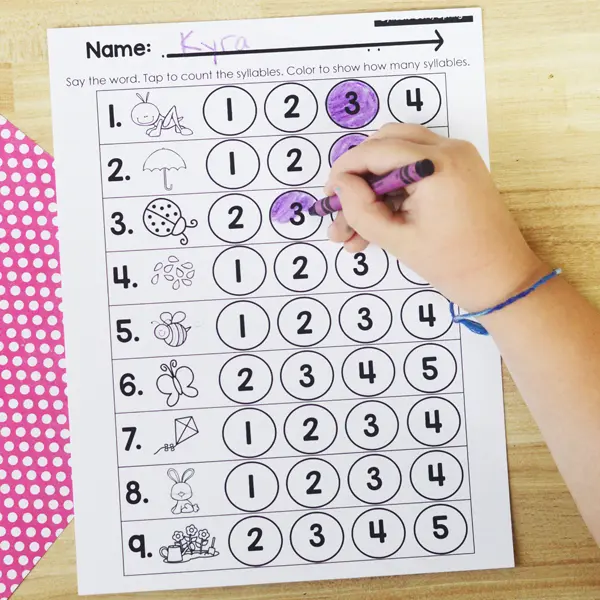
- A black-and-white response worksheet for independent practice or assessment.
- A comprehensive answer key for educators and self-checking stations.
- Four Seasons Syllable Sort (Comprehensive Pack):
- A massive 42-page pedagogical resource spanning all four climatic seasons.
- Specialized syllable clip cards designed to strengthen fine motor skills alongside phonological processing.
- Picture-based sorting mats that eliminate early reading barriers, ensuring focus remains strictly on auditory and structural word analysis.
Official Statements and Educator Insights
The pedagogical methodology behind these sorting activities has drawn widespread praise from early childhood educators, literacy coaches, and curriculum specialists.

"When teaching young children how to read, we cannot skip the foundational steps of phonological awareness," notes an early childhood literacy specialist. "Tools that prompt children to physically interact with language—through clapping, tapping, and sorting—transform abstract linguistic rules into tangible experiences. The integration of seasonal themes keeps student engagement high while systematically building their phonetic toolkits."
Furthermore, educators emphasize the importance of vocabulary front-loading before launching into independent center work.

"Before a child can accurately sort a picture card by its syllable count, they must accurately identify the object depicted," explains a veteran kindergarten teacher. "Taking a few moments to introduce and practice the vocabulary ensures that the activity measures a child’s phonological sorting ability rather than testing their object recognition."
Classroom implementation data further supports the flexibility of these resources. Teachers report utilizing the printables across multiple instructional formats:

- Literacy Centers: Placed in rotation stations for small groups or pairs to collaborate on sorting mats.
- Take-Home Practice: Sent home to families, bridging the gap between classroom learning and home-based literacy reinforcement.
- Formative Assessment: Utilizing the optional response worksheets to evaluate individual student mastery of segmenting concepts.
Future Outlook: The Direction of Early Childhood Literacy
As educational institutions continue to refine their reading curricula in accordance with the Science of Reading, the demand for high-quality, evidence-based, and engaging instructional materials will only intensify. The success of thematic sorting activities signals a broader trend in early education: the demand for resources that balance rigorous academic standards with developmentally appropriate play and exploration.
Key Trends to Watch:
- Integration of Multisensory Learning: Future literacy tools will likely lean even heavier into kinesthetic, tactile, and auditory modalities to support diverse learners, including English Language Learners (ELLs) and students with special educational needs.
- Digital and Printable Hybrids: While physical manipulatives like clip cards and sorting mats remain gold standards for fine motor development, companion digital modules are expected to emerge to support hybrid and remote learning environments.
- Thematic Continuity: Educators are increasingly moving away from isolated worksheets in favor of thematic, cross-curricular units that connect literacy to science, nature, and seasonal changes—mirroring the holistic design of the Four Seasons Syllable Sort packs.
Ultimately, equipping young learners with the ability to hear and manipulate word parts lays a resilient foundation for decoding, spelling, and reading comprehension. By turning foundational skill-building into an engaging, seasonal game, educators can foster a lifelong love of reading from the very first syllable.

