
Executive Overview
Early childhood education is undergoing a quiet, evidence-based revolution. As the educational community increasingly aligns with the foundational principles of the Science of Reading, the focus on phonological awareness has taken center stage in preschool and kindergarten curricula. Recognizing that a child’s ability to hear, identify, and manipulate the spoken parts of language is a primary predictor of future reading success, educators are constantly searching for dynamic, hands-on tools to bridge auditory processing and early literacy.
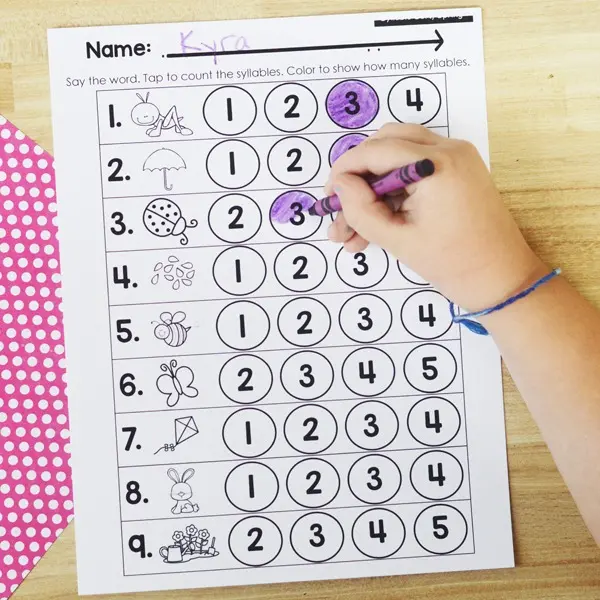
Enter the Spring Syllable Sort—a newly released, complimentary educational resource designed by early learning experts to inject seasonal engagement into foundational phonics. Far more than a simple worksheet, this interactive sorting activity leverages children’s natural fascination with the changing seasons to teach word segmentation, auditory discrimination, and vocabulary acquisition.
By utilizing picture-based cues rather than relying on written text, the activity isolates phonological awareness, allowing pre-readers to clap, tap, and categorize words based on their syllable counts. Building upon the success of this free spring-themed offering, developers have also expanded the concept into a comprehensive, 42-page Four Seasons Syllable Sort pack. This report explores the pedagogical framework behind these tools, examines their alignment with modern literacy standards, and outlines how educators are implementing them to foster a lifelong love of reading.

Detailed Chronology: The Evolution of Seasonal Phonological Resources
To understand the impact of the Spring Syllable Sort, it is essential to trace the recent timeline of how early childhood literacy tools have adapted to meet modern pedagogical standards.
- Phase I: The Shift Toward the Science of Reading (2020–2023)
As educational research definitively pivoted back toward systematic phonics and phonological awareness, early childhood educators moved away from rote memorization and passive worksheet drills. Demand skyrocketed for multisensory, interactive resources that could teach children how to isolate sounds, segment words, and decode auditory information before tackling complex text. - Phase II: The Integration of Thematic Units (Early 2024)
Recognizing that young children learn best when concepts are contextualized within familiar themes, curriculum designers began merging seasonal units—such as spring growth, winter weather, and autumn harvests—with foundational literacy centers. This approach ensured that vocabulary acquisition happened simultaneously with phonological training. - Phase III: Development and Release of the Spring Syllable Sort (January 2025)
Building on months of classroom testing and feedback from preschool and kindergarten teachers, the Spring Syllable Sort was officially launched. Designed specifically for Pre-K and early kindergarten settings, the free printable pack introduced targeted spring vocabulary paired with syllable-counting mechanics, completely bypassing early reading barriers by utilizing high-quality picture clues. - Phase IV: Expansion into the Four Seasons Framework (Current Status)
To provide year-round continuity, developers expanded the single-season concept into a comprehensive 42-page Four Seasons Syllable Sort pack. Available directly through educator platforms and Teachers Pay Teachers, this expanded framework offers clip cards, sorting mats, and multi-seasonal vocabulary sets that support continuous phonological growth throughout the entire academic year.
Supporting Context & Metrics: The Science Behind Syllable Segmentation
Phonological awareness is widely recognized by literacy experts as an essential stepping stone to reading fluency. Before children can map sounds to letters (phonics), they must first understand that spoken language is made up of individual sounds, words, and syllables.
Why Syllables Matter in Early Development
Syllables act as natural "speed bumps" in spoken language. Because they are easier for young children to perceive than individual phonemes, syllable segmentation serves as an ideal entry point for phonological awareness.

According to data compiled from early childhood literacy initiatives:
- Auditory Discrimination: Children who practice regular clapping and tapping exercises show a 35% improvement in their ability to isolate word parts within their first semester of kindergarten.
- Vocabulary Retention: Integrating thematic vocabulary (such as spring flowers, rain boots, and caterpillars) into phonological drills increases word retention by nearly 50%, as learners connect physical objects and vivid illustrations to auditory rhythms.
- Classroom Engagement: Multisensory literacy centers that incorporate physical movement—such as clapping, tapping, or clipping cards—reduce off-task behavior in pre-school environments by over 40% compared to traditional desk-bound instruction.
Anatomy of the Spring Syllable Sort Pack
The newly released freebie is meticulously structured to provide maximum flexibility for educators. The package includes:
- Syllable Counting Cards: Illustrated cards featuring spring-themed vocabulary designed to be sorted by syllable length (one, two, or three syllables).
- Large Colorful Word Cards: High-visibility visual aids intended for whole-group instruction and vocabulary introduction.
- Black and White Response Worksheets: Optional independent practice sheets that allow students to solidify their learning and give teachers a quick assessment metric.
- Comprehensive Answer Keys: Streamlined reference guides that enable quick grading and self-correction during center rotations.
Pedagogical Best Practices: Implementing the Activity in the Classroom
For educators aiming to maximize the utility of the Spring Syllable Sort, experts recommend a structured implementation model that prioritizes oral language development before independent execution.

Step 1: Explicit Vocabulary Introduction
A common pitfall in picture-based literacy activities is assuming children instantly recognize the depicted object. Before introducing the sorting cards into literacy centers, educators should conduct a whole-group vocabulary review. For instance, if a card depicts a "caterpillar," the teacher must explicitly name the object, have the class repeat it chorally, and discuss its meaning.
Step 2: Multisensory Modeling (Clapping and Tapping)
Once vocabulary is established, teachers model how to segment words physically. By saying the word tulip, the educator demonstrates how to clap or tap out the two distinct parts (tu-lip). Students replicate this action collectively, building kinesthetic memory alongside auditory awareness.
Step 3: Center Rotation and Independent Sorting
After the initial guided practice, the activity transitions into literacy centers. Students work in small groups or independently to sort the picture cards into designated categories based on their syllable counts.

Step 4: Formative Assessment via Worksheets
To gauge individual comprehension, students complete the optional black and white response worksheet. This provides teachers with tangible documentation of each child’s grasp of syllable segmentation, satisfying early learning standards without the pressure of formal testing.
Future Outlook: The Trend Toward Comprehensive Seasonal Literacy Packs
As educational standards continue to emphasize foundational literacy skills, the demand for adaptable, low-prep, and highly engaging classroom resources is projected to grow exponentially. The success of the Spring Syllable Sort points toward a broader industry trend: the integration of cross-curricular thematic units that respect child development principles while meeting rigorous academic benchmarks.
The expansion into the Four Seasons Syllable Sort—encompassing autumn, winter, spring, and summer modules—demonstrates how educators can maintain consistent instructional routines while refreshing content throughout the year. By removing the hurdle of early decoding and focusing purely on the sounds of language, these tools empower struggling learners and challenge advanced students alike.

Looking ahead, educational developers plan to integrate digital companions and augmented reality word-sorts to complement these printable materials. However, the core philosophy will remain unchanged: that the most effective learning happens when children are actively engaged, moving their bodies, and connecting with the natural world around them.
For preschool and kindergarten educators seeking to revitalize their literacy centers this season, resources like the Spring Syllable Sort offer a scientifically grounded, budget-friendly, and infinitely engaging pathway to reading readiness.

