
Executive Overview
In the landscape of modern early childhood education, the foundational mechanics of reading are undergoing a quiet yet profound revolution. Driven by the empirical frameworks of the Science of Reading, educators increasingly recognize that phonological awareness—the ability to recognize and manipulate the spoken parts of sentences and words—is the bedrock upon which all future literacy is built. Long before children learn to decode written text visually, they must master the auditory landscape of language.
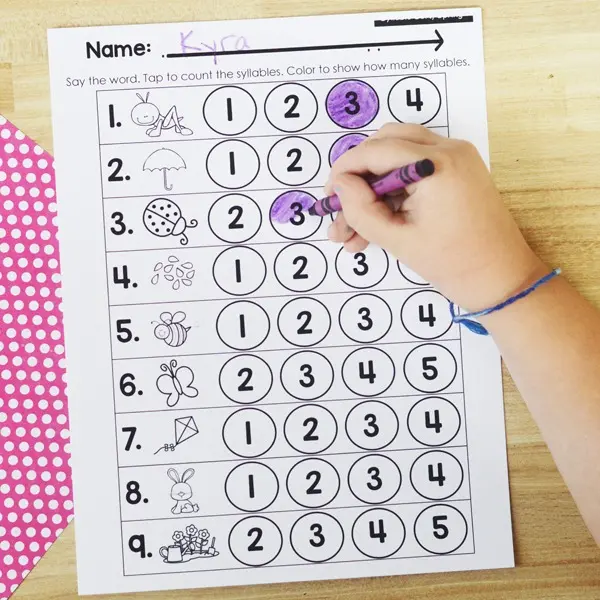
Enter the Spring Syllable Sort, an interactive, play-based pedagogical tool designed to bridge foundational phonics and seasonal thematic learning for pre-kindergarten and kindergarten students. Developed to seamlessly integrate into early education classrooms and home-school environments, this resource targets a critical developmental milestone: segmenting words into distinct beats or syllables.
By combining tactile engagement—such as clapping, tapping, and sorting picture cards—with vibrant seasonal themes, the activity moves away from rote memorization. Instead, it invites young learners to actively construct their understanding of sound structures. Building upon the success of this seasonal freebie, comprehensive expansions like the Four Seasons Syllable Sort pack offer educators a robust, 42-page curricular toolkit designed to sustain phonological engagement year-round. This report provides an authoritative examination of these literacy resources, detailing their methodology, alignment with modern educational standards, implementation strategies, and long-term implications for early childhood pedagogy.

Detailed Chronology: The Evolution of Phonological Curricula and the Birth of the Syllable Sort
To understand the significance of tools like the Spring Syllable Sort, one must examine the chronological shift in early reading instruction over the past two decades.
Phase I: The Shift Toward the Science of Reading (Early 2000s–2010s)
For generations, early reading instruction often relied heavily on whole-word recognition and contextual guessing. However, extensive cognitive research—collectively known as the Science of Reading—demonstrated that explicit, systematic instruction in phonics and phonological awareness yields superior literacy outcomes.
- Focus on Auditory Processing: Educators realized that children must first process sounds before mapping them to letters (graphemes).
- The Missing Link: While phonics programs proliferated, teachers often lacked engaging, hands-on materials that could translate abstract phonological concepts (like "syllables") into concrete, developmentally appropriate tasks for four- and five-year-olds.
Phase II: The Integration of Thematic Learning (2015–2020)
As early childhood experts sought ways to maintain student engagement, thematic teaching gained prominence. Concepts were no longer taught in isolated drills; instead, literacy was woven into seasonal units—exploring autumn leaves, winter snow, spring blossoms, and summer sun.

- Contextualizing Vocabulary: Children learned words like flower, umbrella, and butterfly not just as vocabulary items, but as units of sound.
- The Limitation: Many available worksheets were either too advanced (relying on reading rather than auditory cues) or too simplistic, lacking systematic progression across seasons.
Phase III: The Introduction of the Spring Syllable Sort (Present)
Responding to the demand for practical, research-aligned center activities, developers engineered the Spring Syllable Sort.
- Design Philosophy: The activity intentionally divorces the task of syllable counting from reading written words. By utilizing picture cards, children focus exclusively on auditory segmentation.
- Classroom Implementation: Teachers began deploying the sorting mats, clip cards, and response sheets in literacy centers, small-group interventions, and take-home packs.
- Expansion: Recognizing the year-round utility of the model, creators subsequently rolled out the comprehensive Four Seasons Syllable Sorts collection, transforming a seasonal novelty into a continuous, comprehensive curriculum component.
Supporting Context & Metrics: The Science Behind Syllable Segmentation
Phonological awareness develops along a well-documented continuum, moving from large units of sound (words in sentences, rhyme, and alliteration) to smaller units (syllables, onset-rime, and finally phonemes). Syllable segmentation sits squarely in the middle of this developmental arc, acting as a crucial stepping stone toward phonemic awareness.
Why Syllables Matter
Syllables are natural beats of speech that children can easily feel through physical movement. When a child says the word caterpillar, their jaw drops naturally on each vowel sound (cat-er-pill-ar).

- Kinesthetic Connection: Actions like clapping, tapping, or marching help cement the cognitive connection between physical rhythm and linguistic structure.
- Cognitive Load Reduction: Breaking multi-syllable words into smaller chunks prevents cognitive overload when children later encounter complex, polysyllabic words in text.
Key Metrics and Classroom Impact
Educational research underscores the efficacy of targeted phonological interventions in early childhood settings:
- Early Predictor: According to longitudinal literacy studies, a child’s phonological awareness at the beginning of kindergarten is one of the single strongest predictors of their reading comprehension ability in third grade.
- Engagement Multiplier: Play-based learning centers utilizing manipulatives (such as sorting mats and picture cards) increase student on-task behavior by up to 40% compared to traditional seatwork.
- Vocabulary Acquisition: Integrating thematic seasonal vocabulary simultaneously builds oral language comprehension and phonological skills, addressing two pillars of early literacy development.
Official Guidelines and Implementation Frameworks
Implementing the Spring Syllable Sort and its broader seasonal counterpart requires adherence to best practices in early childhood education. Developers and reading specialists recommend a structured, multi-step instructional framework to maximize the utility of these printables.
1. Pre-Teaching Vocabulary
Before releasing students to independent literacy centers or small-group sorting tasks, educators must explicitly introduce the vocabulary depicted on the picture cards.

- Best Practice: Hold up each card (e.g., raincoat, tulip, nest), name the object clearly, and have the class repeat it. This ensures that a child’s failure to sort a card correctly is an issue of syllable identification rather than an unfamiliar vocabulary word.
2. Multi-Sensory Segmenting
The core mechanic of the activity relies on physical segmentation. Educators should guide students through the following routine:
- Listen: Hear the target word spoken aloud.
- Tap or Clap: Tap a finger on the desk or clap hands for each distinct syllable part.
- Count: State the total number of syllables aloud.
- Sort: Place the picture card onto the corresponding mat (e.g., 1-syllable, 2-syllable, 3-syllable, or 4-syllable categories).
3. Flexible Center Integration
The materials included in the free spring download and the comprehensive 42-page seasonal pack are designed for versatility across various learning environments:
- Literacy Centers: Set up independent or partner sorting stations using colorful word and picture cards.
- Small Group Instruction: Use clip cards and targeted sorting mats during guided reading groups to monitor struggling learners.
- Independent Practice: Utilize the black-and-white response worksheets for individual assessment or as a quick reference check.
- Take-Home Practice: Send home curated card sets and worksheets to foster home-school connections and parental involvement.
Comprehensive Feature Breakdown: What the Packs Include
To provide educators with a clear picture of these instructional resources, the following inventory details the contents of both the free spring offering and the comprehensive seasonal expansion.

The Free Spring Theme Syllable Sort
Tailored specifically for spring thematic units, this introductory kit includes:
- Syllable Counting Cards: Interactive visual guides for measuring word parts.
- Large Colorful Word & Picture Cards: High-engagement visuals representing classic spring vocabulary.
- Black-and-White Response Worksheet: An optional printable for independent student accountability.
- Complete Answer Key: Allows for quick self-checking by students or rapid grading by educators.
The Four Seasons Syllable Sorts (42-Page Expansion Pack)
For educators seeking year-round continuity, the comprehensive pack expands the methodology across all four seasons:
- Comprehensive Clip Cards: Designed for use with clothespins, strengthening fine motor skills while practicing phonological awareness.
- Thematic Sorts: Spans autumn, winter, spring, and summer, ensuring that seasonal vocabulary remains fresh and relevant throughout the academic calendar.
- Accessibility: Available directly via specialized early childhood networks and platforms like Teachers Pay Teachers, ensuring easy integration into existing digital and physical lesson planning ecosystems.
Future Outlook: The Trajectory of Play-Based Literacy Tools
As educational standards continue to evolve in alignment with the Science of Reading, the demand for high-quality, research-backed, and play-based instructional materials will only intensify. The traditional reliance on monotonous worksheets is rapidly giving way to dynamic, multi-sensory resources that respect the developmental realities of young children.

Emerging Trends in Early Literacy
- Digital-Physical Hybrid Models: While tactile printables remain the gold standard for pre-K and kindergarten motor and cognitive development, future iterations of literacy tools are increasingly pairing physical sorting cards with interactive digital assessment trackers for educators.
- Equity and Access: Free foundational resources, such as the Spring Syllable Sort, play a vital role in democratizing access to high-tier educational materials, ensuring that underfunded classrooms and home-schooling parents alike can provide rigorous, research-aligned instruction.
- Curricular Cohesion: The shift toward year-round thematic phonological packs (such as the Four Seasons collection) signals a move away from disjointed, ad-hoc lesson planning toward unified, systemic literacy frameworks.
Conclusion
The journey to literacy begins long before a child reads their first book sentence; it begins with the ability to hear, isolate, and manipulate the sounds of spoken language. Through engaging, thoughtfully designed tools like the Spring Syllable Sort and the comprehensive Four Seasons collection, educators are equipped to turn this critical cognitive milestone into an enjoyable, interactive experience. By blending rigorous phonological science with the joy of seasonal exploration, these resources ensure that young learners build both the skills and the confidence necessary for a lifetime of reading success.

