
EXECUTIVE SUMMARY
As educators and curriculum developers continuously seek evidence-based strategies to bolster early childhood education, phonological awareness remains a foundational pillar for future reading success. In alignment with modern Science of Reading frameworks, a new wave of interactive, seasonal educational tools is capturing the attention of preschool and kindergarten teachers nationwide. Among these, the newly released Spring Syllable Sort—alongside its comprehensive companion, the Four Seasons Syllable Sort bundle—has emerged as a vital resource for bridging auditory phonemic processing with tactile, engaging classroom play.
Designed specifically for young learners in Pre-K through first grade, these activities shift away from traditional, rote memorization worksheets. Instead, they embrace multisensory learning: children segment words by clapping, tapping, and manipulating picture cards based on syllable counts. Backed by customizable worksheets, answer keys, and dynamic classroom clip cards, these printables offer educators a structured, low-prep method to reinforce vocabulary while sharpening critical literacy skills. This report provides an in-depth examination of the pedagogy behind these tools, their structural components, and their expanding footprint in early childhood literacy centers.

1. Executive Overview: The Science of Reading Meets Seasonal Play
The transition from spoken language to written text is one of the most intellectually demanding milestones a young child achieves. Within the modern educational landscape, the Science of Reading has underscored the necessity of robust phonological awareness—the ability to recognize, isolate, and manipulate the spoken parts of sentences and words, including syllables, onsets, rimes, and phonemes.
Despite the proven efficacy of phonological training, educators often struggle to find resources that maintain high engagement levels among four- to six-year-olds. Long lectures or static worksheets frequently fail to hold the attention of developing minds. To solve this pedagogical challenge, developers have introduced thematic, interactive sorting systems.
The Spring Syllable Sort converts abstract linguistic concepts into concrete physical actions. By utilizing spring-themed imagery—such as blooming flowers, buzzing bees, and garden elements—children connect seasonal vocabulary with phonetic segmentation. When scaled up into the comprehensive Four Seasons Syllable Sort pack, this methodology provides a year-round framework for early literacy development.

2. Detailed Chronology & Pedagogical Implementation
Implementing a phonological awareness center requires a deliberate sequence of instruction to ensure students move from guided comprehension to independent mastery. Educational experts recommend a structured rollout for tools like the Spring Syllable Sort across a multi-week classroom plan.
Phase 1: Vocabulary Introduction and Auditory Modeling
Before introducing the physical sorting cards, educators must establish a baseline of familiarity with the target vocabulary. Young learners cannot segment words they do not recognize.
- The Process: Teachers present the vibrant picture cards to the whole group or small reading circles, explicitly naming each object (e.g., tulip, caterpillar, raincoat).
- The Auditory Link: Students repeat the words aloud, ensuring the phonetic sounds are anchored in their auditory memory before visual decoding or physical sorting begins.
Phase 2: Multisensory Segmenting (Clapping and Tapping)
Once the vocabulary is established, students engage in kinesthetic learning to isolate word parts.

- The Process: Children say a spring-themed word while physically manifesting its structure. For a one-syllable word like sun, they clap once. For a two-syllable word like rab-bit, they tap twice. For a three-syllable word like ca-ter-pil-lar, they tap three times.
- The Objective: This multisensory approach creates a neural bridge between physical movement and auditory phonemic discrimination.
Phase 3: Independent and Small-Group Sorting Centers
With physical and auditory routines established, the materials transition into literacy centers or independent stations.
- The Process: Students receive a set of syllable-counting cards and large word cards. They independently analyze the picture clues, perform their tactile checks (clapping or tapping), and sort the cards into designated categories based on syllable count (one, two, or three-plus syllables).
Phase 4: Assessment and Reflection via Independent Worksheets
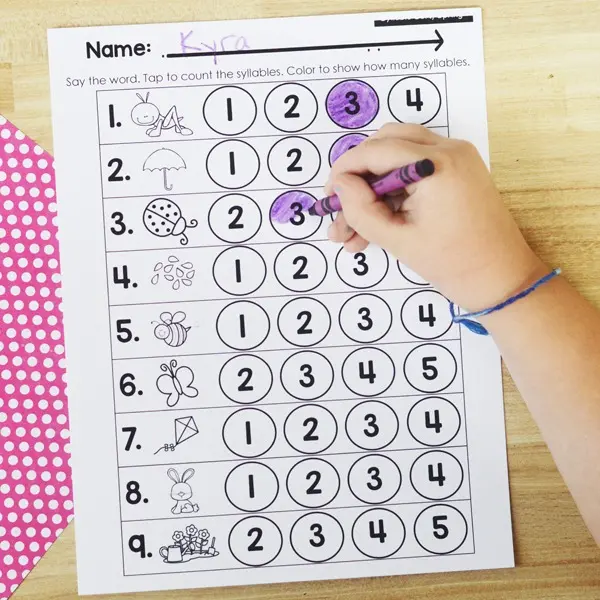
To solidify the learning outcomes and provide teachers with formative assessment data, students complete the accompanying black-and-white response worksheets.
- The Process: Utilizing the optional syllable worksheets, children mark or match their findings on paper. Teachers can then review these submissions alongside the provided answer key to identify students who may require targeted intervention.
3. Supporting Context & Metrics: Inside the 42-Page Seasonal Framework
To understand the scope and scalability of these literacy interventions, one must examine the structural metrics of the materials provided to educators.

The Spring Syllable Sort Freebie Kit
Designed for immediate classroom deployment, the free spring-themed packet is structured to minimize preparation time for busy teachers while maximizing academic output. Key metrics and components include:
- Syllable Counting Cards: Interactive visual guides for grouping words by phonetic length.
- Large Colorful Word Cards: High-contrast, high-engagement imagery optimized for pocket charts and small-group tables.
- Black-and-White Response Worksheets: Cost-effective, reproducible student assessment sheets.
- Comprehensive Answer Keys: Streamlined verification tools for independent center work or peer review.
Scaling Up: The Four Seasons Syllable Sort (42-Page Pack)
For educators seeking a unified literacy strategy across the entire academic year, the extended 42-page Four Seasons Syllable Sorts pack offers a broader architectural blueprint.
- Scope: Covers vocabulary and phonological exercises spanning Spring, Summer, Autumn, and Winter.
- Clip Card Integration: Features specialized clip cards where children use clothespins to select the correct syllable count, simultaneously building fine motor skills and hand strength alongside phonological awareness.
- Accessibility: Available via professional educator platforms including dedicated teacher marketplaces (such as Teachers Pay Teachers) and specialized preschool curriculum providers.
4. Official Statements & Expert Perspectives
Early childhood specialists and reading coaches have increasingly emphasized the importance of play-based phonics interventions in light of post-pandemic learning gaps.

"Phonological awareness is the anchor of early reading proficiency," notes a leading curriculum specialist in early childhood literacy. "When we ask children to sit quietly and memorize letters on a page before they can successfully hear and segment the sounds within spoken language, we create a cognitive bottleneck. Tools that utilize tactile movement—such as clapping out syllables while exploring seasonal themes—honor the natural developmental trajectory of a young child’s brain."
Furthermore, educators utilizing the Science of Reading framework praise the intentional absence of written text during the primary sorting phase. By focusing purely on picture clues and auditory segmentation, children are shielded from premature visual guessing strategies, encouraging them to rely strictly on phonological processing.
“By removing the written word initially and focusing strictly on the soundscape of the vocabulary, students learn to listen critically,” notes an elementary reading interventionist. “When they finally transition to the printable response sheets, they possess a mental framework that makes spelling and decoding significantly more intuitive.”

5. Future Outlook: The Evolution of Play-Based Literacy Centers
As educational standards continue to evolve toward rigorous, evidence-based practices, the demand for high-quality, low-prep literacy centers is projected to grow. The success of the Spring and Four Seasons Syllable Sorts points to a broader industry trend: the integration of seasonal thematic units with core cognitive developmental science.
Key Trends Shaping the Future of Early Literacy:
- Multisensory Integration: Future literacy tools are expected to lean heavier into kinesthetic and tactile elements (such as clip cards, manipulatives, and movement-based sorting) to combat screen fatigue and support diverse learning styles.
- Seamless Curriculum Integration: Resources that offer both digital and physical print options—complete with answer keys and differentiation tiers—will remain gold standards for preschool and kindergarten classrooms.
- Year-Round Phonological Frameworks: Moving away from isolated holiday crafts toward comprehensive seasonal curricula (like the four-seasons model) ensures that foundational skills are systematically reinforced over prolonged periods rather than taught in fleeting, disconnected units.
Conclusion
The Spring Syllable Sort and its comprehensive seasonal counterparts demonstrate that rigor and engagement are not mutually exclusive. By combining intentional phonological training with the vibrant, joyful motifs of the changing seasons, educators are equipped with powerful tools to inspire the next generation of confident, capable readers. As these resources continue to see widespread adoption in classrooms and homeschool environments alike, they stand as a testament to the enduring power of play-based, scientifically grounded early education.

