
EXECUTIVE SUMMARY
In the landscape of early childhood education, foundational literacy remains the bedrock upon which all future academic success is built. As educators and policymakers increasingly align with the Science of Reading, the focus has shifted toward robust, evidence-based instructional strategies that foster phonological awareness in preschool and kindergarten classrooms. Enter the Spring Syllable Sort and its comprehensive counterpart, the Four Seasons Syllable Sort—two innovative, hands-on educational frameworks designed to transform how young learners interact with spoken language.
By prioritizing auditory processing, syllable segmentation, and seasonal vocabulary acquisition over rote memorization, these resources bridge the gap between cognitive science and classroom practice. This report explores the pedagogical mechanics of the Spring Syllable Sort, evaluates its integration into modern literacy centers, examines the broader curriculum of the Four Seasons collection, and provides an authoritative overview of how play-based phonics is shaping the future of early education.

1. THE PEDAGOGICAL IMPERATIVE: UNDERSTANDING PHONOLOGICAL AWARENESS IN EARLY CHILDHOOD
To comprehend the significance of tools like the Spring Syllable Sort, one must first examine the cognitive milestones of children aged three to six. Phonological awareness—the ability to recognize and manipulate the spoken parts of sentences and words, such as syllables, onsets, and rimes—is widely recognized by reading researchers as a critical precursor to decoding and reading comprehension.
Long before children decode written text, they must learn to tune their ears to the sounds of language. Syllable awareness is a crucial stepping stone in this journey. When a child learns to break a word down into distinct beats or chunks, they are exercising the auditory cortex, building the neural pathways necessary for future phonics instruction.
Traditional literacy instruction has often relied heavily on flashcards and passive worksheet drills, which can disengage young learners and fail to connect with how children naturally process information. The Spring Syllable Sort rejects this static approach in favor of active, multisensory engagement. By incorporating physical movements—such as clapping, tapping, and tactile sorting—the activity aligns with kinesthetic learning styles, ensuring that abstract linguistic concepts take on a concrete, memorable form.

2. ANATOMY OF THE SPRING SYLLABLE SORT: DESIGN AND IMPLEMENTATION
Developed as a seasonal response to the need for dynamic literacy resources, the Spring Syllable Sort offers a structured yet playful methodology for isolating word parts. Rather than introducing written words prematurely, the activity centers around vivid, spring-themed picture cards. This deliberate design choice ensures that students focus entirely on auditory discrimination and oral segmentation without the confounding variable of orthographic decoding.
Core Mechanics of the Activity
- Introduction and Vocabulary Building: Educators first introduce the spring-themed vocabulary using large, colorful word cards. Ensuring that students understand the meaning and pronunciation of terms like tulip, caterpillar, rain, or butterfly is a mandatory prerequisite for successful independent work.
- Segmenting via Movement: Students say the target word aloud, engaging in tactile and motor feedback by clapping or tapping out the individual beats (syllables). For instance, "rain" yields one clap, "tulip" yields two, and "caterpillar" yields four.
- Sorting and Categorization: Once the syllable count is established, learners physically sort the picture cards into designated categories based on their syllable count. This tactile categorization reinforces mathematical sorting skills simultaneously with linguistic practice.
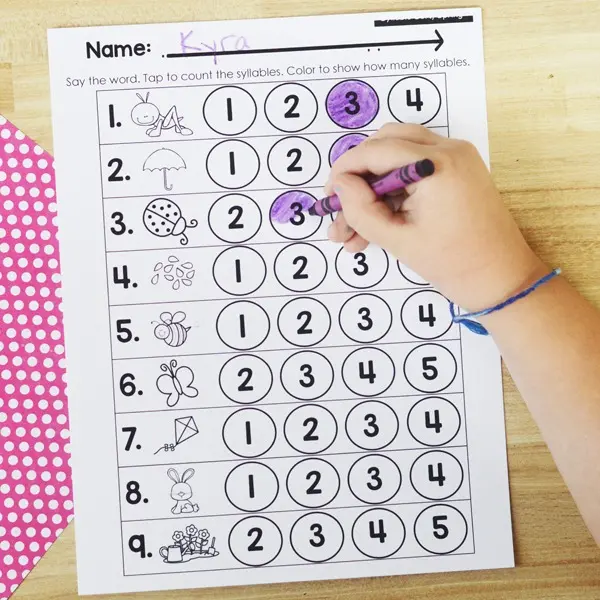
- Independent Reinforcement: To solidify comprehension, students can transition to an optional black-and-white response worksheet. This provides teachers with a reliable assessment tool while granting students autonomy in their independent practice.
Comprehensive Package Contents
The free Spring Syllable Sort kit is meticulously curated to provide maximum utility for educators. It includes:
- Syllable counting cards designed for small-group instruction or literacy centers.
- Large, colorful visual vocabulary cards.
- A black-and-white student response worksheet for independent accountability.
- A comprehensive answer key to streamline grading and self-correction.
3. INTEGRATING SEASONAL LITERACY INTO MODERN CURRICULA
Classroom implementation requires flexibility, and the Spring Syllable Sort is engineered to adapt to various instructional formats. Whether utilized during morning meeting circles, dedicated literacy centers, or sent home for family-guided practice, the activity maintains its pedagogical value.

Versatile Classroom Applications
- Literacy Centers: Positioned as a station rotation, the syllable sort allows small groups of students to collaborate, discuss syllable counts, and correct one another in a low-stakes environment.
- Take-Home Literacy Practice: By providing families with accessible printables, schools can extend the learning day into the home, fostering critical home-school connections.
- Seasonal Thematic Units: Integrating phonological awareness with broader spring themes—such as plant growth, insect life cycles, and weather patterns—enhances cognitive retention by anchoring new linguistic concepts within a familiar thematic framework.
For educators seeking a fully realized curriculum, the resource pairs seamlessly with comprehensive guides like the Spring Theme Preschool Classroom Lesson Plans from Preschool Teacher 101. These expansive frameworks ensure that literacy is not taught in a vacuum but is woven cohesively into art, math, and science explorations.
4. EXPANDING THE HORIZON: THE FOUR SEASONS SYLLABLE SORT ECOSYSTEM
While spring provides a vibrant backdrop for learning, phonological awareness is a year-round necessity. Recognizing this, educational developers expanded the core methodology into a comprehensive, multi-season initiative: The Four Seasons Syllable Sorts.
Spanning a robust 42-page instructional pack, this broader ecosystem scales the spring methodology across the entire calendar year. It equips educators with clip cards and sorting mats tailored to winter, spring, summer, and autumn themes. By maintaining a consistent instructional routine across changing seasons—using the same clapping, tapping, and sorting mechanics—teachers minimize cognitive load related to how an activity works, allowing students to direct 100% of their cognitive energy toward the linguistic task at hand.

Accessibility and Professional Distribution
To ensure these tools reach the widest possible audience of educators, homeschoolers, and speech-language pathologists, the Four Seasons Syllable Sorts and allied curricula are made widely accessible. Educators can acquire the complete unit directly through specialized teacher networks or via dedicated digital marketplaces such as Teachers Pay Teachers. This open-access and easily downloadable model democratizes high-quality, Science of Reading-aligned materials, ensuring that classrooms with varying budgetary constraints can still offer top-tier literacy interventions.
5. FUTURE OUTLOOK: THE EVOLUTION OF PLAY-BASED PHONICS
As educational standards continue to evolve in response to longitudinal reading data, the consensus among literacy experts is clear: early childhood instruction must balance rigorous cognitive science with developmentally appropriate play.
The success of resources like the Spring Syllable Sort signals a broader industry trend away from rigid, desk-bound workbooks and toward interactive, multi-sensory learning experiences. Looking ahead, the integration of digital extensions with tangible printables is expected to accelerate. However, the core tactile elements—clapping, sorting physical cards, and peer-to-peer discussion—will remain irreplaceable components of early childhood development.

Furthermore, as schools place greater emphasis on equity and early intervention, tools that explicitly target phonological deficits before formal reading instruction begins will play a pivotal role in closing achievement gaps. By transforming abstract linguistic concepts into engaging, seasonal games, educators are not only teaching children how to count syllables; they are unlocking a lifelong passion for language, communication, and discovery.
CONCLUSION
The introduction of the Spring Syllable Sort and the comprehensive Four Seasons collection represents a significant step forward in early literacy instruction. By marrying the principles of the Science of Reading with joyful, play-based classroom activities, these resources empower educators to lay a bulletproof foundation for phonological awareness. As preschool and kindergarten classrooms continue to adopt these dynamic sorting strategies, a new generation of learners is stepping up to the reading table—one well-clapped syllable at a time.

