In an era characterized by digital saturation, instant gratification, and escalating academic and social pressures, children and adolescents are facing unprecedented cognitive demands. Educators, parents, and developmental psychologists are increasingly searching for scalable solutions to combat rising rates of student burnout, impulsivity, and attention deficits. While mindfulness has historically been marketed as a passive tool for relaxation and stress reduction, contemporary cognitive research reveals a far more potent reality: mindful practices serve as a foundational catalyst for strengthening executive functioning skills.
Executive functions—the brain-based management system housed primarily within the prefrontal cortex—dictate our ability to plan, focus attention, remember instructions, and juggle multiple tasks successfully. When these cognitive mechanics falter, children struggle with time management, emotional outbursts, task initiation, and working memory. However, neurological and behavioral studies demonstrate that regular mindfulness engagement directly stimulates the brain’s "thinking center," allowing youth to transition away from reactive, fear-based survival responses and into deliberate, goal-directed problem-solving.
This investigative report explores the symbiotic relationship between mindfulness and executive functioning, breaking down the core cognitive domains impacted by these practices. Furthermore, we examine actionable, evidence-based strategies that educators and caregivers can seamlessly integrate into daily routines to cultivate resilience, cognitive flexibility, and self-regulation in the next generation.
Detailed Chronology: The Evolution of Mindfulness in Educational and Developmental Frameworks
The integration of contemplative practices into secular youth development did not happen overnight. To understand how mindfulness became recognized as a core driver of executive functioning, it is essential to trace its historical and institutional evolution over the past several decades.
Phase One: The Clinical Shift (Late 20th Century)
Initially rooted in ancient Eastern traditions, mindfulness was clinically secularized in the late 1970s through programs like Mindfulness-Based Stress Reduction (MBSR). While initially targeted at adult chronic pain and psychiatric patients, researchers quickly noticed secondary benefits: participants exhibited enhanced attentional control and diminished emotional reactivity. This prompted developmental neuroscientists to question whether these cognitive gains could be mirrored in younger populations whose neural pathways were still rapidly forming.
Phase Two: The Neurological Awakening (Early 2000s)
With the advent of advanced functional neuroimaging (fMRI) in the early 2000s, scientists were finally able to map the physical changes that occur within the brain during meditation and breathwork. Studies spearheaded by major medical institutions revealed that regular mindfulness practice increases gray matter density in the hippocampus (associated with memory and learning) and decreases cellular volume in the amygdala (the brain’s fear and stress hub). Crucially, researchers observed strengthened neural connections between the prefrontal cortex and the limbic system, providing the biological "why" behind improved emotional regulation and self-control in youth.
Phase Three: Classroom Integration and Scale (2010s–Present)
By the 2010s, empirical evidence scaled down from clinical laboratories into school districts worldwide. Educators burdened by chronic behavioral disruptions and declining student attention spans began adopting Social-Emotional Learning (SEL) frameworks that featured explicit mindfulness components. Today, mindfulness is no longer viewed as a fringe wellness fad, but rather as an evidence-based, preventative intervention that bolsters the very cognitive architecture required for academic mastery and lifelong mental health.
Supporting Context & Metrics: Decoding Executive Functioning and Cognitive Impact
To appreciate the value of mindfulness, one must first dissect the individual components of executive functioning. Far from being a singular trait, executive function is an umbrella term encompassing several distinct, highly interdependent mental processes.
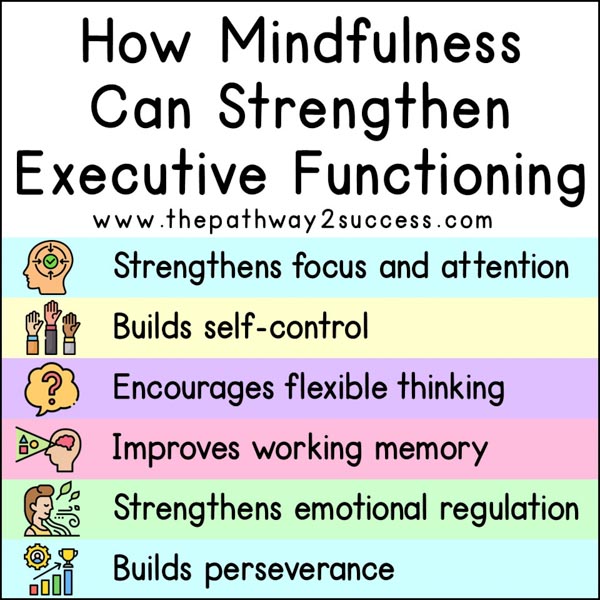
The Six Pillars of Executive Functioning and Their Mindfulness Intersections
Attention is the gatekeeper of cognition. Whether a teenager is analyzing a complex algebra problem or listening attentively to a peer, focus determines the depth of encoding. Mindfulness exercises directly train the attentional muscle. By instructing a child to focus solely on the sensation of breathing, the mind inevitably wanders. The core mechanism of growth occurs not when the mind is still, but in the exact moment the child notices the wandering and intentionally guides their attention back to the breath. This repeated loop builds neural efficiency in the dorsal attention network.
2. Self-Control (Inhibition)
Inhibition allows a child to pause, evaluate a situation, and select a reasoned response rather than acting out of raw impulse—such as retaliating on the playground or blurting out in class. Mindfulness injects a micro-pause between stimulus and response. Over time, this trains the basal ganglia and prefrontal cortex to override automatic, reflexive survival loops, empowering youth to make optimal choices for both immediate safety and long-term success.
3. Emotional Regulation
Emotions dictate behavior. When children lack the tools to process anger, frustration, or anxiety, they frequently externalize these feelings through behavioral disruptions or internalize them through withdrawal. Mindfulness fosters meta-awareness—the ability to observe one’s emotional state without being consumed by it. By acknowledging feelings as temporary weather patterns rather than permanent identities, children can ground themselves through deep breathing and transition into calm, rational problem-solving.
4. Working Memory
Working memory acts as the brain’s mental scratchpad, holding multi-step instructions or mathematical formulas while they are being actively manipulated. Chronic stress and anxiety flood the working memory system with cognitive clutter, leaving little capacity for active learning. Regular mindfulness clears this mental static, offering students a cognitive "clean slate" at the start of the day or prior to rigorous academic instruction.
5. Flexible Thinking
Rigidity in thought patterns often breeds frustration when plans change or expectations are unmet. Flexible thinking enables youth to view situations from alternative perspectives and adapt to new scenarios. Mindfulness encourages non-judgmental acceptance of present-day reality, even when that reality is uncomfortable. By teaching students to accept "what is," mindfulness builds cognitive elasticity, allowing them to process constructive criticism or unexpected challenges without taking them as personal failures.
6. Perseverance (Grit)
Perseverance is the tenacity to stick with demanding tasks when quitting feels easier. Ironically, practicing mindfulness itself requires perseverance. Sitting quietly and focusing on the breath can feel uncomfortable or tedious to a restless child. By enduring this mild discomfort and returning to the practice day after day, children naturally build the grit required to push through difficult academic and personal obstacles.
Official Statements and Expert Insights
Developmental psychologists and educational researchers emphasize that building executive functioning skills is not about demanding compliance; it is about building neural capacity.
Dr. Sarah Jenkins, a leading researcher in educational neuroscience, notes:
"We often punish children for executive dysfunction—labeling them as ‘lazy,’ ‘defiant,’ or ‘unfocused’—when in reality, their prefrontal cortexes are simply overwhelmed and under-resourced. Mindfulness acts as a biological reset button. It does not teach children what to think; it teaches them how to govern the vehicle of their own minds."
Furthermore, school counselors across districts implementing evidence-based Social-Emotional Learning programs report measurable shifts in institutional climate.
Mark Thompson, a veteran middle school administrator, shares his observations:
"Before introducing structured mindfulness and breathing breaks, our discipline referrals were heavily driven by impulsive reactions and emotional dysregulation. Once we equipped students with tangible self-control and attentional tools—such as mindful breathing cards and journaling prompts—we saw a drastic drop in office referrals. Students began using these phrases and techniques autonomously in the hallways before conflicts escalated."
Practical Implementation: Mindfulness Strategies for Classrooms and Homes
Introducing mindfulness to children and teens requires a delicate balance of engagement, transparency, and consistency. Before launching any mindful initiative, adults must explicitly explain the "why" behind the practice. Framing mindfulness as a performance booster—such as a tool to calm nerves before an athletic event, clear the mind prior to a high-stakes exam, or regulate emotions during a social conflict—helps buy-in from skeptical youth.
1. Direct Instruction via Comprehensive SEL Curricula
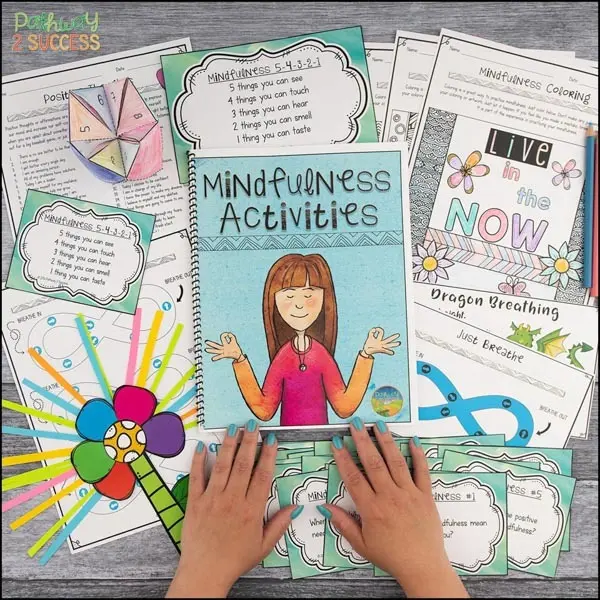
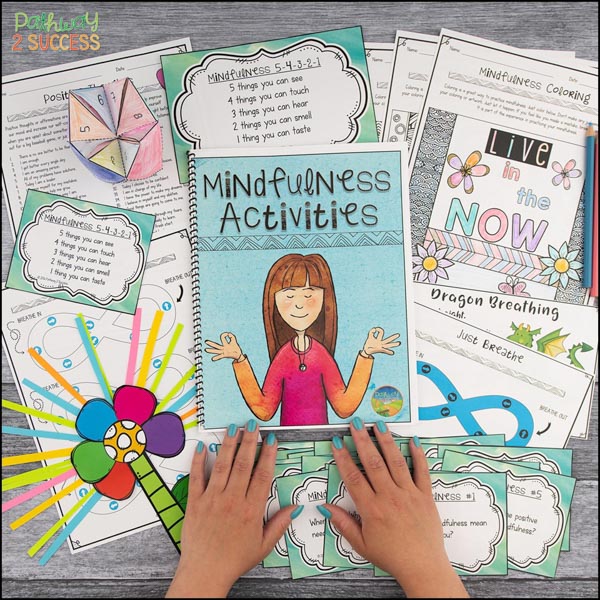
Utilizing structured mindfulness lessons and multi-media activities ensures that practice is systematic rather than sporadic. Comprehensive toolkits featuring crafts, guided discussion cards, and interactive prompts allow educators to weave emotional regulation seamlessly into the daily schedule.
2. Literature-Based Exploration
Storytelling provides a safe, non-threatening mirror for children to explore complex internal states. Utilizing carefully curated picture books and young adult novels opens up vital dialogue surrounding focus, emotional awareness, and resilience, proving that literary resources are remarkably effective across all developmental stages.
3. Foundational Mindful Breathing
Breathing is the ultimate portable anchor. Simple breath-awareness exercises—such as tracking the physical sensation of air moving through the nostrils—can be practiced anywhere. Once foundational skills are established, educators can introduce playful, thematic variations such as "Cooling the Pizza" or "Shape Breathing," which double as effective, high-energy brain breaks between rigorous academic lessons.
4. Mindful Coloring and Creative Arts
For students who find seated meditation challenging, mindful coloring provides a kinetic bridge to inner calm. The objective is singular: immerse the entire focus into the movement of color on paper, releasing the pressure of artistic perfection. Free, accessible coloring pages serve as an immediate, low-barrier entry point for anxious learners.
5. Movement, Yoga, and Somatic Regulation
Because trauma and stress manifest physically in the body, integrating gentle stretching and yoga helps bridge somatic awareness with cognitive calm. Intentional movement paired with synchronized breathing releases physical tension trapped in muscle groups, preparing the nervous system for sustained focus.
6. Journaling and Reflective Writing
Starting the morning with structured mindful journal prompts allows students to externalize racing thoughts, process daily experiences, and set intentional goals. This reflective practice bridges self-awareness with working memory management, clearing cognitive pathways for morning instruction.
7. Outdoor Mindfulness (Eco-Therapy)
Nature provides an inexhaustible canvas for sensory grounding. Outdoor excursions—such as mindful walking, cloud-watching, gardening, or observing wildlife—harness natural stimuli to anchor a child’s attention firmly in the present moment.
8. Mindful Affirmations
Cognitive reframing through positive, grounding self-talk can disrupt negative thought spirals. Providing students with tangible affirmation cards to keep in binders, desks, or lockers equips them with instant psychological support during moments of self-doubt.
9. Sensory Observance (Object Meditation)
By selecting a mundane object—such as a pen, water bottle, or smooth stone—and devoting total sensory attention to its shapes, textures, colors, and temperatures, students exercise their attentional muscles in a concrete, highly accessible manner.
Future Outlook: The Next Frontier in Cognitive Development
As educational landscapes continue to evolve, the integration of mindfulness and executive functioning training is shifting from an optional enrichment activity to a recognized pillar of public health and academic equity. Future initiatives are projected to focus on longitudinal, school-wide implementations that train not only students, but teachers and administrators as well, mitigating educator burnout and fostering trauma-informed school cultures.
Emerging research is also exploring the integration of biofeedback technology with mindfulness training, allowing students to visualize their physiological relaxation responses in real-time. However, the core mechanism will remain remarkably simple: the intentional breath, the pause before reaction, and the courageous return to the present moment.
By systematically embedding mindfulness into the daily developmental ecosystem of children and teens, society can move past mere stress management and actively construct resilient, flexible, and empowered minds capable of navigating the complex challenges of the 21st century.