The rapid integration of artificial intelligence (AI) into daily life has moved past the realm of speculative science fiction and established a permanent foothold in professional sectors worldwide. For educators, the advent of large language models like OpenAI’s ChatGPT presents a paradigm shift of historic proportions. Rather than a passing technological novelty, AI represents a fundamental restructuring of how educational content is produced, delivered, and evaluated.
While concerns regarding academic integrity, rampant plagiarism, and the erosion of foundational writing skills dominate faculty lounges across the globe, a growing cohort of pedagogical experts argues for a more nuanced perspective. Proponents view AI not as an existential threat to traditional schooling, but as a disruptive yet manageable catalyst—comparable to the historical introduction of the calculator or the proliferation of the internet.
This report examines the complex intersection of artificial intelligence and K-12 education. It evaluates how educators are leveraging AI to automate administrative burdens, foster personalized learning environments, and transform classroom challenges into practical lessons in critical thinking. Furthermore, it addresses the inherent limitations of current machine learning models—ranging from knowledge cutoffs to hallucinated facts—and outlines strategic approaches for school districts seeking to embrace, rather than ban, the next frontier of learning technology.
Detailed Chronology: From Novelty to Necessity
The conversation surrounding artificial intelligence in education has accelerated at an unprecedented pace over the past several years. Understanding this trajectory is crucial for contextualizing the current debates taking place in school districts nationwide.
Pre-2022: The Incubation Era
For years, machine learning existed primarily in the background of educational technology—powering adaptive learning software, automated grading systems for multiple-choice assessments, and basic grammar checkers. While these tools offered marginal efficiencies, they operated largely invisibly to the average classroom teacher.
Late 2022: The Public Unveiling of Generative AI
The release of ChatGPT to the general public in November 2022 marked a seismic shift. For the first time, sophisticated natural language generation was accessible to anyone with an internet connection. Students immediately recognized the platform’s potential to draft essays, solve complex mathematical word problems, and synthesize research papers within seconds.
Early 2023: The Panic and Prohibition Phase
Initial reactions from educational institutions were swift and, in many cases, reactive. Citing catastrophic fears of widespread cheating and the death of authentic student writing, major school districts—including New York City Public Schools and Los Angeles Unified—implemented sweeping bans on AI tools across their networks. Educators expressed deep anxiety over maintaining classroom accountability in an era where software could mimic human prose.
Mid-to-Late 2023: The Pivot Toward Integration
As outright bans proved technically difficult to enforce and pedagogically counterproductive, institutional stances began to soften. Educational authorities, including the U.S. Department of Education, began releasing guidance frameworks emphasizing human agency and equitable access. Schools began shifting focus from banning AI to adapting curricula, recognizing that students would graduate into a workforce profoundly shaped by generative technologies.
Present Day: The Coexistence Paradigm
Today, the discourse has matured. Rather than viewing AI as an adversary, forward-thinking educators are exploring ways to treat AI as a virtual teaching assistant. Workshops, professional development days, and specialized detection software (such as Winston AI) have become standard components of modern school operations as stakeholders learn to harness AI responsibly while maintaining rigorous academic standards.
Supporting Context & Metrics: The State of AI in Education
To fully grasp the scope of AI’s integration into modern schools, one must look closely at empirical data regarding public perception, administrative impact, and long-term employment outlooks for educators.
Public Perception and Systemic Change
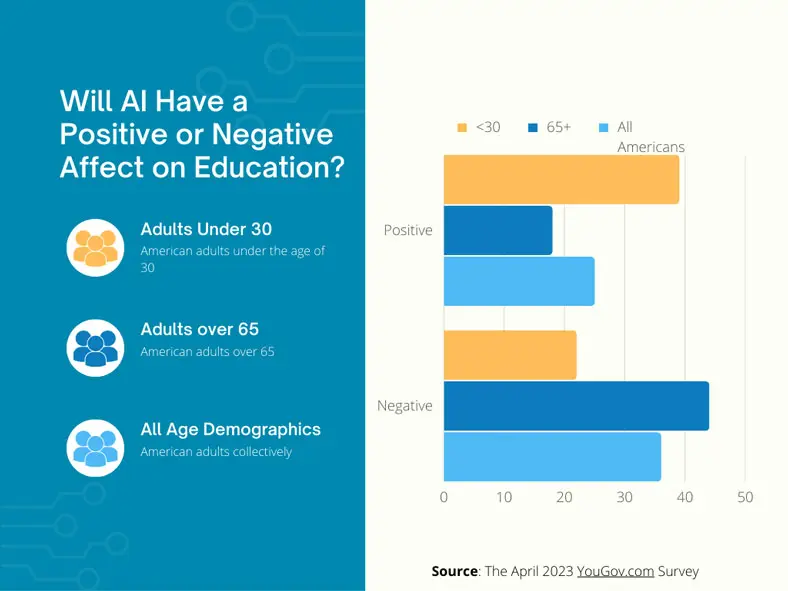
Despite widespread media coverage focusing on academic dishonesty, public sentiment remains surprisingly optimistic about AI’s potential to improve educational systems. According to a comprehensive survey conducted by YouGov, a majority of Americans believe that artificial intelligence will introduce positive challenges to K-12 education, pushing the system to modernize and adapt to a changing technological landscape.
This mirrors historical technological transitions. As OpenAI CEO Sam Altman noted in a recent interview with StrictlyVC:
"We adapted to calculators and changed what we tested for in math class, I imagine. This is a more extreme version of that, no doubt, but also the benefits of it are more extreme, as well."
Quantifying the Benefits: Time Savings and Personalization
For teachers—who notoriously spend hours outside of contracted hours designing lesson plans, differentiating instruction, and grading—AI offers significant relief. Routine administrative tasks that once consumed one to two hours can now be drafted and refined via tailored AI prompts in less than ten minutes.
Key benefits identified by educational researchers include:
Automated Lesson Planning: Rapid generation of foundational lesson outlines, interactive classroom activities, and discussion prompts.
Personalized Tutoring: Acting as a one-to-one tutor for struggling students, breaking down complex literary passages or scientific theories into accessible language.
Differentiated Instruction: Instantly rephrasing difficult-to-understand reading materials to match various reading levels within the same classroom.
Brainstorming and Ideation: Providing students with alternative perspectives on research topics, encouraging divergent thinking and creative problem-solving.
The Limitations: Fact-Checking and Knowledge Gaps
Despite these advantages, integrating generative AI is fraught with technological hurdles. Because large language models generate text based on statistical probabilities rather than a conscious understanding of truth, they are prone to "hallucinations"—fabricating sources, misquoting historical figures, or presenting false data with absolute confidence.
Furthermore, models like standard ChatGPT iterations operate with distinct knowledge cutoffs (such as September 2021 for foundational datasets), making them ill-equipped to provide real-time information without external web-browsing plugins. For educators striving to teach media literacy and rigorous research methodologies, these flaws require constant vigilance and verification.
Official Statements and Pedagogical Frameworks
Educational leaders and institutional bodies have increasingly recognized that sweeping prohibitions are neither sustainable nor effective. In response, they have developed frameworks aimed at turning AI’s inherent flaws into teachable moments.
Transforming AI Inefficiencies into Lessons
Rather than shielding students from the imperfections of generative AI, resourceful educators are designing curricula that require the use of AI tools to critique them. A prime example of this methodology is the AI Fact-Checking and Essay Organization Lesson Plan:
Prompt Generation: High school students are instructed to use an AI writing tool to generate an essay on a specific historical or literary topic.
Critical Analysis: Students read through the AI-generated text, tasked with identifying logical fallacies, weak argumentative structures, and stylistic inconsistencies.
Source Verification: Students must independently fact-check every citation and historical claim produced by the AI, highlighting fabricated sources or distorted data.
Human Revision: Students rewrite and restructure the essay, applying their own critical thinking, authentic voice, and verified research to produce a polished final product.
This approach flips traditional paradigms on their head. By embedding AI directly into classroom exercises, teachers demonstrate that while artificial intelligence is a powerful instrument, it cannot replicate the ingenuity, ethical grounding, and critical intelligence required of human writers.
Future Outlook: Career Security, Salaries, and Professional Growth
As artificial intelligence continues its relentless march forward, natural anxieties persist regarding job security and the future of the teaching profession. Will algorithms eventually replace human educators?
The Irreplaceable Human Element
Industry consensus and labor statistics suggest that teachers face very little risk of displacement. While AI can synthesize text, generate imagery, and organize data, it lacks the foundational capacities that define effective teaching: emotional intelligence, long-term student mentorship, the ability to read non-verbal classroom cues, and the nuance required to adapt instruction to the holistic well-being of a child.
According to data from the U.S. Bureau of Labor Statistics (BLS), the employment outlook for teachers remains stable. High school teacher employment, for instance, is projected to grow by 5% through 2031, keeping pace with the national average for all occupations. Teaching remains a secure, vital career path.
Median Teacher Compensation Across the United States
While salaries vary significantly depending on geographic location, institutional funding, and years of professional experience, median earnings across educational levels remain relatively consistent:
Elementary School Teachers: Stable median earnings reflecting foundational instruction roles.
Middle School Teachers: Comparable compensation structures focused on adolescent developmental transitions.
High School Teachers: Median salaries aligned with specialized subject-matter expertise.
Embracing the Future
To thrive in the algorithmic classroom, educators are encouraged to adopt a mindset of continuous professional development. Educational institutions are increasingly offering specialized workshops, professional learning communities, and advanced degree programs focused on educational technology integration.
As OpenAI CEO Sam Altman remarked regarding detection mechanisms:
"There may be ways we can help teachers be a little more likely to detect output of a GPT-like system. But honestly, a determined person will get around them."
This reality underscores the futility of an arms race centered solely on detection and prohibition. Instead, the future of education lies in proactive adaptation—equipping teachers with the resources, training, and ethical frameworks needed to master artificial intelligence, streamline their workloads, and prepare the next generation of students for a technologically integrated workforce.