
Executive Overview
When young students cross the threshold into an elementary STEM (Science, Technology, Engineering, and Math) classroom, they are rarely just stacking blocks, assembling cardboard contraptions, or talking about simple physics. They are learning an entirely new lexicon—a foundational vocabulary of design, mechanics, force, and motion that will dictate how they understand the engineered world for the rest of their lives.
Traditionally, educators have relied on static worksheets, rote memorization drills, and end-of-unit tests to measure whether this specialized language has taken root. However, for Elisabeth Lainez, a Kahoot! Ambassador and elementary STEM teacher in New York, these traditional methods often acted as barriers rather than bridges to understanding. Recognizing that standard assessments frequently induce anxiety and fail to capture real-time cognitive growth, Lainez turned to a dynamic alternative: game-based formative assessment.
By embedding interactive Kahoot! experiences throughout her engineering and science units, Lainez transformed assessment from a high-stakes penalty box into an integral, low-pressure component of the learning journey. Across multiple grade levels, diverse engineering standards, and complex thematic units—ranging from basic construction mechanisms to earthquakes and biomimicry—this methodology consistently yielded profound results. Students did not merely memorize terms for a single Friday quiz; they built enduring conceptual frameworks, gained the confidence to communicate complex design decisions, and approached hands-on engineering challenges with a shared, authoritative problem-solving language.
This report examines how strategic, iterative formative assessment via game-based platforms is reshaping foundational STEM education, driving measurable academic gains, and empowering young learners to think and speak like professional engineers.
Detailed Chronology: Transforming the STEM Curriculum
To understand the efficacy of Lainez’s instructional model, one must examine how the methodology unfolds across a standard academic timeline. Rather than treating assessment as a terminal event that occurs only at the conclusion of a unit, Lainez weaves interactive digital touchpoints into the very fabric of the curriculum.
Phase 1: Diagnosing the Baseline and Introducing Core Terminology
At the start of the academic year, first-grade students entering Lainez’s STEM lab are immediately introduced to complex engineering techniques and design concepts that they will lean on for months to come. In the past, navigating this influx of specialized vocabulary often left young learners overwhelmed and confused about when and how to apply specific mechanical principles.
To counteract this, Lainez instituted a pre-assessment model using custom-designed kahoots. Serving simultaneously as an engaging low-stakes introduction and a diagnostic tool, these interactive sessions exposed students to foundational terms regarding materials, construction mechanisms, and basic physical forces.
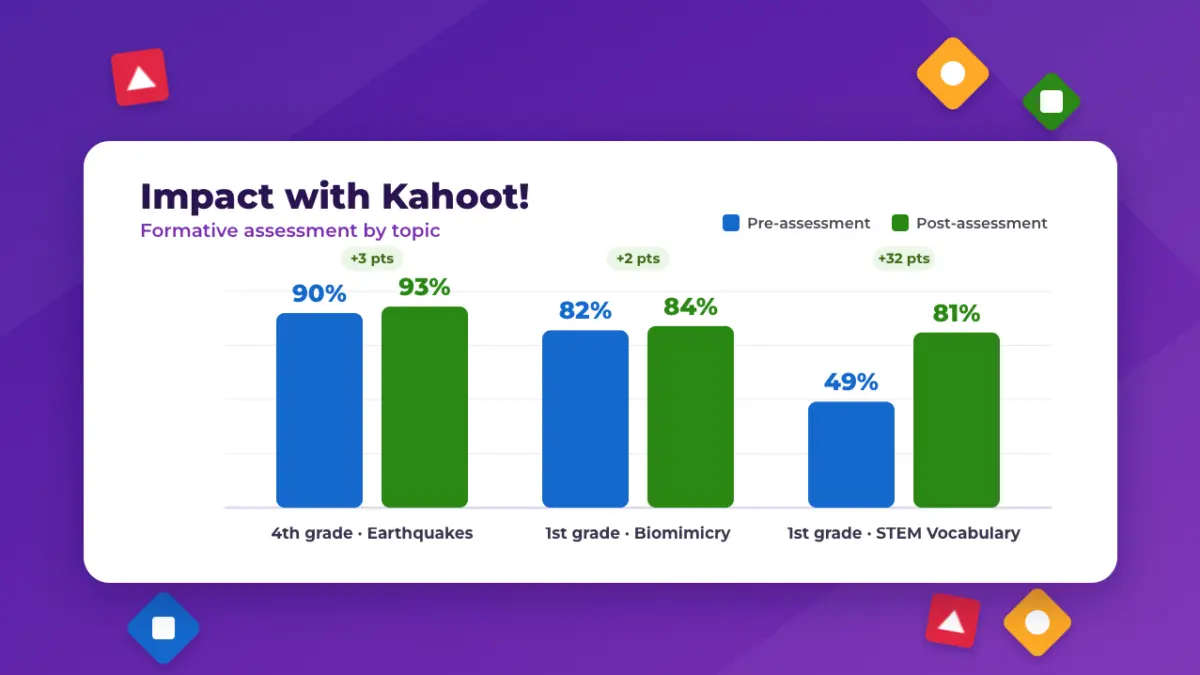
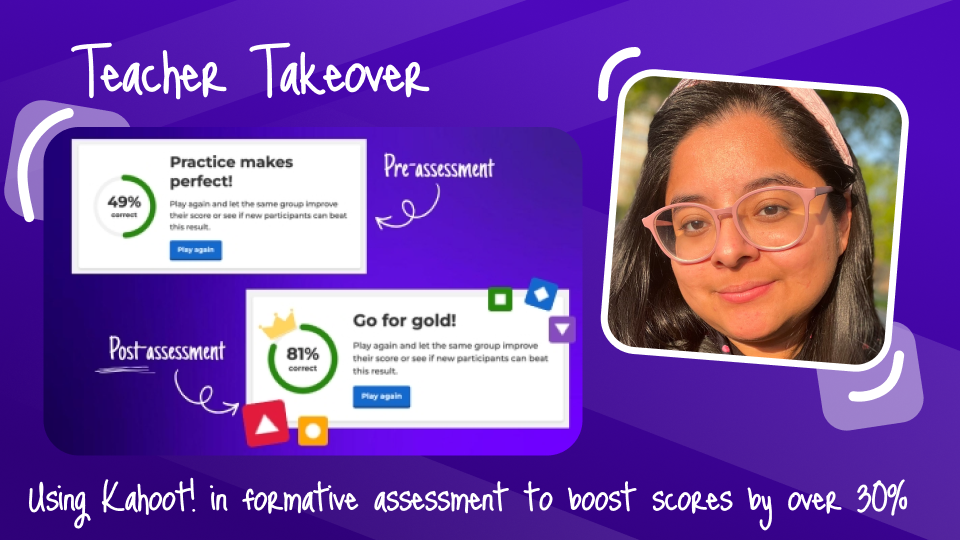
The initial data collected from these pre-assessments consistently confirmed what educators often suspect: young learners possess immense intuitive capability, but their command of formal engineering vocabulary is initially limited. For example, a baseline diagnostic in one primary engineering unit revealed a class average of just 49%. Far from being discouraging, this metric provided Lainez with an empirically clear, actionable starting point for targeted instruction.
Phase 2: Immersive, Multi-Week Instructional Iteration
Once the baseline was established, the curriculum moved into a multi-week phase of deep, hands-on exploration. While the daily content shifted dynamically through explicit teacher modeling, guided practice, collaborative STEM centers, and active engineering challenges, a singular instructional anchor remained constant: Kahoot! served as the primary delivery and review format.
While students engaged in tactile learning—manipulating cardboard, tearing tape by hand, and constructing movable levers and pulleys—their cognitive focus was continually tethered to the vocabulary introduced during the initial game session. Utilizing specialized game modes such as the Treasure Trove experience and flipped-classroom strategies, students interacted with the core material at individual paces tailored to their specific comprehension levels.
Phase 3: The Post-Assessment and Measured Growth
Following weeks of deliberate practice, iterative review, and hands-on application, the students retook the exact same foundational kahoot. The quantitative results were striking: the class average surged from 49% to 81%.
More importantly, the qualitative transformation in the classroom was palpable. Students abandoned hesitant, vague descriptions of their projects and began using precise engineering terminology—words like fulcrum, tension, mechanisms, and structural integrity—to explain their design choices, debate material selections, and collaborate on structural prototypes.
Supporting Context & Metrics: Data-Driven Success Across Grade Levels
While the primary-grade results underscore the power of early intervention, Lainez’s pedagogical approach proved equally transformative when scaled to older elementary students tackling advanced, inquiry-based Earth science units.
Case Study: Fourth-Grade Earthquake Research Unit
During a specialized fourth-grade research unit centered on natural disasters, students were tasked with designing educational projects to teach younger peers about earthquake safety. Every project came with a strict structural requirement: students had to accurately incorporate advanced academic vocabulary related to seismology and structural engineering.
- Initial Diagnostic: Before conducting their research, students completed an interactive kahoot designed to front-load essential scientific language. Uniquely, the class achieved an initial baseline average of 90%, indicating a strong foundational readiness for the material.
- Spaced Retrieval Practice: Rather than moving on, Lainez systematically revisited this exact kahoot multiple times throughout the unit. This deliberate spaced retrieval practice allowed her to monitor long-term retention while anchoring new digital text research in familiar, interactive contexts.
- Mastery Level Achievement: By the conclusion of the research project, repeated exposure and authentic application pushed the class average to 93%, cementing true academic mastery.
| Unit of Study | Target Audience | Initial Baseline Average | Post-Instruction Average | Primary Pedagogical Impact |
|---|---|---|---|---|
| Foundational Engineering | 1st Grade | 49% | 81% | Massive vocabulary acquisition; elevated confidence in articulating design methodologies. |
| Earthquake Safety & Seismology | 4th Grade | 90% | 93% | Reached true mastery through spaced retrieval; precise incorporation of technical science terms. |
| Biomimicry & Nature-Inspired Design | 1st Grade | 82% | 84% | Clarified abstract concepts; replaced time-consuming physical scavenger hunts with focused visual analysis. |
Tackling Abstract Concepts: The Biomimicry Unit
In another pioneering first-grade unit, students explored the concept of biomimicry—the practice of solving human engineering challenges by studying designs found in nature. For young children, biomimicry can easily remain an overly abstract concept.
Previously, Lainez introduced this topic through a classroom scavenger hunt where students matched pictures of animals with human inventions. While popular, the activity presented logistical flaws: it consumed valuable instructional time through physical transition management, and students routinely struggled to articulate the why behind the pairings.
By replacing the scavenger hunt with an interactive kahoot featuring vivid visual examples (such as bullet trains modeled after kingfishers, sticky climbing gloves inspired by geckos, and night-vision tech derived from feline eyes), Lainez streamlined the learning process. The digital platform allowed for immediate visual presentation, rich whole-class dialogue, and instantaneous formative checks.
The quantitative metrics reflected this efficiency: students scored an average of 82% on the initial biomimicry check, rising to 84% on the follow-up. Though the numerical delta was modest, the qualitative shift was undeniable. Students entered their hands-on design challenges with a sophisticated, concrete understanding of how biological adaptations spark technological innovation.
Official Statements & Pedagogical Insights
The success of this game-based formative assessment framework highlights a broader shift in modern education: the democratization of high-level academic language for young learners.
Reflecting on her classroom observations, Elisabeth Lainez emphasizes that the true value of consistent, low-stakes digital assessment extends far beyond report card metrics.
"Students were more confidently using engineering terminology to explain design decisions, discuss materials, and communicate their thinking throughout the engineering process," Lainez notes.
By removing the fear traditionally associated with testing, platforms like Kahoot! allow students to view mistakes not as failures, but as vital data points in an iterative design cycle. This mindset mirrors the very essence of engineering itself: prototype, test, analyze, and redesign.
Furthermore, Lainez highlights how replacing cumbersome physical activities with targeted digital explorations optimizes instructional time without sacrificing engagement:
"Replacing the scavenger hunt with an interactive kahoot created opportunities to present clear visual examples, facilitate rich classroom discussion, and quickly check for understanding before students began designing."
Educational researchers point out that maintaining a uniform learning environment between pre-assessments, instructional reviews, and post-assessments dramatically reduces confounding variables. Because the medium, format, and conceptual presentation remain consistent, educators can isolate knowledge gaps with surgical precision, tailoring their instructional interventions to exact student needs.
Future Outlook: The Evolution of Formative Assessment in STEM
As schools nationwide increasingly prioritize STEM and STEAM (Science, Technology, Engineering, Arts, and Mathematics) programming from pre-kindergarten upward, the demand for scalable, effective assessment strategies has never been higher. Traditional testing models are rapidly giving way to continuous, embedded evaluation frameworks that respect the cognitive realities of young learners.
The methodology pioneered by educators like Elisabeth Lainez points the way toward the future of technology-integrated classrooms. Key trends shaping this horizon include:
- Micro-Assessments as Learning Tools: Moving away from monolithic end-of-term exams in favor of frequent, low-stakes digital check-ins that reinforce memory retention through spaced retrieval.
- Pedagogical Consistency: Utilizing single software ecosystems across multiple phases of a unit (diagnosis, guided practice, application, and evaluation) to minimize cognitive load and eliminate testing anxiety.
- Empowering Student Agency: Leveraging gamified pathways—such as self-paced digital adventures and interactive exploration modes—to let students engage with complex scientific concepts at speeds optimized for their personal comprehension.
- Vocabulary as an Equity Tool: Ensuring that all students, regardless of socioeconomic background or prior exposure, gain early, equitable access to the rigorous academic language required for future careers in science and engineering.
Ultimately, the transformation witnessed in Lainez’s New York classroom demonstrates that when formative assessment is reimagined as an exciting, supportive, and integral part of the daily learning process, test scores become secondary to a far more important outcome. Success is no longer defined by how well a student fills out a bubble sheet, but by whether they possess the language, the critical thinking skills, and the quiet self-assurance to step up to a pile of raw materials, look a complex problem in the eye, and design a solution like a true engineer.

