
EXECUTIVE OVERVIEW
In the landscape of modern early childhood education, bridging the gap between foundational literacy development and engaging classroom play remains one of the most critical challenges for educators. Phonological awareness—the ability to recognize and manipulate the spoken parts of sentences and words, such as syllables, onsets, and rimes—is widely recognized by literacy experts as a primary predictor of future reading success. However, delivering this vital instruction to pre-kindergarten and kindergarten students without resorting to tedious, rote memorization requires creativity, ingenuity, and targeted instructional design.
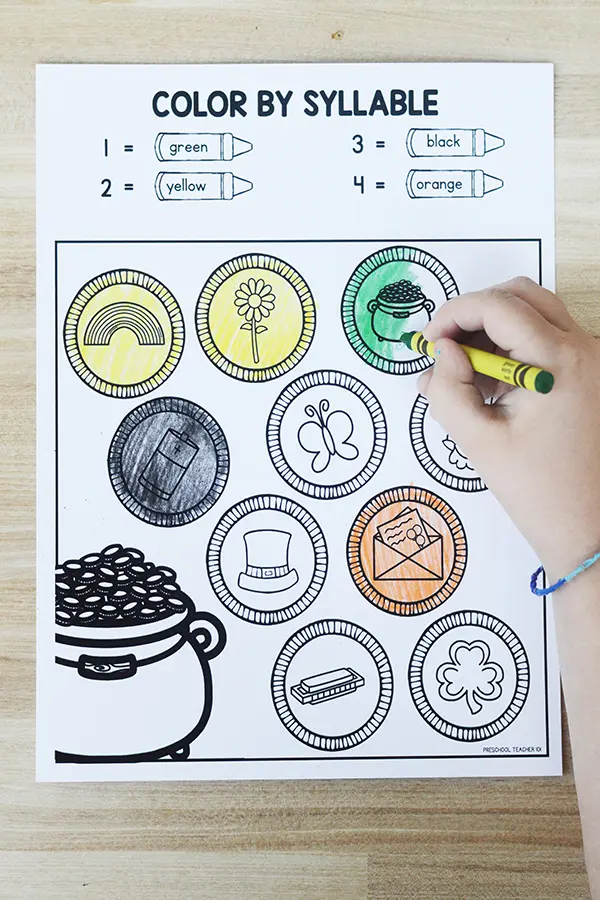
Enter the burgeoning genre of seasonal, no-prep educational printables, exemplified by the newly released St. Patrick’s Day Color by Syllable activity packet and its comprehensive yearlong counterpart. Designed specifically for early learners in preschool through kindergarten, these resources harness the motivational power of holiday-themed color-by-code mechanics to teach word segmentation and syllable counting. By embedding cognitive literacy tasks within familiar, enjoyable artistic routines, these tools offer a scalable, highly adaptable solution for literacy centers, take-home practice modules, and fast-finisher classrooms. This report explores the pedagogical foundations of these innovative learning aids, examines their structural utility within modern classrooms, and evaluates the broader implications of gamified phonological instruction.

The Pedagogical Imperative: Understanding Phonological Awareness in Early Learners
Long before children learn to map letters to sounds through phonics, they must first tune their ears to the sounds of spoken language. Phonological awareness is an umbrella term that encompasses several skills, ranging from rhyming and alliteration to the more complex tasks of blending and segmenting syllables. Among these, the ability to break words down into individual syllables is a crucial stepping stone.
When a child taps out the beats in a word like "sham-rock" (two syllables) or "leprechaun" (three syllables), they are developing cognitive flexibility regarding word structures. Research in cognitive psychology and educational science consistently demonstrates that children with strong phonological awareness acquire reading and spelling skills more rapidly and with greater comprehension than peers who struggle to hear sound segments.
Despite its importance, teaching phonological awareness can be difficult. Young children have varying attention spans, and abstract concepts like "syllables" can feel disconnected from their immediate reality. Traditional worksheets often fail to engage pre-K and kindergarten learners, leading to behavioral friction and reduced retention. To counter this, educators and curriculum designers have increasingly turned to multi-sensory and gamified approaches. The St. Patrick’s Day Color by Syllable framework leverages this exact philosophy, transforming a cognitive auditory task into a visual, tactile, and rewarding artistic exercise.

Inside the St. Patrick’s Day Color by Syllable Toolkit
Developed as part of a broader, holiday-inspired color-by-code series, the St. Patrick’s Day edition provides a targeted intervention for young learners mastering syllable segmentation. The resource is structured to require minimal preparation from educators—a vital consideration given the time constraints placed on modern teachers.
Key Structural Features of the Printable Set:
- Zero-Prep Implementation: Teachers can simply print and distribute the sheets, making them ideal for morning work, independent literacy centers, or emergency substitute teacher folders.
- Differentiation Options: Recognizing that classrooms house children at various developmental stages, the pack includes multiple versions and difficulty tiers. This allows educators to scale tasks according to individual student needs—whether a child is just beginning to isolate single-syllable words or is ready to tackle complex four- and five-syllable vocabulary.
- Thematic Integration: By anchoring literacy practice to culturally recognized seasonal motifs, the activity taps into children’s natural curiosity and enthusiasm for holidays.
Before deploying these sheets independently, pedagogical best practices dictate that educators first introduce the vocabulary terms featured in the illustrations. Ensuring children understand the meaning of the spoken words ensures that the exercise remains a test of phonological awareness rather than an exercise in vocabulary guessing. Once the words are familiar, students count the syllables, match the count to the corresponding color code, and reveal the hidden holiday image stroke by stroke.
Scaling Success: The Comprehensive Yearlong Framework
While holiday-specific printables offer timely engagement, the necessity for continuous, cyclical phonological practice has driven the expansion of these tools into a full yearlong curriculum. The comprehensive Color by Syllable set extends the St. Patrick’s Day methodology across the entire academic calendar, ensuring that foundational literacy practice remains fresh, relevant, and seasonally aligned from August through June.

+-----------------------------------------------------------------+
|               YEARLONG PHONOLOGICAL PROGRESSION                 |
+-----------------------------------------------------------------+
|  [Fall/Winter]      -->  [Spring/Summer]    -->  [Mastery]      |
|  Leaves, Snowflakes     Shamrocks, Flowers       Multi-Syllable |
|  & Holiday Motifs       & Outdoor Themes         Independence   |
+-----------------------------------------------------------------+
Spanning 33 distinct pages, this exhaustive collection targets syllable recognition ranging systematically from one to five syllables. By altering the thematic backdrop—transitioning from autumn leaves and winter snowflakes to spring shamrocks, summer suns, and back again—the curriculum prevents student fatigue while reinforcing core neural pathways associated with phonological processing.
Furthermore, these materials are distributed through prominent educational networks, including dedicated teacher resource platforms and marketplaces like Teachers Pay Teachers, ensuring seamless integration into existing digital and physical classroom ecosystems. For schools utilizing structured lesson plan frameworks—such as the comprehensive guides offered through Preschool Teacher 101—these color-by-code activities slot effortlessly into existing thematic units.
Expert Perspectives and Instructional Best Practices
To evaluate the true efficacy of color-by-syllable resources, education specialists emphasize the importance of scaffolding. Literacy coaches advise that printables should never serve as isolated "busy work," but rather as reinforcing components of a balanced literacy diet.

"When children color by syllable, they are engaging both hemispheres of the brain," notes an early childhood literacy consultant. "The auditory and analytical processing required to segment a word is anchored by the fine-motor control and visual gratification of coloring. It turns a solitary worksheet into an active learning experience."
Recommended Implementation Strategies for Educators:
- Interactive Modeling: Before turning students loose on an independent center, teachers should model the segmentation process aloud. Clapping, tapping, or using physical counters (such as math chips or unifix cubes) helps cement the concept of syllable beats.
- Peer Collaboration: Allowing children to work in pairs during literacy centers promotes peer-to-peer linguistic scaffolding. Children often articulate sound segments to one another in ways that reinforce mutual understanding.
- Formative Assessment: Completed color-by-syllable sheets double as rapid assessment tools. Educators can quickly scan a finished sheet to identify which students consistently miscalculate syllable counts, allowing for targeted small-group interventions the following day.
Future Outlook: The Evolution of Play-Based Literacy Tools
As educational technology and print-based pedagogy continue to evolve, the demand for high-yield, low-friction instructional resources is projected to grow. Teachers are increasingly overwhelmed by administrative burdens, making ready-to-use pedagogical assets indispensable.
The success of programs like the Color by Syllable series points toward a broader trend in early childhood education: the purposeful gamification of foundational skills. Rather than viewing play and rigorous academic instruction as mutually exclusive, modern curriculum designers are proving that deep cognitive work—such as phonological awareness training—is most effective when embedded within joyful, creative experiences.

Looking ahead, the integration of seasonal printables with broader thematic unit studies will likely remain a staple of pre-K and kindergarten classrooms. By making skill practice enjoyable, accessible, and pedagogically sound, resources like the St. Patrick’s Day literacy packets ensure that the "luck of the Irish" has very little to do with how well children learn to read—instead, it is the direct result of thoughtful, intentional, and engaging educational design.

