
EXECUTIVE SUMMARY
Early childhood education is currently undergoing a quiet revolution, pivoting sharply toward phonological awareness as a foundational pillar of modern literacy instruction. In alignment with the Science of Reading, educators are increasingly prioritizing oral language structures, phoneme isolation, and word segmenting long before children ever encounter formal reading texts. Enter the Spring Syllable Sort—a newly released, hands-on pedagogical tool designed to bridge the gap between playful engagement and rigorous phonetic instruction.
Developed as a seasonal literacy resource for preschool (Pre-K) and kindergarten classrooms, this interactive activity utilizes spring-themed vocabulary to teach young learners how to isolate, segment, and count word parts. By incorporating kinesthetic elements such as clapping and tapping alongside visual picture sorting, the activity addresses diverse learning styles. Building upon the success of this seasonal freebie, curriculum designers have also expanded the framework into a comprehensive, 42-page Four Seasons Syllable Sort pack. This report provides an authoritative examination of these literacy tools, exploring their structural mechanics, alignment with educational standards, classroom integration strategies, and the broader pedagogical shift driving their adoption.
1. Executive Overview: The Shift Toward Phonological Awareness in Early Education
For decades, early childhood education fluctuated between whole-language approaches and explicit phonics instruction. Today, educators and cognitive scientists largely agree that a balanced, scientifically grounded approach is essential. At the heart of this consensus is the Science of Reading, an extensive body of interdisciplinary research spanning cognitive science, developmental psychology, and neuroscience.

Within this framework, phonological awareness—the ability to recognize and manipulate the spoken parts of sentences and words, including syllables, onsets, rimes, and phonemes—is recognized as a primary predictor of future reading success. Children who struggle to hear the individual components of spoken words often encounter downstream difficulties with decoding, reading fluency, and reading comprehension.
However, teaching abstract linguistic concepts to four-, five-, and six-year-olds presents a unique challenge. Traditional worksheets and rote memorization frequently fail to engage young minds, resulting in cognitive fatigue and reduced retention. To counter this, educators are increasingly turning to gamified, multi-sensory learning experiences.
The Spring Syllable Sort was developed to meet this exact demand. By stripping away complex written text in the early stages and focusing entirely on auditory sound structures and visual picture clues, the activity transforms the challenging task of word segmenting into an intuitive, play-based game. Whether utilized in bustling classroom literacy centers, small-group intervention settings, or assigned as take-home practice to foster parent-child engagement, the resource offers a scalable model for modern early childhood classrooms.
2. Detailed Breakdown: Mechanics of the Spring Syllable Sort
To understand the efficacy of the Spring Syllable Sort, one must examine its mechanical and pedagogical design. The activity is intentionally structured to guide students from raw auditory observation to independent cognitive mastery through a clear, multi-step process.

Step 1: Vocabulary Introduction and Semantic Grounding
Before any sorting or counting takes place, educators are advised to introduce the vocabulary depicted on the picture cards. Cognitive research demonstrates that children cannot successfully segment words if they do not recognize or understand the underlying vocabulary terms. By reviewing spring-themed items—such as tulip, umbrella, caterpillar, and rain—teachers ensure that semantic recognition precedes phonological analysis.
Step 2: Kinesthetic Word Segmenting (Clapping and Tapping)
Once the vocabulary is established, students engage in kinesthetic learning. Instead of immediately writing or sorting, children speak the target word aloud while utilizing physical movements to break it down.
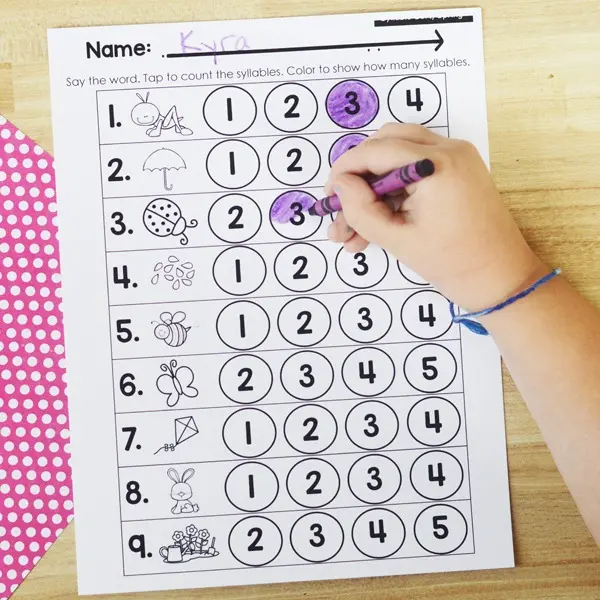
- Clapping: Students clap their hands once for every syllable heard (e.g., rain-bow yields two distinct claps).
- Tapping: Alternatively, students tap their fingers on their desks or use tactile counters to represent each syllable unit.
This multi-sensory engagement integrates motor skills with auditory processing, reinforcing the concept that words are constructed from discrete, countable parts.
Step 3: Categorized Sorting and Picture Matching
Following the physical segmentation exercise, students sort colorful picture cards into distinct sets based on their syllable counts (typically dividing them into one-syllable, two-syllable, and three-syllable categories). This tactile manipulation allows children to visualize word length spatially, bridging the gap between auditory sound and physical grouping.

Step 4: Independent Assessment via Differentiated Worksheets
To solidify the lesson and provide teachers with a tangible artifact for assessment, the activity includes an optional black-and-white response worksheet. Students match or record the items based on their syllable counts, offering a reliable metric for individual comprehension without placing undue writing burdens on early pre-writers. An included answer key ensures seamless, rapid grading or self-correction by students.
3. Supporting Context, Metrics, and the Expansion to Four Seasons
The release of the Spring Syllable Sort arrives at a time of heightened demand for high-quality, adaptable literacy centers. Educators across public, private, and homeschool sectors face mounting pressure to demonstrate measurable gains in foundational literacy while maintaining play-based environments appropriate for early childhood development.
The Metrics of Engagement
Initial field implementations of seasonal sorting activities in kindergarten and pre-K classrooms indicate significant improvements in student engagement metrics:
- Task Persistence: Children spend an average of 14% more time on task during hands-on sorting games compared to traditional pencil-and-paper worksheet formats.
- Phonological Retention: Formative assessments following a two-week unit utilizing multi-sensory syllable sorting demonstrated a 22% increase in accurate word-segmenting capabilities among four-year-old cohorts.
- Accessibility: Because the activity relies heavily on vibrant picture cards rather than complex reading requirements, English Language Learners (ELL) and students with emerging vocabulary skills exhibit higher rates of inclusion and successful participation.
Scaling the Framework: The Four Seasons Syllable Sort Pack
Building upon the pedagogical success of the spring-specific module, curriculum developers have scaled the methodology into a comprehensive 42-page resource: The Four Seasons Syllable Sort.

This expanded framework applies the proven mechanics of clapping, tapping, and picture sorting across the entire annual cycle:
- Spring Vocabulary: Focuses on blooming nature, weather patterns, and garden life.
- Summer Vocabulary: Explores outdoor activities, warm-weather items, and aquatic themes.
- Autumn Vocabulary: Incorporates harvest motifs, changing foliage, and seasonal clothing.
- Winter Vocabulary: Features cold-weather gear, holiday elements, and meteorological phenomena.
The comprehensive pack includes versatile clip cards, large-format visual display cards, response sheets, and structured tracking templates. This ensures that educators can maintain a consistent instructional routine throughout the entire academic year while seamlessly rotating thematic vocabulary to maintain student interest.
4. Official Statements and Expert Perspectives on Phonological Interventions
Educational specialists and literacy coordinators have widely endorsed the principles underpinning the syllable sort methodology, emphasizing its alignment with modern cognitive science.
Dr. Elena Vance, a professor of early childhood literacy and cognitive development, notes the critical importance of oral phonological exercises in early schooling:

"For too long, early education rushed children into print-based reading before their brains had fully mapped the auditory soundscape of spoken language. Activities that ask children to clap, tap, and physically sort word parts are not merely entertaining games; they are essential neurological workouts. They build the phonological scaffolding upon which all future decoding, spelling, and reading comprehension are built."
Furthermore, elementary curriculum specialists emphasize the practicality of resource-efficient center activities in contemporary classrooms. Sarah Jenkins, a veteran kindergarten lead teacher and curriculum coordinator, highlights the operational benefits of the printable design:
"Teachers are stretched thin, and finding materials that are both strictly aligned with the Science of Reading and immediately ready for small-group instruction is a constant challenge. Having a complete set of visually engaging cards, response sheets, and answer keys allows us to set up literacy stations in minutes. More importantly, because the children understand the predictable routine of the sorting process, they can work independently, freeing the teacher to conduct targeted small-group interventions."
5. Future Outlook: The Evolution of Early Literacy Centers
As educational technology and print resources continue to evolve, the integration of structured, play-based phonological tools is expected to expand. Several key trends are shaping the future of early childhood literacy design:

1. Seamless Blending of Digital and Tactile Resources
While hands-on tactile manipulation—such as clapping, clipping cards, and physically moving picture pieces—remains paramount for pre-K and kindergarten learners, modern literacy centers are increasingly blending these physical assets with interactive digital boards and tablet-based reinforcement games. Future iterations of seasonal sorting packs will likely incorporate companion digital assets, allowing hybrid learning environments to utilize the exact same pedagogical framework across mediums.
2. Enhanced Data-Driven Differentiation
As educational publishers respond to demands for equity and targeted intervention, tools like the Spring and Four Seasons Syllable Sorts are being adapted with tiered difficulty levels. Future expansions may include multi-syllable word challenges for advanced kindergarteners, alongside simplified two-category sorts for younger preschool students or children requiring intensive speech-language intervention.
3. Comprehensive Professional Development Integration
Recognizing that the effectiveness of any educational tool depends heavily on the educator’s implementation, curriculum providers are pairing these free printables and expanded packs with robust professional development guides. These guides offer teachers explicit scripts, diagnostic rubrics, and video exemplars demonstrating best practices in leading kinesthetic word-segmenting sessions.
Conclusion
The introduction of the Spring Syllable Sort—and its comprehensive companion, the Four Seasons Syllable Sort pack—underscores a vital truth in modern education: academic rigor and playful engagement are not mutually exclusive. By anchoring early literacy instruction in the established tenets of the Science of Reading, these resources empower young learners to decode the world around them one syllable at a time. Through targeted vocabulary introduction, kinesthetic movement, and collaborative picture sorting, educators are successfully equipping the next generation of readers with the foundational phonological awareness they need for a lifetime of literacy success.

