By Lia Milgram, Managing Editor for ACTE Published in partnership with the Association for Career and Technical Education (ACTE)
Executive Overview
From September 2025 through May 2026, Techniques magazine—the flagship publication of the Association for Career and Technical Education (ACTE)—embarked on a rigorous, year-long journalistic exploration of the most pressing questions facing modern Career and Technical Education (CTE). As ACTE proudly marks a monumental century of service, advocacy, and educational leadership, the core challenges of workforce training feel more urgent and relevant than ever.
What does it truly take to construct educational pathways that reach every single learner, regardless of their background or systemic barriers? How do physical learning spaces, classroom environments, and hands-on experiences actively shape what students believe is possible for their futures? And how can educators, administrators, and industry leaders combat outdated stigmas to ensure that skills-based education is recognized as a primary engine of economic mobility?
The definitive archive of this academic year is captured in eight landmark articles. Moving beyond standard program evaluations and statistical summaries, these stories center squarely on the human element: the educators who innovate in under-resourced classrooms, the program leaders who redesign physical facilities to inspire ambition, the advocates who translate student success into hard data for policymakers, and the students who refuse to let historical disadvantages define their trajectories. This retrospective explores how these eight defining narratives recorded a pivotal year in CTE history—a year defined by a century of legacy and a relentless drive toward the future.
Detailed Chronology: A Year of Defining CTE Stories
The narrative arc of the 2025–2026 academic year unfolded across eight distinct monthly chapters, each tackling a specialized frontier in career and technical education.
September 2025: Skills Over Stigma
High-quality CTE functions as a promise to students: learn a high-demand trade, master a technical craft, and secure a viable, dignified economic future. However, for justice-impacted learners, the stakes of that promise are exponentially higher, and the systemic barriers are starkly real.
The September feature opened the publishing year with a powerful perspective written by an author who knows the terrain firsthand. Having experienced the justice system directly and transitioned into professional education and reentry advocacy, the writer made a compelling, undeniable case for building pathways that prioritize skills over stigma. By dismantling the punitive biases that often shut formerly incarcerated individuals out of the workforce, the article highlighted how targeted CTE programs can successfully bridge the gap between incarceration and sustainable, community-anchored employment.
October 2025: Leading the Change
As public perception slowly shifts, the overarching narrative around CTE is undergoing a massive transformation. Leading this charge are the alumni of the NextLevel Postsecondary CTE Fellowship. Hailing from diverse institutions of all sizes across the nation, these dynamic leaders are rewriting the playbook for modern technical education.
In October, Techniques celebrated these educational leaders who refuse to accept outdated perceptions of "vocational" training. Interestingly, these change-makers point to an unexpected source of wisdom: their own students. By listening closely to the evolving needs of the modern learner, these fellows are successfully constructing flexible, high-rigor pathways that meet the demands of a rapidly modernizing global economy.
Work-based learning (WBL) is universally praised as a cornerstone of CTE, but its true efficacy depends entirely on its execution. When WBL is rigid and prescriptive, it often fails to engage students. Conversely, when it is student-centered, it encourages learners to deeply explore their authentic interests.
The winter double-issue explored the reality that meaningful career exploration requires the freedom to question, refine, and occasionally redirect one’s path. Because career clarity looks radically different for every student, this installment examined the precise pedagogical frameworks required to design flexible experiences that meet students precisely where they are—and gracefully guide them toward what is possible.
January 2026: High-Quality CTE By Design
Wraparound supports—such as mental health counseling, housing assistance, childcare, and transportation subsidies—are frequently treated as optional, supplemental add-ons in education. The January 2026 feature dismantled this deficit mindset, arguing that holistic supports are fundamentally central to maintaining student engagement and program completion.
When institutions embed wraparound services directly into program design from day one, a profound transformation occurs. Retention rates climb, student stress plummets, and the local communities counting on a steady pipeline of skilled talent reap the long-term rewards. This article offered a tactical look at how institutions can institutionalize these vital supports without stretching already-fragile budgets to the breaking point.
February 2026: Meaningful Student Experiences Through Facilities Design
The physical environment of a classroom communicates volumes before a single lesson is taught. The strongest CTE programs begin with a clear curricular vision, and the physical spaces housing them must reflect that ambition.
Rather than advocating for multi-million-dollar capital campaigns and new construction—which many districts simply cannot afford—the February feature provided a practical, highly actionable roadmap for facilities design. By taking a fresh, critical look at existing spaces, educators and administrators can reconfigure labs and workshops to help students instantly visualize themselves in high-tech, modern careers the moment they walk through the door.
March 2026: A Century of Storytelling and Advocacy
Data is undeniably essential for making the fiscal case for CTE to legislators and school boards, but human stories are what make people remember why it matters. As ACTE celebrated its milestone 100th anniversary, the March issue explored how the Association is leveraging the emotional resonance of documentary filmmaking as a powerful tool for advocacy.
By translating dry programmatic metrics into compelling human narratives, this storytelling approach makes the impact of CTE visible, relatable, and deeply personal. It bridges a century of foundational educational leadership with the modern students, educators, and community partners who are actively writing the next chapter of the movement.
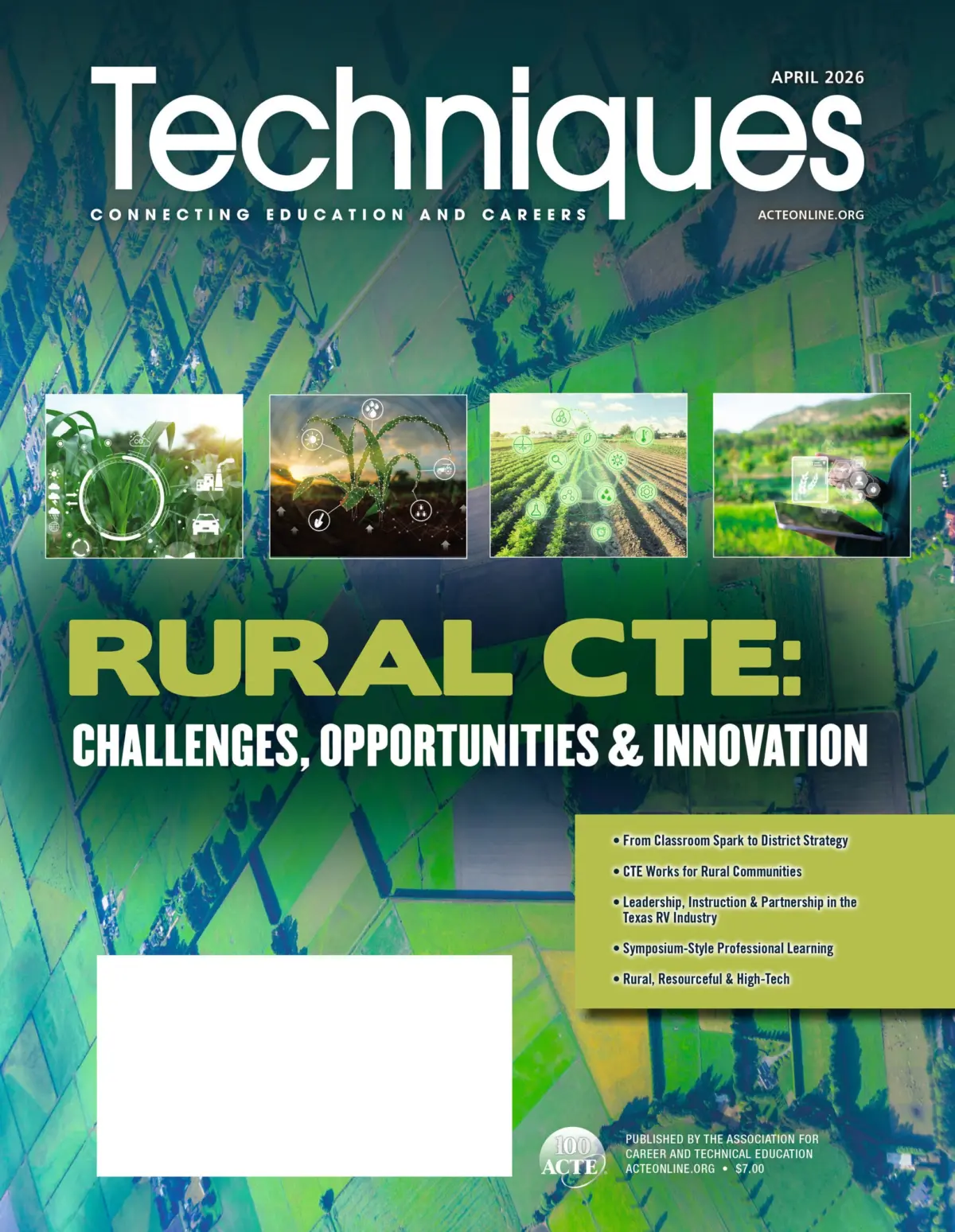
April 2026: Navigating Challenges and Opportunities in Rural CTE
Rural CTE programs face severe, systemic headwinds. Shrinking local populations, diminishing workforce numbers, and dwindling municipal services mean that rural schools frequently operate on the precipice of closure.
The April feature delivered a much-needed operational lifeline by offering a practical framework that helps rural administrators translate qualitative program impact into hard, quantitative data. By effectively articulating return on investment (ROI), rural educators can secure critical funding. The resulting narrative transcends standard graduation rates, directly tying student success to broader regional workforce development and long-term community survival.
May 2026: Ending the "Revolving Door" of Teacher Retention
The crisis of teacher burnout is well-documented, but in CTE, the challenge is uniquely complex: schools are trying to recruit and retain high-demand industry experts who could often make significantly more money working directly in the private sector.
Highlighting a cautionary tale of a former insurance professional who transitioned to a CTE teaching career only to resign two days into the school year, the May feature diagnosed a systemic pattern of early burnout. Drawing on original research, the author presented CTE administrators with a blueprint to stop the "revolving door." The core finding was clear: when teacher induction is treated as an immersive, ongoing professional experience rather than a superficial HR checklist, industry experts stay. And when expert educators stay, programs and students thrive.
Supporting Context and Metrics
To fully understand the weight of the stories featured in Techniques throughout the 2025–2026 publishing cycle, one must examine the broader socio-economic landscape of American education:
The Skills Gap: Industry analysts project millions of unfilled middle-skills jobs over the next decade due to a widening skills gap. Robust, high-quality CTE programs are the single most effective pipeline to fill these critical roles in healthcare, advanced manufacturing, information technology, and green energy.
The Power of Retention: Research highlighted across the academic year emphasizes that student retention is no longer solely a function of academic rigor; it is directly tethered to the presence of wraparound services, inclusive admissions policies (such as those supporting justice-impacted individuals), and mentorship from industry-connected educators.
Facilities and Mindshare: Environmental psychology studies cited in modern educational design suggest that students exposed to updated, professional-grade technical labs exhibit higher self-efficacy and confidence in their career choices compared to those trained in obsolete, poorly maintained spaces.
Official Statements and Perspectives
Reflecting on the monumental milestone of ACTE’s centennial and the year-long editorial journey of Techniques, organizational leaders emphasized the enduring mission of career and technical education:
"The best CTE stories are never only about programs. They are about the people inside them—what they built, what they believed, and what they refused to give up on," noted the editorial board of Techniques as they framed the Year in Review.
Furthermore, ACTE leadership has continually stressed that as the association enters its second century, the integration of storytelling, rigorous data analysis, and holistic student support will serve as the holy trinity of successful educational advocacy. By proving the tangible return on investment of rural and urban programs alike, ACTE continues to position technical education not as an alternative to traditional academics, but as an indispensable pillar of modern American progress.
Future Outlook: The Next Century of CTE
As the ink dries on the 2025–2026 volume of Techniques, the horizon for Career and Technical Education looks both demanding and profoundly hopeful. The lessons cataloged over these eight months—from reforming teacher induction pipelines and designing student-centered work-based learning, to humanizing rural data metrics and embracing justice-impacted learners—provide a robust roadmap for the decade ahead.
The challenges of dwindling resources, rural community pressures, and stubborn social stigmas have not vanished entirely. However, armed with the tactical frameworks, innovative facility designs, and inspiring human stories documented by ACTE over this centennial year, educators and program leaders are better equipped than ever to face them. The next century of CTE has officially begun, and if this year’s review is any indication, the movement will be defined by an unwavering refusal to lower the bar for any student.
For those interested in contributing to the upcoming publishing cycle, learning opportunities, or submitting work for future Year in Review editions, please consult the official ACTE Techniques Editorial Calendar.