
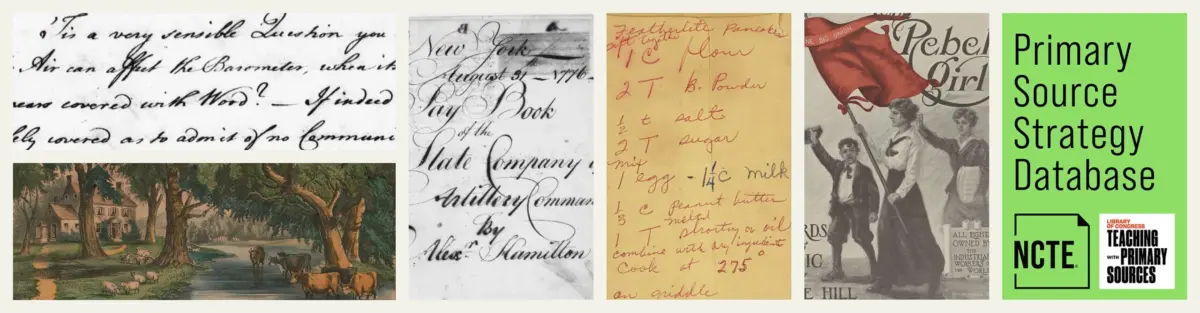
Executive Overview
In an era defined by rapid digital consumption, shifting media landscapes, and an ongoing national dialogue about media literacy, educators face a monumental challenge: teaching students not just what to think, but how to think critically. Enter a powerful, multifaceted collaborative initiative between the National Council of Teachers of English (NCTE) and the Library of Congress.
As part of the prestigious Teaching with Primary Sources (TPS) Consortium, the NCTE has spearheaded an ambitious national effort to integrate digitized historical artifacts directly into the daily habits, curricula, and pedagogical strategies of English Language Arts (ELA) teachers and students nationwide. At the heart of this initiative is a newly expanded, highly searchable digital database featuring pedagogical strategies for over 150 specific items culled from the Library of Congress’s vast, unparalleled archives.
Developed by more than two dozen distinguished educators and ELA curriculum leaders, the database bridges the gap between raw historical archives and modern classroom instruction. These resources articulate specific literacy merits—ranging from rhetorical analysis to foundational argument construction—while mapping directly to state-level educational standards.
By leveraging smart, user-friendly tags such as picture book and argument, educators can instantly source high-impact materials that transform passive learners into active historical investigators. This article explores the mechanics of this groundbreaking partnership, examines a representative historical artifact from the database—an 1851 defense of the controversial "Bloomer costume"—and evaluates the profound implications of this work for the future of American education.
Detailed Chronology: The Evolution of the TPS Partnership and the 1851 "Bloomer Costume" Case Study
To understand the scale and precision of the NCTE-Library of Congress initiative, one must look at both the macro-level timeline of the partnership and the micro-level implementation of individual primary sources within the classroom.
The Macro Timeline: Bridging Archives and Classrooms
- Foundation of the TPS Program: The Library of Congress established the Teaching with Primary Sources program to help educators use its digitized collections to enhance student learning. Over the years, the program expanded into a robust consortium of universities, foundations, and educational organizations.
- The NCTE Partnership Integration: Recognizing a vital synergy between historical archival research and English Language Arts pedagogy, the NCTE integrated itself deeply into the TPS Consortium. The goal was clear: move history out of dusty textbooks and place raw, primary source documentation into the hands of language arts students to sharpen critical reading, writing, and rhetorical analysis skills.
- Database Expansion and Educator Collaboration: More than 24 master teachers and ELA leaders convened to design, test, and vet instructional strategies for over 150 distinct Library of Congress items. The resulting database was optimized with tagging architecture, ensuring immediate utility for teachers searching by format (e.g., picture books, letters, broadsides) or rhetorical skill (e.g., counterarguments, persuasive techniques).
Micro Case Study: "The New Costume" (1851)
To appreciate how these resources operate in practice, consider one of the crown jewels of the database: an 1851 letter to the editor published in The Mountain Sentinel titled "The New Costume."
- The Historical Spark: In the mid-19th century, women’s fashion was dictated by heavy, restrictive Victorian garments—namely, whalebone corsets, voluminous petticoats, and heavy skirts that severely limited physical mobility and compromised health. While credited to Elizabeth Smith Miller, the radical new alternative—a knee-length dress worn over loose trousers—was aggressively popularized by women’s rights advocate Amelia Bloomer through her feminist publication, The Lily.
- The Primary Source Artifact: The 1851 letter discovered in The Mountain Sentinel and cataloged in the NCTE database was written by a supporter signing under the pseudonym "Amicus." The letter passionately defends the "Bloomer costume" against a wave of societal backlash, ridiculing critics who deemed the attire immodest or unfeminine while championing its undeniable health benefits, ergonomic comfort, and symbolic alignment with bodily autonomy.
- The Classroom Integration: Rather than simply reading a textbook paragraph stating that "women wore trousers in the 1850s and faced criticism," ELA students read "Amicus’s" actual polemical letter. They trace how the author constructs a counter-argument, utilizes loaded rhetorical devices to dismantle patriarchal dress codes, and engages directly with contemporary critics.
Supporting Context & Metrics: The Pedagogical Engine Behind the Database
The effectiveness of the NCTE and Library of Congress initiative is rooted in rigorous alignment with state and national learning standards. The database does not merely provide cool historical trivia; it delivers hard, standards-based academic rigor designed to elevate student performance in reading informational texts (RI) and crafting evidence-based arguments.
State Standards Mapping: A Closer Look
Using the 1851 "Bloomer Costume" letter as a benchmark, the instructional frameworks provided by the database map directly onto advanced secondary education standards, such as those implemented by the Missouri Department of Elementary and Secondary Education (DESE) and mirrored nationwide:
- MLS.9-10.RI.2.B: Analyze how an author uses rhetoric to advance a point of view or purpose.
- Application: Students analyze how "Amicus" employs satirical irony and appeals to logic (logos) to defend practical attire over fashionable oppression.
- MLS.11-12.RI.2.D: Evaluate an author’s argument and reasoning for effectiveness, validity, logic, credibility, and relevance of the evidence.
- Application: Advanced students scrutinize the physiological claims made in the 1851 letter regarding the hazards of corsetry, evaluating whether the author’s evidence holds up under modern standards of historical and scientific critique.
Database Architecture and Metrics at a Glance
- Total Curated Items: Over 150 specific, digitized artifacts from the Library of Congress collection.
- Creator Network: More than 24 expert teachers, instructional coaches, and English language arts leaders.
- Search Parameters: Multi-tiered tagging system allowing filtering by genre, instructional focus (e.g., argument, narrative arc), historical era, and thematic resonance.
- Cross-Disciplinary Reach: Seamless integration across Arts and Culture, Government, Law and Politics, History, and Nonfiction/Informational Text categories.
Official Statements and Educational Philosophy
The collaboration between the NCTE and the Library of Congress underscores a fundamental shift in modern literacy education: the realization that informational and historical texts are essential tools for teaching deep critical thinking.
Educational leaders within the TPS network have consistently emphasized that primary sources act as cognitive entry points for diverse learners. Unlike secondary textbook summaries—which frequently neutralize controversy, flatten historical debates, and present history as a neat, settled narrative—primary sources are raw, messy, and deeply human. They reveal the passion, biases, fears, and progressive visions of the people who lived through historical moments.
By analyzing an 1851 newspaper defense of women’s trousers or examining political cartoons from the suffrage movement, students are forced to wrestle with perspective. They learn to ask critical questions: Who wrote this? Who was the intended audience? What was omitted? How does the author’s choice of language manipulate the reader’s emotions?
The NCTE’s curriculum frameworks designed for these 150+ sources ensure that teachers are not left stranded with raw data. Each entry includes curated focus questions, suggested teaching approaches, guidance on navigating potential classroom challenges, and recommendations for complementary or alternative primary sources. This comprehensive scaffolding empowers educators of all experience levels to facilitate nuanced, text-rich discussions.
Future Outlook: The Next Frontier in Literacy Education
As educational technology evolves and digital archives expand exponentially, the challenge for teachers is no longer finding information, but filtering, evaluating, and applying it meaningfully. The ongoing work between the NCTE and the Library of Congress provides a masterclass in how major cultural institutions and professional organizations can partner to support the nation’s classrooms.
Looking ahead, the TPS Consortium aims to continuously expand its digital footprint, incorporating new artifacts that reflect diverse American voices, multicultural histories, and evolving contemporary themes. Furthermore, as artificial intelligence and digital media literacy become increasingly central to secondary education, the foundational skills taught through these historical primary sources—source evaluation, rhetorical awareness, and evidence-based reasoning—will only grow in value.
For ELA teachers seeking to revitalize their curricula, foster vibrant classroom debates, and meet rigorous state standards through compelling historical texts, the NCTE-Library of Congress database stands as an indispensable resource. By opening a window directly into the past, this initiative ensures that the students of today develop the sharp, analytical minds required to navigate the complex information ecosystem of tomorrow.
To explore the searchable database, access instructional strategies, and discover additional resources for integrating primary sources into your ELA curriculum, visit the official NCTE Teaching with Primary Sources portal and the Library of Congress TPS Consortium.

