

Executive Overview
As enterprise artificial intelligence pivots from experimental prompts to autonomous, task-executing agents, underlying IT architectures face an unprecedented stress test. Organizations are no longer looking for isolated sandbox environments to train boutique models; they require robust, scalable production systems capable of running advanced agentic workflows alongside legacy core applications, databases, and microservices.
Addressing this critical enterprise requirement, Nutanix has announced a sweeping set of enhancements to the Nutanix Cloud Platform (NCP). Centered around the immediate general availability of Nutanix Enterprise AI (NAI) 2.8, alongside the upcoming release of the Nutanix Kubernetes Platform (NKP) 2.19 and Service Provider Central (SP Central), these updates are engineered to give enterprises absolute flexibility. By treating virtual machines (VMs) and containers as first-class, co-equal infrastructure primitives—an architectural philosophy Nutanix terms "dual-native"—the company aims to eliminate the friction of siloed deployments.
The latest round of updates introduces critical governance frameworks for Model Context Protocol (MCP) servers, extends private inference and model fine-tuning capabilities, and bridges container orchestration across both virtualized environments and bare-metal servers. For IT leaders navigating the complexities of sovereign data, strict compliance mandates, and high-performance agentic AI pipelines, Nutanix’s strategy offers a coherent blueprint: run AI where your data already lives, without forcing a massive, costly infrastructure re-platforming exercise.
Detailed Chronology of Releases and Architectural Enhancements
The rollout of these advanced capabilities follows a deliberate, multi-phased engineering roadmap executed throughout August 2026, solidifying Nutanix’s position as a premier enterprise hybrid cloud and AI infrastructure provider.

The Foundation: Open Source MCP Server for NCP (August 10, 2026)
The architectural groundwork for the current wave of updates was laid earlier in the month with the open-source release of the Model Context Protocol (MCP) server for NCP. Designed to bridge the gap between autonomous AI agents and core infrastructure operations, this software leverages the Nutanix Prism v4 API.
By exposing infrastructure operations through a standardized protocol, the MCP server enables prominent developer tools and coding assistants—such as GitHub Copilot, Claude Code, and Cursor—to interact directly with the Nutanix environment. Crucially, operations executed via these AI assistants are not left unmonitored; they pass through the Prism v4 API Gateway, which enforces stringent governance, security, role-based access control (RBAC), API throttling, metering, and audit logging.
The Main Expansion: NAI 2.8 and SP Central Launch (August 26, 2026)
Building upon the MCP foundation, Nutanix officially announced the broader platform updates on August 26.
- Nutanix Enterprise AI 2.8 (NAI 2.8): Reached general availability immediately, bringing advanced MCP server management within the Nutanix Agent Gateway, alongside enhanced private inference workflows.
- Service Provider Central (SP Central): Reached general availability, introducing a unified, multitenant control plane specifically tailored to manage infrastructure, application, cloud-native, and AI services across distributed footprints.
- Nutanix Kubernetes Platform 2.19 (NKP 2.19): Announced for general availability "coming soon," targeting expanded container management across bare-metal and hypervisor-driven estates.
Deep Dive: Core Technological Innovations
1. NAI 2.8 and Centralized MCP Governance
Agentic AI systems rely on external tools, databases, and APIs to execute complex workflows autonomously. The Model Context Protocol (MCP) has rapidly emerged as the standard way to connect LLMs to these tools. However, managing dozens of disparate MCP servers without sacrificing security or operational visibility has become a major headache for enterprise security teams.
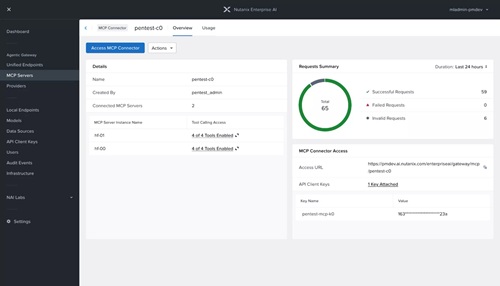
Nutanix Enterprise AI 2.8 directly addresses this challenge by introducing generally available MCP server management within the Nutanix Agent Gateway.
- Centralized Connection Point: Agent Gateway acts as a secure proxy and connection hub between AI agents and MCP servers, whether those servers are deployed locally within the NAI cluster or hosted remotely.
- Granular Access Control: Administrators can assign specific tool permissions to individual users or distinct API keys, ensuring that an AI agent cannot execute unauthorized database queries or infrastructure alterations.
- Operational Agility: Locally deployed MCP servers within the gateway framework fully support rolling updates, minimizing downtime during software maintenance cycles.
2. Extending Nutanix Private Inference
Data privacy and latency constraints continue to drive enterprises toward private, on-premises AI deployment models. NAI 2.8 significantly enhances Nutanix Private Inference by adding:
- Fine-Tuning Capabilities: Support for fine-tuning models with fewer than 8 billion parameters, enabling organizations to adapt foundational models to proprietary domain-specific data sets securely on-premises.
- NVIDIA NIM Integration: Native support for deploying NVIDIA NIM microservices within air-gapped environments, ensuring that sensitive financial, healthcare, or government data never traverses public networks.
- Previews of Heavyweight Capabilities: NAI 2.8 introduces technical previews for multi-node and multi-GPU inference (designed to support massive models exceeding 100 billion parameters) and KV cache offloading from high-cost GPU memory to host CPU memory. Nutanix explicitly notes that these preview features are intended for testing and validation rather than immediate production deployment.
3. NKP 2.19: Unifying Bare-Metal and Virtualized Kubernetes
Containerization is the lifeblood of modern cloud-native applications, and artificial intelligence workloads are overwhelmingly packaged and distributed as containers. With NKP 2.19, Nutanix is expanding container orchestration flexibility.
- NKP Metal: Extends the familiar Nutanix operating model directly to physical, bare-metal servers. Leveraging Nutanix Foundation and Lifecycle Manager (LCM), NKP Metal automates node deployment, operating system provisioning, and firmware lifecycle management.
- NKP on AHV: Can be seamlessly combined with Nutanix Flow, providing network-level micro-segmentation and isolation for active AI agents to prevent lateral movement in the event of a security breach.
- AI Applications Catalog: A curated catalog providing rapid, validated deployment of essential AI/ML software stacks, including Kubeflow (for machine learning pipelines), Milvus (for vector database operations), and Slurm (for high-performance computing workload management). Furthermore, NKP has achieved official CNCF Kubernetes AI Conformant Platform certification, assuring interoperability.
Supporting Context & Strategic Metrics
The timing of these updates reflects a broader macroeconomic and technological shift. Enterprise adoption of generative AI has transitioned past the proof-of-concept phase, but operationalizing autonomous agents has revealed severe architectural bottlenecks.

The "Dual-Native" Infrastructure Imperative
Historically, organizations building out AI infrastructure fell into two traps: either they stood up completely isolated, specialized AI silos (leading to data duplication, governance blind spots, and exorbitant hardware costs), or they tried to force-fit AI models onto rigid, legacy virtualization layers that choked GPU throughput.
Nutanix’s "dual-native" architecture treats VMs and containers with equal priority. By allowing virtualized line-of-business applications and containerized AI agents to run side-by-side on the same hyperconverged infrastructure (HCI) fabric, enterprises achieve maximum resource efficiency. Compute, storage, and networking resources can be dynamically allocated to heavy model inferencing during peak hours and reclaimed for standard transactional databases when demand shifts.
Multitenancy and SP Central
For managed service providers (MSPs) and large enterprise IT departments operating internal shared services, managing multitenancy across hybrid environments is exceptionally complex. The general availability of SP Central provides a single pane of glass to oversee multitenant infrastructure, cloud-native platforms, and AI services, simplifying metering, billing, resource isolation, and policy enforcement.
Perspectives from Leadership
Industry executives have emphasized that the latest platform updates are designed to alleviate the integration fatigue currently plaguing enterprise IT departments.

"Enterprise AI should not require customers to rebuild the systems that already run their business," noted Thomas Cornely, Executive Vice President of Product Management at Nutanix, during the platform announcement.
Cornely’s sentiment highlights the core value proposition of NAI 2.8 and NKP 2.19: meeting enterprises where they are. Rather than demanding a wholesale migration to public cloud AI services—which often introduces regulatory compliance hurdles and unpredictable egress costs—Nutanix provides a turnkey framework that layers modern agentic AI governance directly onto existing, trusted enterprise data centers.
Future Outlook
As autonomous agentic AI matures throughout the remainder of the decade, the differentiating factor for enterprise success will not be access to models, but rather the security, governance, and efficiency with which those models interact with corporate data and IT systems.
Nutanix’s aggressive integration of the Model Context Protocol, combined with robust private inference pipelines and flexible bare-metal Kubernetes management, positions the company at the center of the enterprise hybrid AI discussion. As features currently residing in technical preview—such as multi-node/multi-GPU inference for 100B+ parameter models and CPU-based KV cache offloading—graduate to general availability, organizations utilizing the Nutanix Cloud Platform will find themselves well-equipped to scale autonomous AI agents without sacrificing operational stability, security, or performance.

For IT architects and enterprise leaders, the directive is clear: the path to production agentic AI does not require architectural reinvention; it requires an intelligent, governed extension of the hybrid cloud infrastructure already in place.

