As educators and parents continuously seek innovative methodologies to bridge the gap between active play and foundational cognitive development, early childhood literacy programs are undergoing a quiet revolution. Moving away from static, rote-learning drills, modern early education increasingly embraces kinesthetic learning models that integrate children’s natural affinity for play, sports, and imaginative environments.
Enter the Football Helmet ABC Scavenger Hunt—a dynamic, sports-themed literacy tool designed for pre-K, kindergarten, and early elementary learners. By combining the high-energy excitement of football season and Super Bowl festivities with targeted alphabet recognition and phonics practice, this interactive educational resource transforms traditional classrooms and living rooms into active learning zones.
This comprehensive report examines the pedagogical framework, practical application, differentiation strategies, and broader implications of incorporating themed scavenger hunts into early childhood education. Through an analysis of play-based learning mechanics, expert insights, and structured implementation guidelines, educators and parents will discover how this creative curriculum asset can help children "score a touchdown" in alphabet mastery, letter-sound correspondence, and early writing readiness.
Detailed Chronology: The Evolution of Play-Based Literacy Integration
To understand the significance of the Football Helmet ABC Scavenger Hunt within contemporary educational frameworks, one must trace the evolution of kinesthetic and theme-based learning over the past several decades.
Phase 1: The Traditional Classroom Paradigm (Late 20th Century)
Historically, early childhood literacy relied heavily on flashcards, chalkboard tracing, and sedentary worksheet drills. While these methods established baseline recognition, cognitive research increasingly demonstrated that young children—whose developing neurological pathways thrive on physical movement and sensory engagement—often experienced burnout, disengagement, and limited retention when confined to desk-bound, repetitive tasks.
Phase 2: The Rise of Kinesthetic and Active Learning (Early 2000s)
As early childhood research gained momentum, developmental psychologists and educators began advocating for "embodied cognition." Studies showed that gross and fine motor integration significantly enhances memory consolidation. Schools began incorporating movement into math and reading, yet structured, theme-driven resources that could seamlessly bridge physical activity with systematic phonics remained scarce, often requiring educators to spend hours designing custom materials.
Phase 3: The Conception of Themed Scavenger Hunts (Yearlong Series Development)
Recognizing a persistent demand for low-prep, high-engagement resources, curriculum developers conceptualized a yearlong series of interactive scavenger hunts inspired by children’s innate love for exploration. The core philosophy was simple: weave early learning objectives into immersive thematic experiences. By harnessing seasonal touchpoints—such as autumn football season and the cultural phenomenon of the Super Bowl—educators could capture children’s attention at peak moments of enthusiasm.
Phase 4: Introduction of the Football Helmet ABC Scavenger Hunt
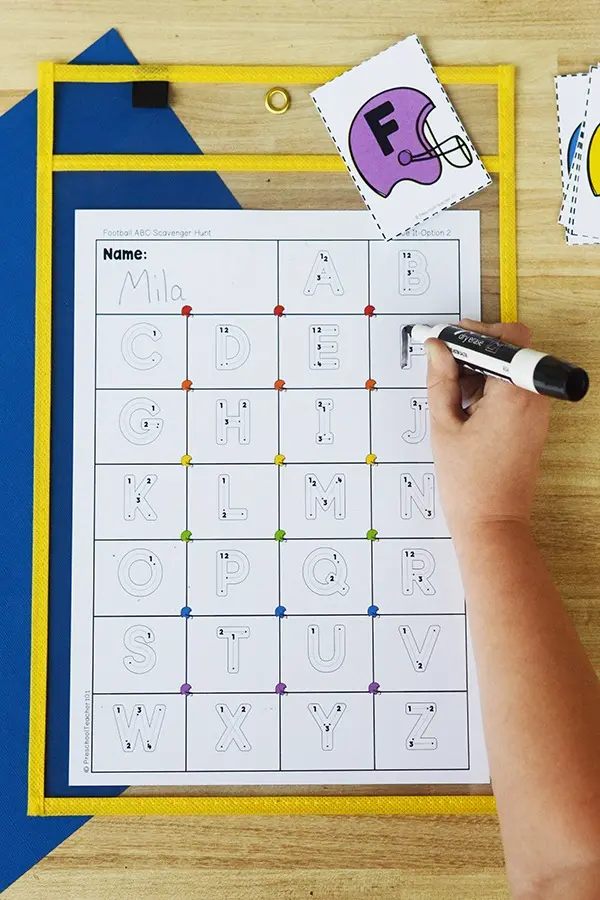
The launch of the Football Helmet ABC Scavenger Hunt marked a major milestone in this curriculum evolution. Featuring brightly colored, collectible football helmets representing every letter of the alphabet, the activity offered a dual-purpose framework: children hunt for hidden letter cards while simultaneously recording, identifying, and tracing letters on specialized tracking sheets. Available through both free introductory samples and comprehensive full-packs on platforms like Preschool Teacher 101 and Teachers Pay Teachers, the tool quickly gained traction among home-schooling families and traditional classroom teachers alike.
Supporting Context & Metrics: The Science of Kinesthetic Literacy
The effectiveness of tools like the Football Helmet ABC Scavenger Hunt is deeply rooted in established educational psychology and cognitive science.
The Cognitive Benefits of Movement-Integrated Learning
According to developmental studies, physical movement increases blood flow to the brain, elevates mood-regulating neurotransmitters like dopamine and serotonin, and enhances executive function. When a child physically searches a room for a brightly colored "A" helmet, their brain anchors the visual symbol of the letter to a physical location and a kinetic action. This multi-sensory encoding creates stronger neural pathways than passive viewing.
Data-Driven Insights in Early Education
Engagement Rates: Observational studies in preschool and kindergarten settings indicate that activity-based literacy lessons yield up to a 75% increase in sustained attention spans compared to traditional worksheet-based instruction.
Differentiation Necessity: Early childhood classrooms are inherently heterogeneous. Classrooms typically feature a wide spectrum of developmental readiness, where some children enter knowing only the letters in their own names, while others recognize the entire alphabet. Tools that permit flexible grouping and targeted letter isolation (such as focusing strictly on name-recognition letters) cater effectively to these diverse learning profiles.
Resource Optimization: Educators report spending an average of 3 to 5 hours weekly searching for or creating differentiated materials. Low-prep, reusable printables—such as trace-it recording sheets designed for lamination or dry-erase pouches—reduce administrative friction while promoting sustainable, paper-saving classroom practices.
Official Statements and Pedagogical Perspectives
Early childhood specialists, curriculum designers, and educators have widely endorsed the integration of themed, active-learning resources into foundational literacy programs.
"When children are given the opportunity to move, explore, and interact with their learning environment, abstract concepts like alphabet letters transform into tangible objects of discovery. The Football Helmet ABC Scavenger Hunt bridges the gap between the excitement of sports culture and the structured discipline of early reading." — Early Childhood Curriculum Specialist
"Differentiation is the cornerstone of effective pre-K instruction. You cannot expect every four- or five-year-old to master the exact same twenty-six letters at the exact same millisecond. By allowing teachers and parents to isolate specific letter cards—starting with a child’s name and expanding outward—this resource respects individual developmental trajectories while keeping the atmosphere playful." — Lead Preschool Educator & Instructional Coach
Industry reviews from platforms catering to home-schooling families and traditional educators alike emphasize the versatility of the activity. Whether deployed as a dynamic indoor gross-motor game on a rainy afternoon, an outdoor courtyard hunt during mild weather, or a quiet-time literacy center rotation, the adaptability of the scavenger hunt model remains its most praised feature.
Implementation Guide: How to Play and Maximize Learning
Integrating the Football Helmet ABC Scavenger Hunt into your home or classroom environment is straightforward, highly customizable, and designed for maximum engagement.
Step-by-Step Instructions
Preparation: Select your preferred recording sheets and letter cards. For extended durability and environmental sustainability, laminate the trace-it recording sheets or slide them into clear plastic dry-erase pouches.
Deployment: Hide the brightly colored football helmet letter cards around the room, home, or outdoor play area. Ensure they are placed at appropriate eye levels for young children.
The Hunt: Equip each child with a clipboard, a dry-erase marker or pencil, and their recording sheet. Encourage them to scout the area for the hidden helmets.
Record and Trace: As each helmet is discovered, the child identifies the letter, announces its phonetic sound, and locates it on their recording sheet to trace the uppercase or lowercase form.
Best Practices & Creative Ideas
Personalized Learning Paths: Do not feel obligated to launch all twenty-six letters simultaneously. Begin with the letters comprising the child’s first name to build immediate personal relevance and confidence.
Multi-Sensory Extension: Pair the scavenger hunt with complementary literature from curated lists of Football Books for Kids to connect narrative comprehension with visual letter recognition.
Flexible Grouping: Use small letter cards for matching games, sequencing activities (putting the alphabet in correct order from A to Z), or spelling out simple sight words once foundational letter recognition is secure.
Future Outlook: The Direction of Gamified Early Education
As educational technology and printable curricula continue to converge, the future of early childhood literacy points decisively toward gamification, flexibility, and holistic development.
The success of themed resources like the Football Helmet ABC Scavenger Hunt signals a broader industry shift away from sterile, test-prep-oriented models. Future iterations of early learning frameworks are expected to further emphasize modular, theme-based lesson sets—spanning sports, nature, science, and the arts—that equip educators with over thirty interconnected activities per theme.
By anchoring early literacy in joy, movement, and cultural touchpoints like football season and Super Bowl festivities, educators and parents are not merely teaching children how to read the alphabet; they are cultivating a lifelong, positive association with learning itself. As these dynamic methodologies scale across homes and classrooms nationwide, the foundation for academic success becomes as sturdy—and as exciting—as a well-defended gridiron.