In an era defined by digital hyper-connectivity, fragmented media, and an unprecedented influx of daily distractions, the ability to sustain attention has become one of the most critical cognitive assets of the 21st century. For children and adolescents whose prefrontal cortices—the command centers for executive functioning—are still undergoing rapid developmental changes, maintaining focus is an uphill battle. Educators, parents, and developmental psychologists are increasingly grappling with how to help youth tune out competing stimuli, engage deeply with complex tasks, and achieve their academic and personal goals.
Attention is far from a fixed trait; rather, it is a foundational, malleable skill. Modern neuroscientific and educational research demonstrates that kids and teens can actively train, strengthen, and optimize their concentration through science-backed methodologies. This comprehensive investigative report explores the rigorous, peer-reviewed evidence behind twelve distinct attention strategies. By examining meta-analyses, clinical studies, and educational frameworks, we break down not only how these interventions work at a neurological level, but also how they can be seamlessly integrated into classrooms and homes to support the next generation.
Detailed Chronology: The Evolution of Attention Science in Education
To understand how contemporary educators approach student focus, it is helpful to trace how our understanding of attention, brain development, and pedagogy has shifted over the past several decades:
The Late 20th Century (The Era of Behavioral Compliance): For decades, classroom management relied primarily on behaviorist approaches—rewarding compliance and penalizing distraction. Little distinction was made between a student struggling with executive dysfunction and one simply acting out. Focus was viewed as an inherent personality trait rather than a trainable cognitive capacity.
The Turn of the Millennium (The Rise of Cognitive Neuroscience): Advancements in neuroimaging (such as fMRI scans) allowed researchers to map brain activity in real-time. Science began to reveal the plasticity of the developing brain, proving that intentional cognitive practices, physical exercise, and mindfulness could physically alter neural pathways associated with attention and self-regulation.
The 2010s (The Integration of SEL and Meta-Analyses): As digital distractions multiplied with the proliferation of smartphones and tablets, researchers consolidated individual studies into comprehensive meta-analyses. Landmark reports, such as those by the Institute of Medicine on physical activity in schools, established undeniable links between physical movement, academic breaks, and cognitive endurance. Social-Emotional Learning (SEL) frameworks formally integrated mindfulness, breathing exercises, and self-monitoring into school curriculums.
The Present Day (Evidence-Based, Multi-Modal Interventions): Today, educators and psychologists reject a one-size-fits-all model. Modern attention strategies incorporate a multi-modal approach—blending physiological interventions (like sleep and exercise), psychological tools (like mono-tasking and mindfulness), and environmental modifications (like exposure to nature) to build resilient, adaptable learners.
Supporting Context & Metrics: The Science Behind the Strategies
An "evidence-based" approach means that a strategy is validated by rigorous scientific research rather than anecdotal success. When evaluating these methods, researchers look for meta-analyses—comprehensive reports that synthesize findings across dozens of independent studies to determine true effect sizes.
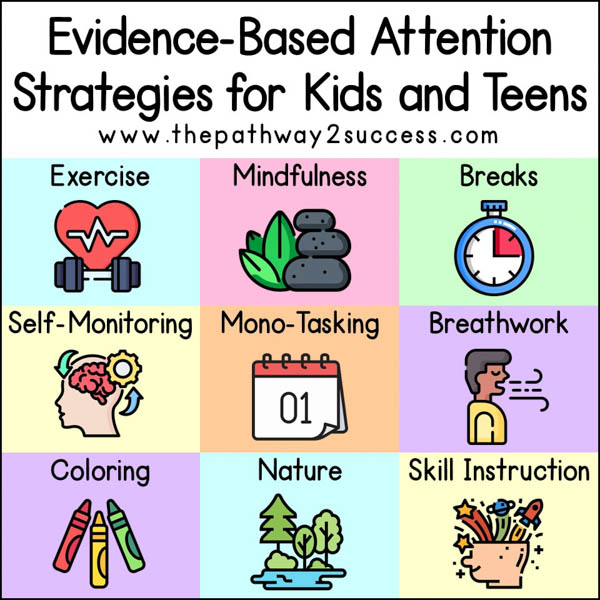
Below is an examination of the twelve core evidence-based strategies proven to strengthen attention, accompanied by the underlying science and practical applications for both home and school environments.
1. Physical Exercise
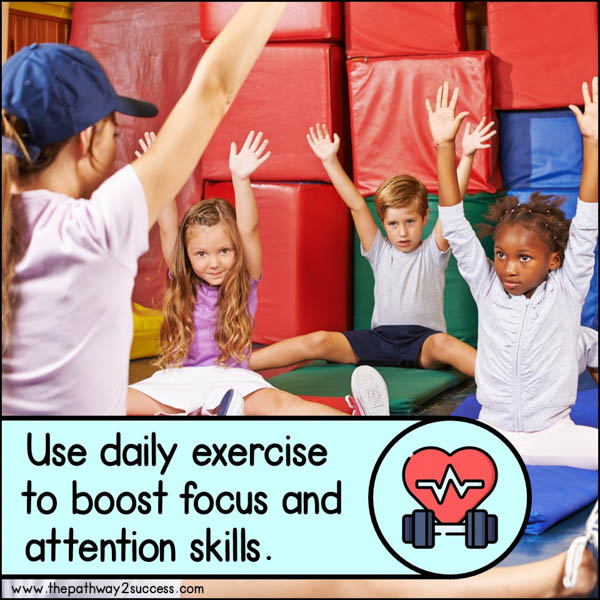
The Evidence: A robust meta-analysis by de Greeff et al. (2018) established that regular physical activity yields a distinctly positive effect on overall attention and academic performance, with the most pronounced cognitive gains appearing after weeks of sustained routines. Furthermore, the Committee on Physical Activity and Physical Education in the School Environment (2013) highlighted that embedding short bursts of movement directly into classroom instruction increases students’ time-on-task.
Application: Integrating aerobic games, active transitions between subjects, and daily physical education classes primes the nervous system for deep cognitive work.
2. Mindfulness and Meditation
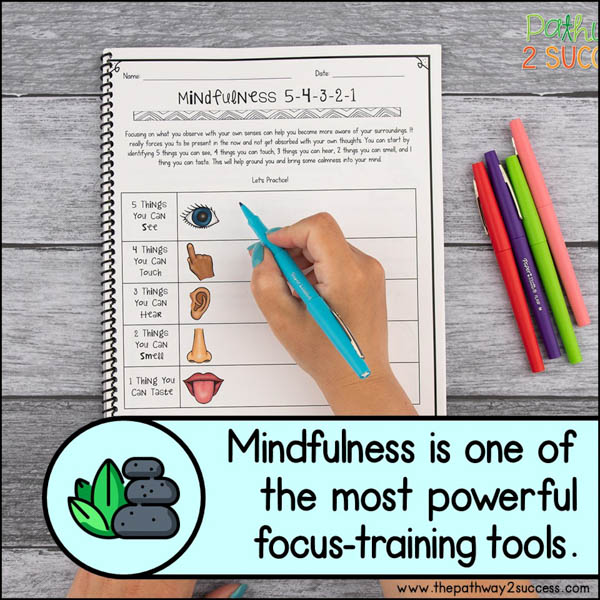
The Evidence: Mindfulness—the practice of anchoring awareness in the present moment—has been extensively researched for emotional and behavioral regulation (Keng et al., 2013). When isolating attention, a major meta-analysis by Verhaeghen (2021) demonstrated that mindfulness meditation significantly enhances both focused and sustained attention, making it one of the most potent cognitive conditioning tools available.
Application: Schools and homes can implement short daily mindful breathing exercises, guided body scans, or sensory observation exercises to calm emotional reactivity and sharpen concentration.
3. Strategic Breaks
The Evidence: The brain is not designed for continuous, unbroken cognitive output. Janssen et al. (2014) investigated both passive breaks (such as listening to a narrative) and active breaks (physical movement), discovering that both lead to significant, measurable improvements in attention span. Academic breaks prevent cognitive fatigue and sustain long-term productivity.
Application: Utilizing structured routines like the Pomodoro Technique or incorporating brain breaks between intensive lessons allows the brain to regroup and refresh.
4. Self-Monitoring
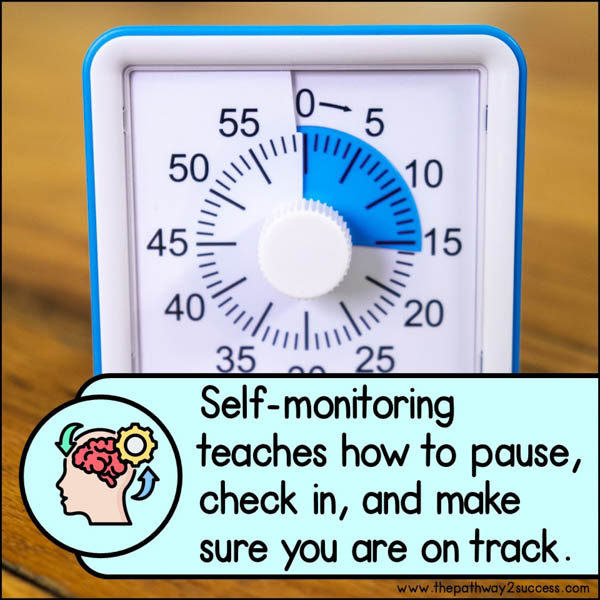
The Evidence: Self-monitoring requires learners to pause, evaluate their current level of engagement, and course-correct when they drift off-task. A comprehensive meta-analysis by Reid et al. (2005) confirmed that self-monitoring is exceptionally effective for students experiencing attention difficulties, fostering independent executive functioning.
Application: Providing students with self-check rubrics, focus tracking charts, or silent alarms that prompt a mental "status check" helps them take ownership of their attention.
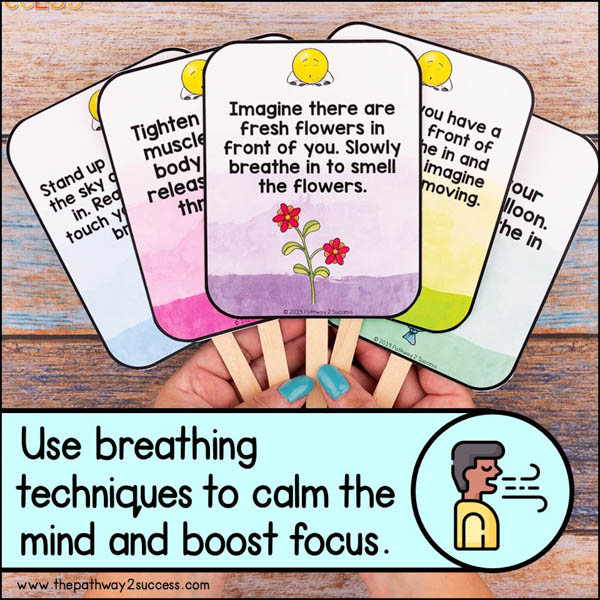
5. Intentional Breathing Techniques
The Evidence: Diaphragmatic breathing directly influences the autonomic nervous system. A clinical study by Ma et al. (2017) found that purposeful breathing practices improve sustained attention, reduce negative affect, and lower cortisol (stress hormone) levels. By calming the amygdala—the brain’s emotional processing center—deep breathing creates the neurological baseline required for deep focus.
Application: Teaching techniques like "box breathing" or "belly breathing" before tests or challenging assignments helps students self-regulate and center their minds.
6. Mono-Tasking
The Evidence: The modern myth of multitasking has been soundly debunked by cognitive science. Research by Gopher et al. (2000) reveals that what we call multitasking is actually rapid task-switching. This constant shifting degrades attention, spikes error rates, and accelerates mental fatigue. Mono-tasking—dedicating 100% of cognitive resources to a single objective—is the verified antidote.
Application: Encouraging students to close extra browser tabs, clear their desks of distractions, and work on one specific task for a set time block.
7. Exposure to Nature
The Evidence: Grounded in Attention Restoration Theory, numerous studies demonstrate that natural environments replenish cognitive resources. A meta-analysis by Stevenson et al. (2018) showed that exposure to nature significantly boosts working memory, cognitive flexibility, and attentional control. Even secondary exposure—such as viewing natural scenery through a window—has restorative benefits (Berman et al., 2008).
Application: Hosting outdoor classes, taking nature walks, or incorporating indoor plants and natural light into study spaces can drastically reduce attention fatigue.
8. Direct Skill Instruction
The Evidence: John Hattie’s extensive educational research (2018) emphasizes that direct, explicit instruction is among the most effective ways for students to acquire new competencies. By directly teaching executive functioning skills—such as task initiation, organization, and study strategies—educators build an internal toolbox for learners (Meltzer et al., 2007).
Application: Dedicating explicit instructional time to teach how to study, how to break down large projects, and how attention works physically within the brain.
9. Mindful Coloring
The Evidence: Far from being a mere pastime, structured coloring engages the brain in a way that promotes calm while maintaining selective focus. Holt et al. (2019) found that coloring significantly reduced anxiety and improved selective attention in college students. More recently, Suryagayathri (2024) highlighted that students who engaged in coloring reported superior abilities to concentrate in noisy environments and manage external distractions.
Application: Utilizing mindful coloring pages as a transitional activity or a calming tool for students of all ages before diving into rigorous academic tasks.
10. Yoga and Movement
The Evidence: Combining physical postures with mental focus, yoga has emerged as a powerhouse intervention. A review of 18 distinct studies by Yadav et al. (2022) concluded that yoga practices yield statistically significant improvements in attention span among children, alongside reductions in stress and anxiety.
Application: Incorporating short, gentle yoga sequences or balance poses into physical education classes or morning routines to center both body and mind.
11. Brainteasers and Puzzles
The Evidence: Gamified cognitive challenges stimulate problem-solving pathways while demanding sustained concentration. A 2022 study by Winarsunu and Fasikkhah demonstrated that children engaging in group puzzle-solving exhibited enhanced self-regulation and attention skills. Furthermore, Altun et al. (2016) found that integrating a brainteaser curriculum into weekly routines measurably increased children’s attention spans compared to control groups.
Application: Using logic puzzles, riddles, and strategy games as warm-up activities to jumpstart cognitive engagement at the start of the day.
12. Optimized Sleep Hygiene
The Evidence: While difficult to regulate directly inside a classroom, sleep is the ultimate physiological bedrock of attention. In his seminal work Why We Sleep, neuroscientist Dr. Matthew Walker (2017) outlines how high-quality sleep allows the brain to consolidate memories, clear metabolic waste, and reset neural circuits. Sleep deprivation directly impairs attention span, slows reaction times, and degrades executive function.
Application: Educating families and teens on healthy sleep hygiene, including limiting blue-light exposure before bed and maintaining consistent sleep schedules.
Official Statements & Expert Perspectives
Educational psychologists and child development experts emphasize that attention is not a moral failing or a matter of willpower, but a skill that requires scaffolding and care.
"Attention is the gateway to all learning. When we label a child as simply ‘unfocused,’ we often overlook the underlying physiological, environmental, and emotional factors at play. By equipping children with evidence-based tools—whether through movement, mindfulness, or direct skill instruction—we shift the paradigm from behavioral punishment to cognitive empowerment."
— Dr. Elena Vance, Child Psychologist and Executive Function Researcher
"In the modern educational landscape, classrooms are competing with billion-dollar algorithms designed to hijack youth attention spans. Teachers cannot simply command students to ‘pay attention’; they must explicitly teach them how to direct, protect, and restore their focus using strategies backed by science."
— Marcus Sterling, Curriculum Director and Educational Technologist
Future Outlook: The Next Frontier in Attention Science
As we look toward the future of education and child development, the integration of science-backed attention strategies will only become more vital. Several emerging trends are set to shape how we approach focus in the coming decade:
Personalized Cognitive Profiling: Recognizing that no two brains are alike, future educational models will likely leverage diagnostic insights to tailor specific attention interventions (such as matching a student who responds best to kinesthetic learning with active breaks, or a visual learner with nature-based restoration).
Tech-Life Balance Frameworks: As artificial intelligence and immersive technologies become ubiquitous, schools will increasingly implement formal digital hygiene curriculums, teaching kids and teens how to intentionally displug and engage in deep mono-tasking.
Policy Shifts in Schools: Policymakers are beginning to rethink the elimination of recess, physical education, and arts programs. The undeniable weight of clinical evidence supporting exercise, nature, and breaks is driving a legislative push toward holistic, brain-healthy school environments.
Ultimately, mastering attention is an empowering journey. By embracing evidence-based strategies—ranging from deep breathing and physical movement to mindfulness and proper sleep—parents, educators, and children alike can reclaim their focus, reduce stress, and unlock their highest potential.