
Executive Overview
Across the United States, school districts are confronting a persistent instructional dilemma: while significant resources and research have been poured into early childhood and elementary literacy, adolescent literacy in middle schools often hits a developmental plateau. Students entering grades 6 through 8 frequently struggle with unresolved foundational reading gaps—such as decoding complex multisyllabic words, fluency, and structural spelling—that impede their ability to comprehend subject-area texts. Traditional secondary education frameworks, designed around content specialization rather than foundational reading mechanics, are rarely equipped to address these deficits.
To tackle this challenge, Loudoun County Public Schools (LCPS) in Virginia launched a systemic overhaul of its secondary literacy framework. Rather than relying on a standalone digital tool or a short-lived curriculum mandate, district leaders re-engineered their operational structures, professional development pathways, and data evaluation protocols.
Co-authored by Dr. Michelle Picard, District Supervisor of Secondary English and Reading at LCPS, and Dr. Octavia Gray-Essex, National Senior Education Advisor at Lexia, a recent comprehensive analysis reveals how the district combined Lexia PowerUp Literacy with targeted, teacher-led instruction. The resulting framework yielded measurable reading gains across middle schools, particularly among multilingual learners and students with disabilities.
The experience of LCPS demonstrates that accelerating secondary literacy requires shifting focus from software purchase to systemic design—restructuring school schedules, empowering content-area teachers with foundational instructional practices, and moving metrics from passive program completion to true skill mastery.
Detailed Chronology of Systemic Transformation
+-----------------------------------------------------------------------------------+
|                           SYSTEMIC TRANSFORMATION TIMELINE                         |
+-----------------------------------------------------------------------------------+
| Phase 1: Diagnostic Assessment & Gap Identification                              |
|   • Middle school data audit exposes foundational decoding & fluency deficits.    |
|   • Structural mismatch recognized: Content experts vs. foundational readers.      |
+-----------------------------------------------------------------------------------+
                                         │
                                         ▼
+-----------------------------------------------------------------------------------+
| Phase 2: Structural Scheduling & Operational Integration                          |
|   • Shift from temporary "initiative" to institutionalized "structure."            |
|   • Embedded intervention blocks, advisory periods, and "all-hands" support.     |
+-----------------------------------------------------------------------------------+
                                         │
                                         ▼
+-----------------------------------------------------------------------------------+
| Phase 3: Blended Tool Deployment & Real-Time Diagnostics                          |
|   • Adoption of Lexia PowerUp Literacy to deliver adaptive student paths.         |
|   • Integration of real-time diagnostic data into weekly teacher planning.        |
+-----------------------------------------------------------------------------------+
                                         │
                                         ▼
+-----------------------------------------------------------------------------------+
| Phase 4: Paradigm Shift – From Content Completion to Skill Mastery                |
|   • Transition away from tracking simple logged hours and usage time.             |
|   • Focus placed on objective skill mastery, depth over pace, and targeted re-teaching|
+-----------------------------------------------------------------------------------+
                                         │
                                         ▼
+-----------------------------------------------------------------------------------+
| Phase 5: Organic Scaling & Network Expansion                                      |
|   • Opt-in model ("coalition of the willing") drives peer-to-peer adoption.       |
|   • District-wide implementation validated by independent outcome evaluations.   |
+-----------------------------------------------------------------------------------+
Phase 1: Confronting the Uncomfortable Reality
The transformation began with a critical audit of district-wide middle school assessment data. While LCPS had historically invested heavily in elementary reading frameworks, data revealed that a substantial tier of middle school students were entering 6th grade with underlying gaps in foundational literacy. These gaps quietly undermined performance across English language arts, science, social studies, and mathematics.
District leadership identified a operational mismatch:
- Middle school teachers were domain specialists trained in literature analysis, essay structure, and critical exposition.
- Middle school teachers were generally not trained in explicit, diagnostic foundational reading instruction (e.g., phonology, morphology, and structural analysis).
- As a result, struggling readers were expected to comprehend complex texts without receiving the direct instruction needed to decode them.
Phase 2: Shifting from "Initiative" to "Structural Imperative"
Recognizing that short-term initiatives often fail to create lasting change, LCPS moved secondary literacy into the master scheduling framework. District leadership recognized that if time for literacy was not explicitly carved out, it would inevitably be squeezed into the margins of the school day.
Rather than imposing a rigid schedule across the district, LCPS granted building-level leaders the autonomy to design execution models tailored to their school environments. Implementation strategies included:
- Dedicated literacy intervention blocks integrated directly into daily schedules.
- Repurposed advisory and homeroom periods utilized for targeted skill groups.
- "All-hands-on-deck" co-teaching and small-group models where elective, content, and intervention staff supported direct literacy instruction.
Phase 3: Integrating Blended Learning and Real-Time Diagnostics
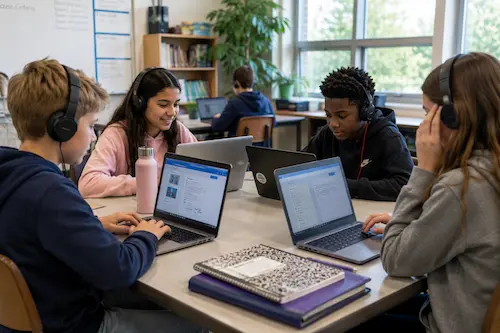
To operationalize foundational reading instruction at scale without overburdening secondary ELA faculty, LCPS adopted Lexia PowerUp Literacy. The tool was integrated within a blended learning framework combining adaptive online learning with explicit, teacher-directed small-group instruction.
The technology served a dual function:
- Student Personalization: It provided automated, age-appropriate instruction in word study, grammar, and comprehension, allowing middle schoolers to fill specific skill gaps without feeling patronized by elementary-level materials.
- Teacher Actionability: It delivered real-time diagnostic reporting to educators, pinpointing exact skill deficits and generating targeted, scriptable teacher-led lessons for small-group intervention.
Phase 4: Rethinking Data Analytics – From Progress Completion to Skill Mastery
During the early implementation phase, district leaders monitored usage metrics such as time-on-task, login frequency, and unit completion rates. However, internal reviews alongside national secondary literacy research revealed a critical flaw in this approach: high engagement and completion rates did not consistently translate into reading mastery.
This realization prompted a shift in the district’s monitoring framework. District leaders, reading specialists, and principals shifted their analytical focus from tracking activity to measuring understanding:
| Former Metric Orientation (Activity-Based) | Evolved Metric Orientation (Mastery-Based) |
|---|---|
| Logged hours per week | Concept mastery across literacy domains |
| Percentage of software modules completed | Accuracy rate on real-time diagnostic checks |
| Speed of progression through program levels | Skill transfer into classroom reading tasks |
| Compliance with scheduled screen-time goals | Targeted, teacher-led intervention response |
This analytical pivot ensured that teachers used software diagnostics to adjust classroom instruction, prioritize depth of understanding over speed, and re-teach concepts whenever student performance stalled.
Phase 5: Fostering Organic Adoption and Teacher Empowerment
Rather than issuing an immediate top-down mandate across all secondary campuses, LCPS adopted an opt-in expansion strategy. The district invited school leadership teams to participate voluntarily, promising structural support, job-embedded professional development, and actionable data integration.
As early-adopting middle schools began demonstrating clear reading gains, peer leaders took notice. Neighboring school principals and department chairs observed improvements in student engagement and standardized measures, creating organic demand for the framework across the district.
Supporting Context & Metrics: Evaluating Impact and Research Rigor
To evaluate the impact of this approach, LCPS collaborated with Lexia’s research and evaluation team to conduct longitudinal analyses across grades 6 through 8. The analysis paid particular attention to high-need student populations, including multilingual learners (MLs) and students receiving special education services.
                  PUPIL READING GAIN FACTOR
    ┌──────────────────────────────────────────────────┐
    │ Average Middle School Intervention (Baseline: 1x)│
    ├──────────────────────────────────────────────────┤
    │ LCPS Blended Implementation (Up to 5x Growth)    │
    └──────────────────────────────────────────────────┘
    0x       1x       2x       3x       4x       5x
Empirical Growth and ESSA Alignment
The evaluation revealed that students across middle school grades who participated in the blended literacy model with consistent fidelity demonstrated significant skill growth from the beginning to the end of the academic year:
- Multidimensional Skill Growth: Students made gains across all three core software domains—Word Study (decoding and morphology), Grammar (syntax and sentence structure), and Comprehension (meaning construction and analytical reading).
- ESSA Tier 1 Standard Evidence Alignment: The instructional model utilized by LCPS aligns with Every Student Succeeds Act (ESSA) Tier 1 (Strong Evidence) standards. In rigorous randomized controlled trials, this blended instruction model demonstrated up to five times the impact of standard middle school reading interventions.
Mechanics of Secondary Reading Recovery
The quantitative success observed in Loudoun County highlights several critical structural components of adolescent literacy:
- Morphological and Structural Analysis: Advanced middle school readers must process multisyllabic vocabulary across disciplines. Adaptive software combined with explicit teacher instruction allowed students to break down prefixes, suffixes, and Latin/Greek roots, converting non-fluent decoding into fluid recognition.
- Grammatical and Syntactic Mapping: Secondary reading comprehension frequently founders on complex sentence structures found in advanced texts. By isolating syntax, clause dependencies, and punctuation, students learned to deconstruct academic phrasing.
- Agency and Metacognition: As students recognized their own progress through transparent diagnostic feedback, teachers reported a marked increase in student agency. Middle schoolers began actively identifying their reading gaps, asking for targeted support, and taking ownership of their learning.
Official Statements & Leadership Insights
District leadership and research partners attribute the success of the initiative to building human capacity alongside technology integration.
Perspective from District Leadership
"When people hear about the literacy gains we’ve seen in our middle schools, they often ask a simple question: What program did you use? I understand why. In education, we’re always looking for the lever, the thing that will move outcomes quickly and at scale. But what changed outcomes for our students wasn’t a single tool. It was a set of deliberate decisions about time, instruction, data, and, most importantly, people."
— Dr. Michelle Picard, District Supervisor of Secondary English and Reading, Loudoun County Public Schools
Dr. Picard emphasized that supporting secondary teachers requires recognizing their unique instructional context:
"Teachers are the linchpin. We cannot expect teachers to deliver instruction they haven’t been prepared to deliver, especially in secondary settings where foundational literacy training is often limited. Teachers often understand the ‘why’ behind effective literacy instruction, but they need support with the ‘how’—how to apply those practices within the constraints of their classrooms. That’s why we focused on job-embedded professional learning that connected research to daily practice."
Insights from Educational Technology Research
"Completion and mastery are not the same thing, and confusing the two can lead to overestimating impact. When districts move beyond tracking simple compliance metrics and instead empower teachers with real-time, actionable diagnostics, technology shifts from being a passive digital tool to an accelerator of high-quality classroom instruction."
— Dr. Octavia Gray-Essex, National Senior Education Advisor, Lexia
Future Outlook & Systemic Takeaways
The strategic transformation at Loudoun County Public Schools offers a clear roadmap for K-12 district leaders seeking to strengthen adolescent literacy. The findings suggest that sustainably closing secondary reading gaps requires building a comprehensive support system rather than simply adopting new software.
                      5 PILLARS OF SECONDARY LITERACY

         [ TIME ]          [ INSTRUCTION ]       [ METRICS ]
    Dedicated Blocks       Explicit & Direct     Focus on Mastery
    In Master Schedule     Research-Aligned      Over Completion
           │                      │                     │
           └──────────────────────┼─────────────────────┘
                                  │
                   ┌──────────────┴──────────────┐
                   │                             │
           [ CAPACITY ]                     [ SCALING ]
        Job-Embedded PD                  Organic Growth
        For Secondary Staff              Via Results
Actionable Takeaways for K-12 District Leaders
- Institutionalize Time in Master Schedules: Literacy support cannot rely on voluntary before-school tutoring or informal work time. Districts must build dedicated intervention blocks or co-teaching frameworks into middle school master schedules.
- Invest in Job-Embedded Secondary PD: Secondary ELA teachers require targeted professional learning in the mechanics of foundational reading—specifically morphology, multisyllabic decoding, and syntax—tailored to adolescent learners.
- Pivot from Completion to Mastery Metrics: Dashboards should track student skill acquisition and accuracy rather than logged screen time or module completion rates.
- Distinguish Tool from Strategy: Software tools accelerate progress only when integrated with explicit, direct teacher instruction. Technology provides diagnostic clarity, but teachers drive instructional execution.
- Scale Through Demonstrated Success: Mandates often spark compliance without deep implementation. Inviting school leaders into an initial implementation cohort and letting demonstrated student growth drive expansion builds sustainable buy-in.
Long-Term Impact
As Loudoun County Public Schools continues to refine its secondary literacy framework, district leaders remain focused on long-term sustainability. By combining real-time data, targeted teacher training, adaptive technology, and structured scheduling, LCPS has created a reproducible model for middle school literacy intervention.
The key takeaway for the broader education landscape is clear: closing the adolescent reading gap requires moving beyond the search for a simple software solution. Lasting literacy growth happens when districts build a cohesive system that supports both the educator and the student.

