

Executive Overview
The cybersecurity landscape has reached a critical inflection point. Emerging research and empirical data released around the Black Hat USA 2026 conference reveal a sobering reality: rather than ushering in an era of entirely novel, science-fiction-style cyber weapons, artificial intelligence is primarily acting as a high-octane accelerant for familiar, deeply entrenched attack vectors.
While enterprise security teams have spent years preparing for highly sophisticated, autonomous artificial intelligence entities executing novel exploits, threat actors are leveraging AI to do what they have always done—only faster, at a vastly expanded scale, and with unprecedented precision. The core vectors of risk remain stubbornly consistent: phishing, stolen credentials, exposed services, human misconfigurations, and software supply-chain vulnerabilities continue to serve as the primary gateways for malicious actors.
However, the velocity and scale at which these threats are now deployed have shifted dramatically. Autonomous vulnerability-research systems are now capable of sweeping through thousands of open-source projects in a matter of weeks, uncovering tens of thousands of zero-day flaws before human developers can patch them. Simultaneously, malicious actors are weaponizing enterprise AI infrastructure, compressing attacker breakout times to under 30 minutes, and bypassing traditional defensive perimeters using direct-to-IP command-and-control communications.
For cloud and infrastructure teams, this dynamic has translated into a dangerously shrinking response window. This comprehensive report explores the multifaceted findings from the recent wave of security studies, examining how AI is transforming the velocity of cyberattacks, the systemic vulnerabilities embedded within modern codebases, and the evolving strategies required to defend an increasingly hyper-connected digital ecosystem.

Detailed Chronology: The Evolution of AI-Driven Threat Vectors
The convergence of artificial intelligence and malicious cyber activity did not happen overnight. To understand the current threat paradigm, it is essential to trace how threat actors and security researchers alike have progressed from rudimentary automated scripts to fully autonomous, frontier AI-driven vulnerability discovery systems.
Phase One: Early Automation and Scripted Exploitation (Pre-2024)
Historically, automated attacks relied on static vulnerability scanners, dictionary attacks, and pre-written scripts. While these tools allowed attackers to scale their operations beyond manual targeting, they lacked adaptability. If a network configuration shifted or a web application presented an unexpected error handling routine, legacy scripts would frequently fail, requiring human intervention to adjust parameters and continue the assault.
Phase Two: Generative AI and Phishing Scale (2024–2025)
The advent and widespread commercialization of Large Language Models (LLMs) marked the first major disruption. Threat actors quickly moved past the friction of language barriers and poor grammar that traditionally tipped off targets to phishing campaigns. Generative AI enabled cybercriminals to craft hyper-personalized, contextually accurate spear-phishing emails at scale. Simultaneously, junior hackers leveraged AI coding assistants to draft boilerplate exploit code, slightly lowering the technical barrier to entry for lower-tier cybercrime syndicates.
Phase Three: Autonomous Vulnerability Discovery and Hyper-Speed Exploitation (2026 and Beyond)
The findings presented around the Black Hat USA 2026 conference illustrate a profound evolutionary leap: the transition from generative assistance to autonomous execution. Security research released by organizations like Palo Alto Networks Unit 42 demonstrates that AI is no longer just writing emails or assisting with code snippets—it is performing systematic, end-to-end security analysis at a scale previously unimaginable.
Autonomous systems can now ingest vast repositories of open-source code, map out complex logic flows, execute fuzzing tests, and confirm vulnerabilities without human oversight. This capability has compressed the vulnerability lifecycle. Where developers once had weeks or months to identify and remediate software flaws after discovery, autonomous AI agents can scour the global digital supply chain, identify thousands of undocumented vulnerabilities, and potentially weaponize them before patches can be conceived.
Supporting Context & Metrics: Unpacking the Data
The data gathered across multiple technical studies and incident response reports from the Black Hat era paints a granular picture of a threat landscape operating at machine speed. Below is a detailed breakdown of the primary metrics defining the current cybersecurity posture.
Software-Scale Vulnerability Discovery: The NOVA Findings
One of the most profound disclosures came from Palo Alto Networks Unit 42, which published the results of its frontier AI vulnerability study evaluating NOVA, an advanced autonomous vulnerability research system.
Over a compressed two-month testing window, NOVA was unleashed on 3,915 open-source software projects. The results underscore the sheer capability of autonomous systems to process codebases at machine speed:
- Total Confirmed Vulnerabilities: NOVA successfully identified and confirmed 14,090 distinct flaws across the evaluated repositories.
- The Zero-Day Epidemic: An astounding 99.4% of these vulnerabilities had never been previously reported to developers or CVE databases, representing a massive catalog of undocumented zero-day risks.
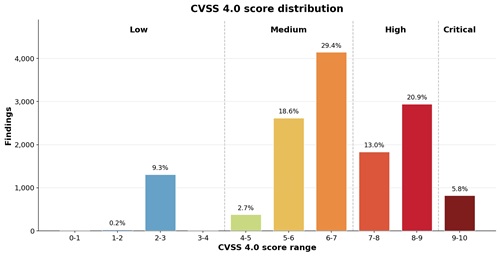
- Severity Distribution: According to the Common Vulnerability Scoring System (CVSS) version 4.0 framework, 39.7% of the discovered flaws were rated as High or Critical, demanding immediate remediation.
+-------------------------------------------------------------------------+
|                  NOVA Autonomous Vulnerability Analysis                 |
+-------------------------------------------------------------------------+
|  Total Open-Source Projects Analyzed : 3,915                            |
|  Total Confirmed Vulnerabilities     : 14,090                           |
|  Previously Unreported (Zero-Days)   : 99.4%                            |
|  High / Critical Severity (CVSS 4.0) : 39.7%                            |
+-------------------------------------------------------------------------+
Linguistic Ecosystems and Vulnerability Patterns
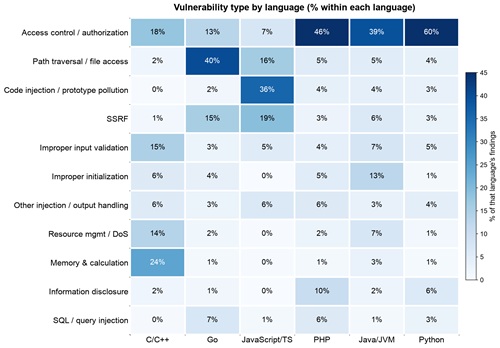
Unit 42’s research further revealed that the nature and frequency of vulnerabilities varied significantly across different programming-language ecosystems. The structural quirks, memory management models, and design philosophies of various languages directly influenced the types of flaws exposed by autonomous analysis:
- Access-Control Flaws: Predominantly surfaced in languages heavily reliant on complex framework-level permission hierarchies.
- Path Traversal & Code Injection: Frequently identified in environments handling extensive file I/O operations and dynamic string evaluations without strict sanitization.
- Prototype Pollution & Server-Side Request Forgery (SSRF): Heavily clustered in modern web application stacks, reflecting the inherent complexities of distributed microservice architectures.
Evading the Defensive Perimeter: Direct-to-IP Malware Traffic
Beyond vulnerability research, threat actors are aggressively adapting their operational infrastructure to evade traditional enterprise security controls. A separate Unit 42 study analyzed more than 4 million dynamic-analysis reports focusing on malware behavior and command-and-control (C2) communication methodologies.
Historically, security monitoring tools have relied heavily on Domain Name System (DNS) queries and sinkholing to track and block malware communicating with its controllers. However, modern malware families are increasingly circumventing this visibility layer:
- Direct IP Communication: Among malware samples actively communicating with C2 infrastructure, 45.32% made at least one direct-to-IP connection, completely bypassing standard DNS resolution lookups.
- Filtered Baseline: Even after stripping out bulk network scanning noise, 41.97% of relevant malware samples utilized direct-to-IP routing.
- Traffic Volume: Direct-to-IP traffic accounted for 23.17% of all command-and-control connection attempts observed in the study, highlighting a significant blind spot for organizations relying solely on DNS-based threat intelligence.
Identity, Breakout Times, and Cloud Infrastructure Risks
Incident response data released alongside these technical analyses reinforced the centrality of identity management and speed in modern network incursions:

- Identity and Privilege Dominance: Identity or privilege escalation vectors were explicitly highlighted in 75% of completed enterprise security investigations, proving that credential compromise remains the primary lever for lateral movement.
- Compressed Breakout Times: Attacker breakout times—the duration it takes for an adversary to move from initial compromise to lateral movement within a network—have dropped precipitously, with numerous incidents recording breakout times below 30 minutes.
- Cloud-Aware Criminality: Infrastructure teams are facing an influx of sophisticated, cloud-aware attacks that abuse legitimate enterprise AI infrastructure, poison software dependencies, and weaponize standard authentication mechanisms to turn valid user credentials into stealthy pathways for unauthorized access.
Official Statements and Industry Insights
The implications of these findings have sparked intense debate among cybersecurity leaders, researchers, and enterprise architects.
Industry analysts point out that while artificial intelligence lowers the barrier to entry for malicious actors, it also provides the foundational tooling necessary for defenders to scale their operations symmetrically. However, an asymmetry remains: defenders must secure every possible entry point across an infinite attack surface, whereas attackers only need to find a single open door.
"Autonomous systems like NOVA demonstrate that the speed of vulnerability discovery has fundamentally changed," notes telemetry data from threat intelligence briefings. "When an AI can identify thousands of undocumented, high-severity flaws in open-source software over a matter of weeks, the traditional patch management cycle—measured in months and weeks—becomes fundamentally untenable."
Furthermore, security architects emphasize that the heavy reliance on identity-based attacks (accounting for 75% of investigations) underscores a systemic failure in modern enterprise architectures. Organizations have largely transitioned away from hard perimeter defenses toward cloud-native environments, yet they continue to rely on legacy identity verification models that fail to recognize anomalous behavior in real-time.

Future Outlook: Securing the AI-Accelerated Enterprise
As the cybersecurity industry digests the revelations from the Black Hat 2026 cycle, it is abundantly clear that incremental security improvements will no longer suffice. Protecting modern infrastructure against AI-accelerated threats requires a fundamental paradigm shift across technology, process, and strategy.
1. Embracing Defensive AI at Scale
To counter autonomous vulnerability discovery and rapid exploitation, defenders must adopt AI-driven security orchestration. Human security analysts cannot manually review millions of lines of code or parse tens of thousands of alerts fast enough to match machine-driven adversaries. Automated remediation, continuous AI-driven fuzzing, and real-time posture management must become standard operational procedures.
2. Reinforcing Identity as the New Perimeter
With 75% of investigations centering on identity and privilege, organizations must move beyond multi-factor authentication (MFA) as a silver bullet. Modern identity security demands continuous, context-aware authorization frameworks, zero-trust network access (ZTNA), and behavioral analytics capable of spotting unauthorized lateral movement within minutes—well before the adversary’s sub-30-minute breakout window closes.
3. Hardening the Software Supply Chain
The discovery of over 14,000 vulnerabilities in open-source projects highlights the fragility of the global software supply chain. Enterprises must implement rigorous Software Bills of Materials (SBOMs), automated dependency scanning, and proactive vetting of third-party libraries before integrating them into production environments.

4. Overhauling Network Visibility
The proliferation of direct-to-IP command-and-control malware traffic demands an evolution in network monitoring. Security teams can no longer rely solely on DNS logging and domain reputation feeds. Comprehensive endpoint detection and response (EDR), deep packet inspection (DPI), and NetFlow anomaly analysis are critical to detecting un-resolved IP communications before data exfiltration occurs.
Conclusion
The intersection of artificial intelligence and cybersecurity has not created a dystopian future of unstoppable, sentient cyber weapons; rather, it has supercharged the timeless cat-and-mouse game between attackers and defenders. By accelerating familiar threats—phishing, credential theft, misconfigurations, and supply-chain weaknesses—AI has drastically compressed the timeline for security incidents.
Organizations that adapt by matching machine speed with autonomous defense, hardening their identity frameworks, and expanding their network visibility will survive the transition. Those that cling to legacy, manual security paradigms risk being overwhelmed in an era where the adversary operates at the speed of thought.

