
Executive Overview
Navigating the labyrinth of K-12 school finance has historically been one of the most formidable hurdles for education researchers, policy analysts, and data scientists. School funding data—vital for understanding equity, resource allocation, and systemic efficiency—has long been scattered across multiple federal and state agencies. These datasets frequently arrive in disjointed formats, utilize inconsistent naming conventions, and demand exhaustive, time-consuming data cleaning before any meaningful analysis can even begin.
To dismantle these structural barriers, education nonprofit Bellwether introduced edfinr one year ago. Designed specifically for the R programming environment, edfinr delivered a centralized, tidy repository of K-12 school finance data. The response from the research community was immediate and overwhelming. Downloaded more than 2,000 times since August 2025, the package quickly became a staple for academic researchers, think tanks, and data-driven advocates seeking to demystify educational budgets.
Building upon this profound success, and incorporating extensive user feedback gathered from major academic conferences and professional workshops, Bellwether has officially launched a major update to the platform. The next-generation version of edfinr introduces enhanced data fields, expanded analytical capabilities, and streamlined workflows. As school districts nationwide grapple with the complex financial pressures of post-pandemic fiscal cliffs and declining student enrollment, this newly upgraded tool arrives at a critical juncture, empowering researchers to deliver the insights policymakers urgently need to secure equitable futures for students.
Detailed Chronology: From Concept to Community Standard
The genesis of edfinr was rooted in a practical, day-to-day frustration familiar to anyone working in education policy: the sheer friction of data preparation. For decades, analyzing school finance meant wrestling with raw files from the National Center for Education Statistics (NCES), the U.S. Census Bureau’s Annual Survey of School System Finances (F-33), and various state departments of education. Researchers routinely spent weeks—sometimes months—writing custom scripts just to merge datasets, standardize district identifiers, and adjust figures for inflation.
Recognizing that this administrative drag stifled innovation and delayed critical research, the team at Bellwether engineered edfinr to automate the heavy lifting. By providing a clean, pre-processed, and standardized library of K-12 finance data directly within R, the package transformed what used to be a grueling multi-week data-cleaning ordeal into a matter of a few lines of code.
The Path of Adoption and Direct Feedback
Following its initial launch, the edfinr team embarked on an ambitious outreach campaign to engage directly with the education finance community. Presentations and hands-on technical workshops were hosted at premier academic and professional gatherings, including:
- The Association for Education Finance and Policy (AEFP): A primary hub for top-tier education economists and policy researchers.
- Harvard University’s Strategic Data Project (SDP): An initiative dedicated to transforming how educational agencies use data to improve student achievement.
Through a hybrid model of virtual tutorials and in-person training sessions, Bellwether’s researchers did more than just demonstrate how to install and run the package; they listened. Interacting directly with users—ranging from graduate students and university professors to analysts at state education agencies—provided invaluable feedback regarding missing variables, emerging analytical needs, and formatting preferences.
This iterative dialogue directly informed the development of the newly released, upgraded version of edfinr, ensuring that the tool continues to evolve in lockstep with the practical demands of the field.
Supporting Context & Metrics: The Modern Landscape of School Funding
To appreciate the value of edfinr, one must examine the broader macroeconomic and structural shifts currently sweeping American public education. School finance is no longer just about balancing local budgets; it is a high-stakes arena influenced by historic federal interventions, demographic shifts, and stark geographic disparities.
The Post-Pandemic Fiscal Reality
For the past several years, K-12 school systems have operated under an unprecedented influx of federal capital courtesy of the Elementary and Secondary School Emergency Relief (ESSER) funds tied to the COVID-19 pandemic relief packages. As this federal lifeline officially expires, school districts across the country are facing daunting fiscal cliffs. Administrators are forced to make agonizing choices regarding staff retention, programmatic cuts, and facility management—all while attempting to sustain academic recovery initiatives for students impacted by extended remote learning.
Simultaneously, many regions are experiencing severe declining enrollment. Falling birth rates, demographic shifts toward suburban and rural migrations, and the expansion of school choice options (such as vouchers and charter school networks) have left many traditional public school districts with empty classrooms and fixed operational costs that do not scale downward easily.
The Analytical Challenge
In this volatile environment, policymakers, school board members, and community advocates require precise, granular data to answer fundamental questions:
- How are operational dollars actually flowing from state treasuries down to the individual school building level?
- How do regional cost-of-living adjustments impact purchasing power across different geographic contexts?
- Are funding formulas adequately compensating districts that face chronic enrollment declines alongside rising fixed costs?
Without sophisticated tools like edfinr, answering these questions requires navigating a fragmented data ecosystem. By consolidating disparate financial streams into a single, cohesive R package, edfinr bridges the gap between raw bureaucratic data and actionable policy insights.
Practical Application: Analyzing Wage Indices and Geographic Disparities
The true test of any research tool lies in its utility under real-world analytical conditions. The updated edfinr is engineered to handle complex, multi-layered queries with unprecedented ease.
A Case Study: The CWIFT Wage Index
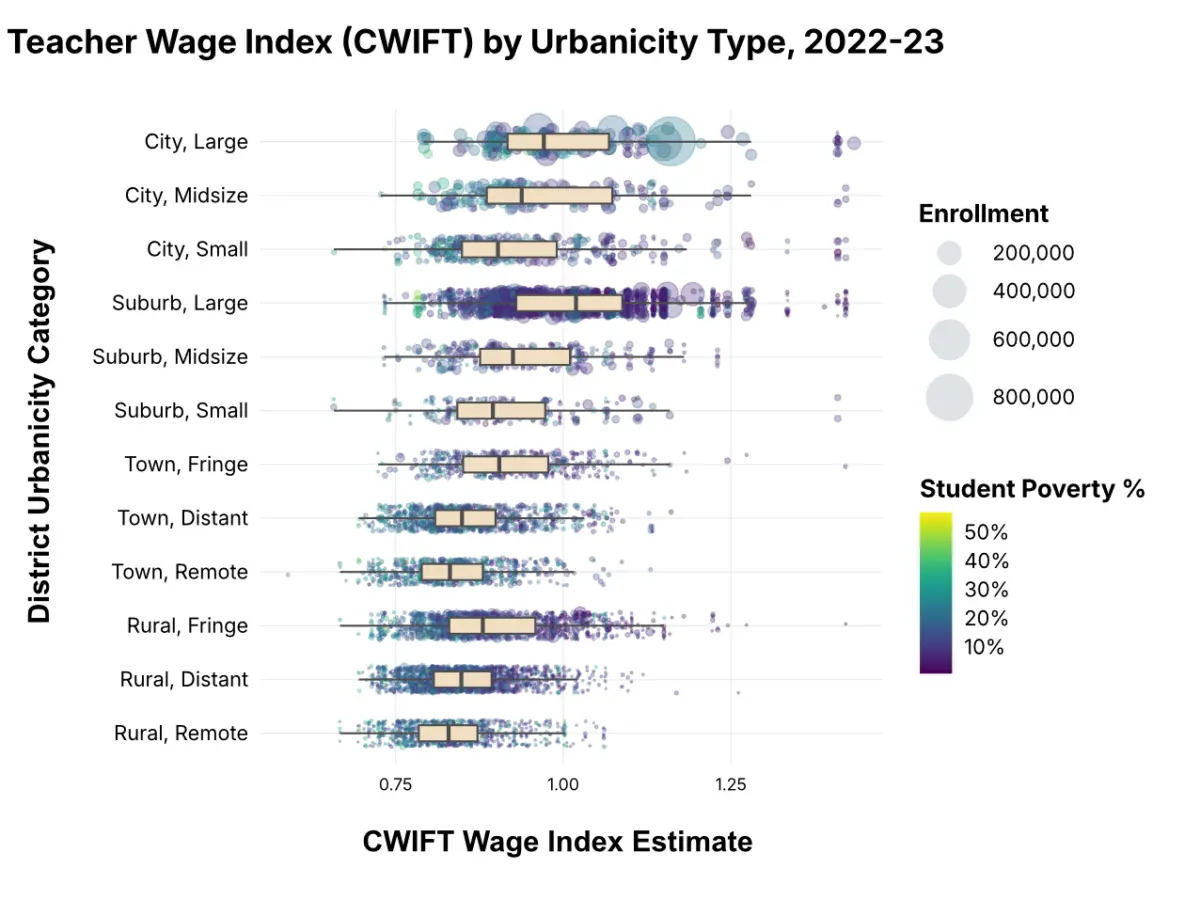
Consider a common, highly relevant research question: How does the Comparable Wage Index for Teachers (CWIFT) differ across urban, suburban, and rural school districts?
In the past, investigating this question required pulling geographic typology crosswalks, merging them manually with teacher wage data, handling missing values across divergent district classifications, and writing extensive custom code to plot the results. With the updated edfinr, this entire workflow is streamlined into a remarkably concise script.
# Example conceptual workflow using the updated edfinr package
library(edfinr)
library(tidyverse)

# Load updated district finance and geographic typology data
district_data <- load_edfinr_data()

# Analyze CWIFT wage index across urban, suburban, and rural districts (Enrollment > 300)
district_data %>%
  filter(enrollment > 300) %>%
  group_by(locale_type) %>%
  summarize(mean_cwift = mean(cwift_index, na.rm = TRUE)) %>%
  ggplot(aes(x = locale_type, y = mean_cwift, fill = locale_type)) +
    geom_col() +
    theme_minimal() +
    labs(title = "CWIFT Wage Index by District Typology",
         x = "District Locale",
         y = "Mean CWIFT Index")
Uncovering High-Level Trends
When researchers execute such visualizations using edfinr, the resulting plots immediately illuminate critical structural trends. For instance, data filtered for districts with an enrollment greater than 300 students often reveals stark disparities in teacher wage adjustments required to remain competitive. Urban and high-cost suburban districts frequently cluster at the higher end of the wage index spectrum, while rural districts face unique labor market pressures that traditional funding formulas may fail to capture adequately.
These insights go far beyond academic exercise. By rapidly visualizing geographic and structural cost disparities, researchers can provide state legislators with empirical evidence showing where current funding formulas fall short, ultimately guiding more equitable resource distributions.
Official Statements and Future Outlook
The release of the enhanced edfinr package marks a milestone in Bellwether’s ongoing commitment to democratizing education data and fostering transparent, rigorous policy research.
The Vision Ahead
As financial pressures mount across state capitals, the demand for sophisticated, transparent school finance research will only intensify. Bellwether’s leadership emphasizes that edfinr is designed to be a living tool—one that will continuously adapt alongside changes in federal reporting standards, state accounting methods, and academic research methodologies.
"School finance data should not require a secret decoder ring to understand," notes the Bellwether research team. "As states navigate declining enrollment and the aftermath of pandemic relief funding, our goal with edfinr is to remove the technical friction from data analysis so researchers and advocates can focus on what truly matters: making better, more equitable decisions for students."
Getting Started and Contributing
Bellwether has ensured that the platform remains fully accessible and open to the community. The functionality, data-cleaning scripts, and underlying methodology of edfinr will continue to evolve through collaborative engagement with researchers, data scientists, and policy analysts.
- Documentation & Installation: To learn how to install the package, explore vignettes, and review data dictionaries, visit the official edfinr webpage.
- Feedback & Collaboration: Researchers with questions, feature suggestions, or feedback regarding the updated datasets are encouraged to reach out directly to Alex Spurrier at [email protected].
By bridging the gap between raw data chaos and clean analytical workflows, edfinr stands ready to empower the next generation of education finance research, ensuring that every dollar invested in America’s public schools is accounted for, understood, and optimized for student success.

