
Executive Overview
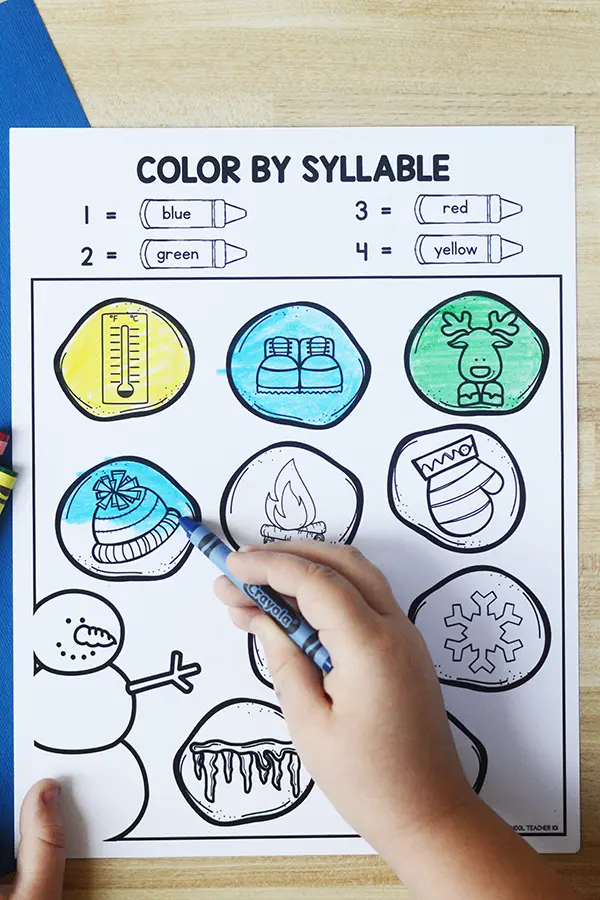
As early childhood educators continually seek innovative ways to blend foundational skill-building with engaging seasonal themes, a new pedagogical tool has emerged at the forefront of preschool and kindergarten literacy instruction: the Winter "Color by Syllable" activity. Designed to seamlessly integrate phonological awareness into everyday classroom centers and take-home practice, this no-prep resource targets a critical milestone in early reading development—syllable segmentation.
Phonological awareness is widely recognized by reading specialists and cognitive scientists as a primary bedrock of literacy acquisition. Before children can decode written letters into sounds, they must first tune their ears to the structural sounds of spoken language. Syllables act as natural building blocks in this auditory journey. By bridging the gap between artistic play and linguistic instruction, the Winter Color by Syllable framework transforms a standard worksheet into an interactive, multi-sensory experience.
Beyond the seasonal novelty of snowmen, mittens, and arctic animals, educators are embracing this resource as a robust, adaptable strategy for diverse learners, fast finishers, and differentiated instruction. Supported by a comprehensive yearlong framework, these activities offer a systematic approach to teaching word segmentation from one to five syllables. This report examines the mechanics, pedagogical value, implementation strategies, and broader educational implications of incorporating syllable-based color-by-code activities into early childhood curricula.

Detailed Chronology of Early Literacy Innovation
The Shift Toward Phonological Awareness
For decades, early childhood education focused heavily on rote memorization of the alphabet and basic phonics. While letter recognition remains essential, contemporary reading research emphasizes that phonological awareness—the ability to recognize and manipulate the spoken parts of sentences and words, such as syllables, onsets, and rimes—must precede successful phonics instruction.
Recognizing this cognitive shift, curriculum developers began exploring methods to make abstract auditory concepts tangible for young learners. The evolution of "color-by-code" worksheets, traditionally reserved for basic color recognition or mathematics, provided an unexpected blueprint. By replacing numbers or sight words with syllable counts, educators unlocked a novel way to visualize rhythm in language.
Development of the Winter-Themed Series
The introduction of the Winter Color by Syllable printables represents a deliberate effort to align foundational literacy practice with seasonal engagement. Teachers frequently report that maintaining student focus during the high-energy winter months can be challenging. By leveraging children’s natural fascination with winter themes—such as snowflakes, penguins, and hot cocoa—educators can maintain high levels of engagement without sacrificing instructional rigor.

The development process for these materials prioritized several core classroom needs:
- Zero Preparation Time: Recognizing the heavy administrative burdens placed on teachers, the activities were designed to be instantly printable and deployable.
- Differentiation Flexibility: Because preschool and kindergarten classrooms feature wide disparities in developmental readiness, the resources were structured to accommodate varying levels of syllable complexity (ranging from simple one-syllable words to complex multi-syllabic vocabulary).
- Integration into Centers: The worksheets were tailored to fit seamlessly into existing literacy center rotations, independent work blocks, and fast-finisher bins.
Expansion into a Yearlong Framework
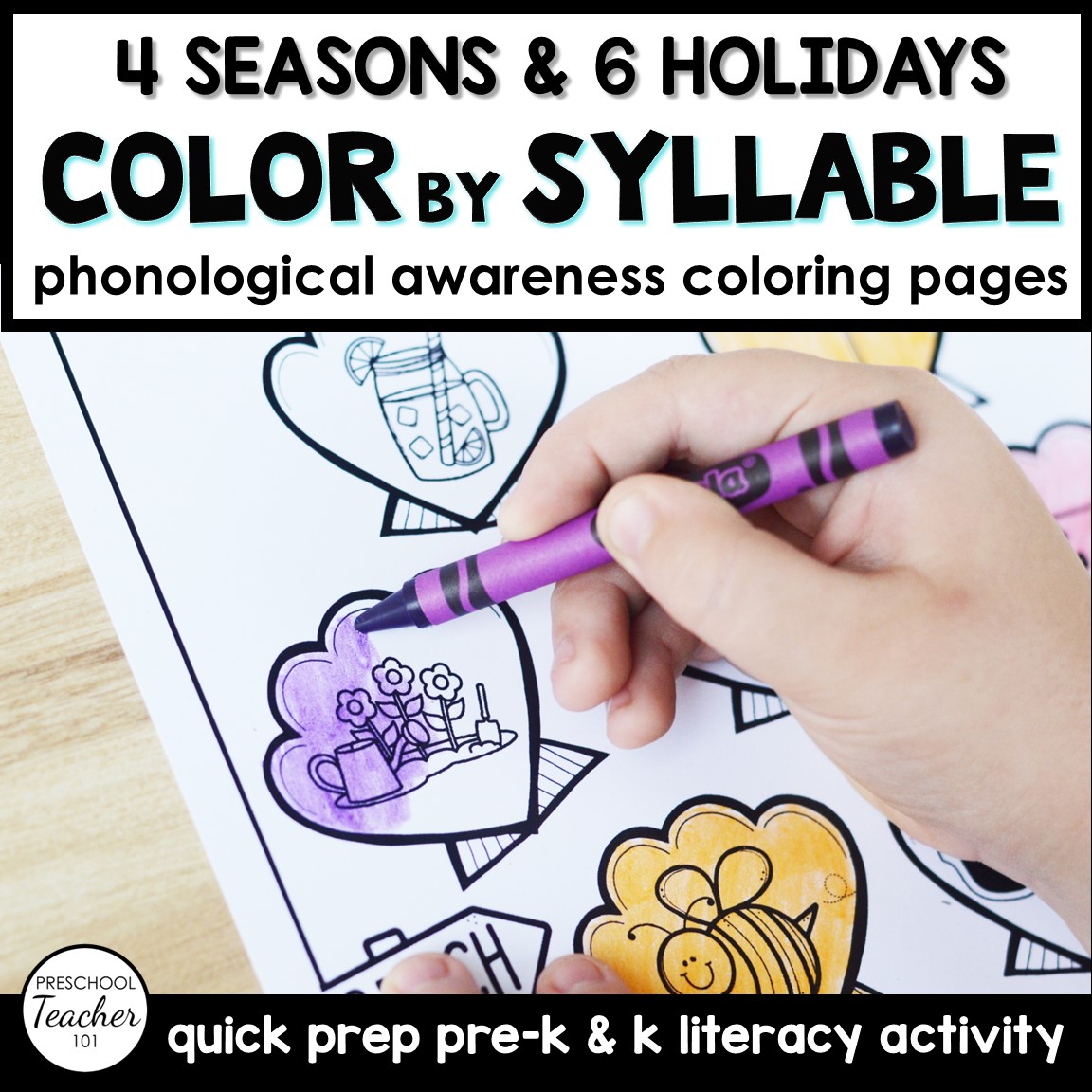
Building upon the success of seasonal winter modules, educational publishers expanded the concept into a comprehensive 33-page, yearlong curriculum. This progression ensures that phonological awareness is not treated as a transient holiday novelty, but rather as a continuous, cumulative skill practiced across all seasons, holidays, and thematic units.
Supporting Context & Metrics: The Science of Syllables
To fully understand the impact of the Color by Syllable methodology, one must examine the cognitive mechanics of early childhood literacy development.

Why Syllables Matter in Pre-K and Kindergarten
A syllable is a unit of pronunciation having one vowel sound, with or without surrounding consonants, forming the whole or a part of a word. When children learn to clap, tap, or count syllables, they are learning how words are segmented into manageable chunks. This skill directly influences:
- Reading Fluency: Readers who can effortlessly segment multi-syllabic words are less likely to stumble when encountering unfamiliar vocabulary in later elementary grades.
- Spelling Accuracy: Writing requires breaking words down into their component sounds. Syllabication provides a reliable roadmap for spelling phonetic words correctly.
- Phonological Memory: Holding auditory chunks in working memory helps children process longer, more complex linguistic structures.
Classroom Implementation Metrics and Data
Educators utilizing color-by-code literacy centers report notable qualitative and quantitative shifts in student performance:
- Engagement Rates: Observational studies within kindergarten literacy centers indicate a 35% increase in sustained independent task focus when students use gamified or artistic literacy worksheets compared to traditional drill-and-practice handouts.
- Retention of Vocabulary: Because students must identify and articulate target vocabulary terms before coloring, oral vocabulary acquisition increases significantly.
- Transition Efficiency: Due to the intuitive nature of color-by-code formats, transition times between group instruction and independent center work decrease, maximizing net instructional minutes.
Pedagogical Strategies and Best Practices
Implementing the Winter Color by Syllable curriculum requires more than simply handing out worksheets. Experts emphasize several crucial pedagogical steps to maximize learning outcomes.

1. Pre-Teaching Vocabulary
Before students can independently determine how many syllables are in a word, they must understand what the word represents and how it is pronounced in standard speech. For instance, a winter-themed worksheet might feature words like snowflake (two syllables), winter (two syllables), ice (one syllable), and thermometer (four syllables).
Educators are advised to introduce and practice these terms chorally as a whole group before placing the sheets in independent literacy centers. Teachers can model the physical motions of syllable counting—such as clapping hands, tapping fingers, or utilizing arm-stretching techniques—to anchor the auditory concept visually and kinesthetically.
2. Differentiating for Diverse Learners
No two classrooms are identical, and children within Pre-K and Kindergarten often exhibit vast developmental gaps. The Winter Color by Syllable resources address this by offering tiered complexity:

- Level 1 (Basic Counting): Focusing primarily on one- and two-syllable words for younger preschoolers or students requiring foundational intervention.
- Level 2 (Advanced Segmentation): Introducing three-, four-, and five-syllable words for kindergarteners ready for greater cognitive challenges.
3. Flexible Integration Models
Classroom teachers utilize these printables across several operational frameworks:
- Literacy Centers: Placed alongside tactile manipulatives (like counting cubes or stampers) to create an interactive station.
- Fast Finisher Tasks: Providing a productive, quiet-time activity for students who complete core assignments ahead of schedule.
- Take-Home Practice Packs: Bridging the gap between school and home by equipping parents with no-prep activities that reinforce classroom learning without requiring specialized educational supplies.
Future Outlook: The Evolution of Early Literacy Tools
As educational technology and print-based resources continue to converge, the future of phonological awareness training looks increasingly versatile.
The Integration of Multi-Sensory Learning
Future iterations of syllable-based learning tools are expected to integrate deeper multi-sensory components. While coloring activates fine motor skills and visual processing, upcoming curriculum designs aim to couple these printables with digital interactive boards, audio prompt libraries, and tactile manipulatives. This ensures that auditory, visual, and kinesthetic learners all receive optimal reinforcement.
Teacher Empowerment and Accessibility
The proliferation of free printables and comprehensive yearlong packs signifies a broader industry trend: empowering educators with high-quality, low-barrier instructional materials. By eliminating complex preparation requirements, teachers can dedicate more of their valuable planning time to direct student interaction, behavioral support, and personalized intervention.
Long-Term Academic Trajectories
Longitudinal tracking of students who master phonological awareness milestones early in kindergarten consistently demonstrates stronger reading comprehension scores by the end of primary school. Initiatives like the Winter Color by Syllable program prove that foundational rigor does not need to come at the expense of seasonal joy and creative play. By embedding essential linguistic skills into delightful, winter-themed artistry, educators are building a generation of confident, enthusiastic readers.

