
By Theo Nash
AI Infrastructure Specialist, Unite.AI
Executive Overview
In a landmark transaction signaling the unyielding capital intensity of the artificial intelligence boom, London-headquartered AI cloud platform Nscale announced on August 31, 2026, that it has successfully closed approximately $3 billion in aggregate commitments. The financing is structured across two senior secured delayed draw term loan facilities dedicated to backing a pair of flagship U.S. AI infrastructure projects: a massive greenfield campus in Ward County, Texas, and an advanced colocation retrofit in Madison, North Carolina.
Both credit facilities have achieved coveted investment-grade ratings alongside stable outlooks—a testament to the robust contractual backstopping and institutional confidence underpinning modern computational real estate.
The transaction marks a critical milestone not only for Nscale but for the broader digital infrastructure asset class. As the artificial intelligence landscape transitions rapidly from training foundational models to heavy inference workloads, multimodal scaling, and agentic workflows, the demand for hyper-dense, power-dense, and liquid-cooled data centers has reached unprecedented heights. Nscale’s massive capital injection is engineered to procure next-generation hardware—specifically NVIDIA’s Blackwell Ultra and Vera Rubin architectures—while building out the critical network fabrics, power distribution systems, and specialized thermal management capabilities required to keep them running efficiently.
This $3 billion debt raise does not happen in a vacuum. It represents the latest, and largest, in a relentless cascade of financing rounds executed by Nscale throughout 2026, showcasing how tier-one financial institutions and private credit markets are aggressively mobilizing capital to build out the physical backbone of the global AI economy.
Detailed Chronology: The Anatomy of Nscale’s 2026 Financial Surge
To truly understand the weight of Nscale’s latest $3 billion announcement, one must examine the broader temporal context of the company’s capital-raising strategy over the past year. Nscale has meticulously constructed a layered financing architecture, blending equity, revolving credit lines, and asset-backed debt to insulate its operations against the staggering cash-burn rates typical of hyperscale compute deployment.
1. Early-Year Equity and SAFE Foundations
The groundwork for Nscale’s aggressive 2026 expansion was laid via substantial private equity and bridge funding. Earlier in the year, the company secured a major $1.1 billion Series B equity round, quickly followed by a $433 million Pre-Series C Simple Agreement for Future Equity (SAFE) raise. These equity cushions provided the foundational balance-sheet strength required to approach top-tier institutional lenders and secure investment-grade credit ratings for subsequent debt facilities.
2. The European and International GPU-Backed Loan ($1.4 Billion)
On February 12, 2026, Nscale signaled its global ambitions by signing a $1.4 billion delayed draw term loan specifically backed by GPUs. This facility was engineered to finance high-performance cluster deployments across strategic international nodes, including Norway, Portugal, Iceland, and the United Kingdom.
The structure of this international raise highlighted Nscale’s innovative approach to collateralizing compute hardware. Led by specialized credit funds managed by PIMCO, Blue Owl, and LuminArx Capital Management—with Goldman Sachs acting as the sole structuring and placement agent—this facility proved that financial markets were increasingly comfortable treating high-end AI accelerators as bankable, institutional-grade assets.
3. Global Revolving Credit Facility ($900 Million)
As operational tempos accelerated, Nscale closed a $900 million revolving credit facility on July 7, 2026. Designed to provide crucial short- and medium-term liquidity, this multi-jurisdictional revolver supports ongoing AI data center build-outs and capital deployment across the United States, Europe, and Asia-Pacific (APAC) regions.
The syndicate for the July revolver reads like a "who’s who" of global banking, reflecting deep international confidence in Nscale’s business model. Participating institutions included:
- J.P. Morgan
- Goldman Sachs
- Morgan Stanley
- MUFG
- RBC Capital Markets
- Bank of America
- Crédit Agricole CIB
- Deutsche Bank
- Mizuho
- SMBC
- TD Securities
- KeyBank N.A.
4. The Dual U.S. Term Loan Facilities ($3 Billion)
Culminating this intensive capital-raising cycle, the August 31, 2026 announcement of the $3 billion delayed draw term loans brings Nscale’s total newly structured debt and liquidity arrangements for the year to historic proportions. Split between the Ward County, Texas greenfield project ($1.85 billion) and the Madison, North Carolina retrofit ($1.2 billion), these facilities cement the United States as a primary theater for Nscale’s high-density compute operations.
Supporting Context & Project Metrics
The $3 billion capital deployment is bifurcated into two distinct operational strategies: a massive greenfield build in Texas designed for next-generation silicon, and an agile colocation retrofit in North Carolina optimized for rapid deployment.
+-----------------------------------------------------------------------------------+
|                         NSCALE $3B U.S. DEBT FACILITY BREAKDOWN                   |
+-----------------------------+-----------------------+-----------------------------+
| Metric / Feature            | Ward County, Texas    | Madison, North Carolina     |
+-----------------------------+-----------------------+-----------------------------+
| Max Loan Amount             | Up to $1.85 Billion   | Up to $1.2 Billion          |
| Project Type                | Greenfield Campus     | Colocation Retrofit         |
| Site Acreage / Capacity     | ~275 MW IT Load       | 96 Acres / Up to 40 MW      |
| Target Hardware             | NVIDIA GB300 / VR200  | High-Performance AI Compute |
| Cooling Methodology         | Direct Liquid + Rear  | Standard/Upgraded Retrofit  |
| Special Purpose Vehicle     | Nscale Ward County    | Direct Corporate Borrowing  |
|                             | Borrower SPV, LLC     |                             |
+-----------------------------+-----------------------+-----------------------------+
Ward County, Texas: The Greenfield Powerhouse
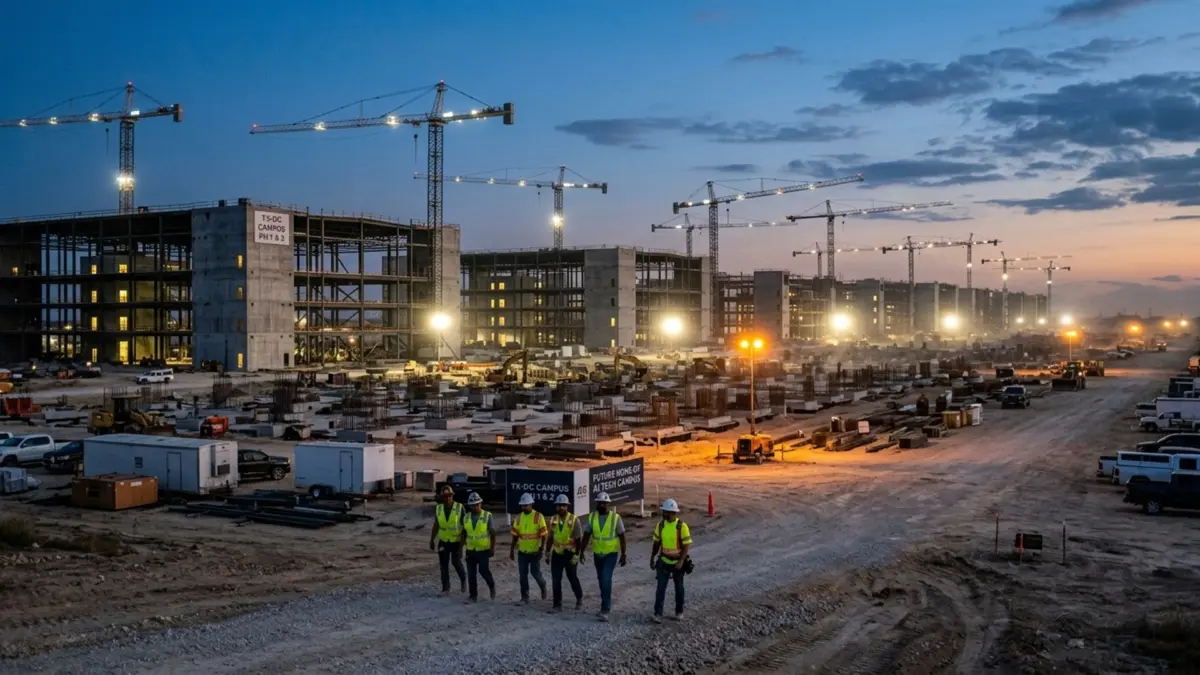
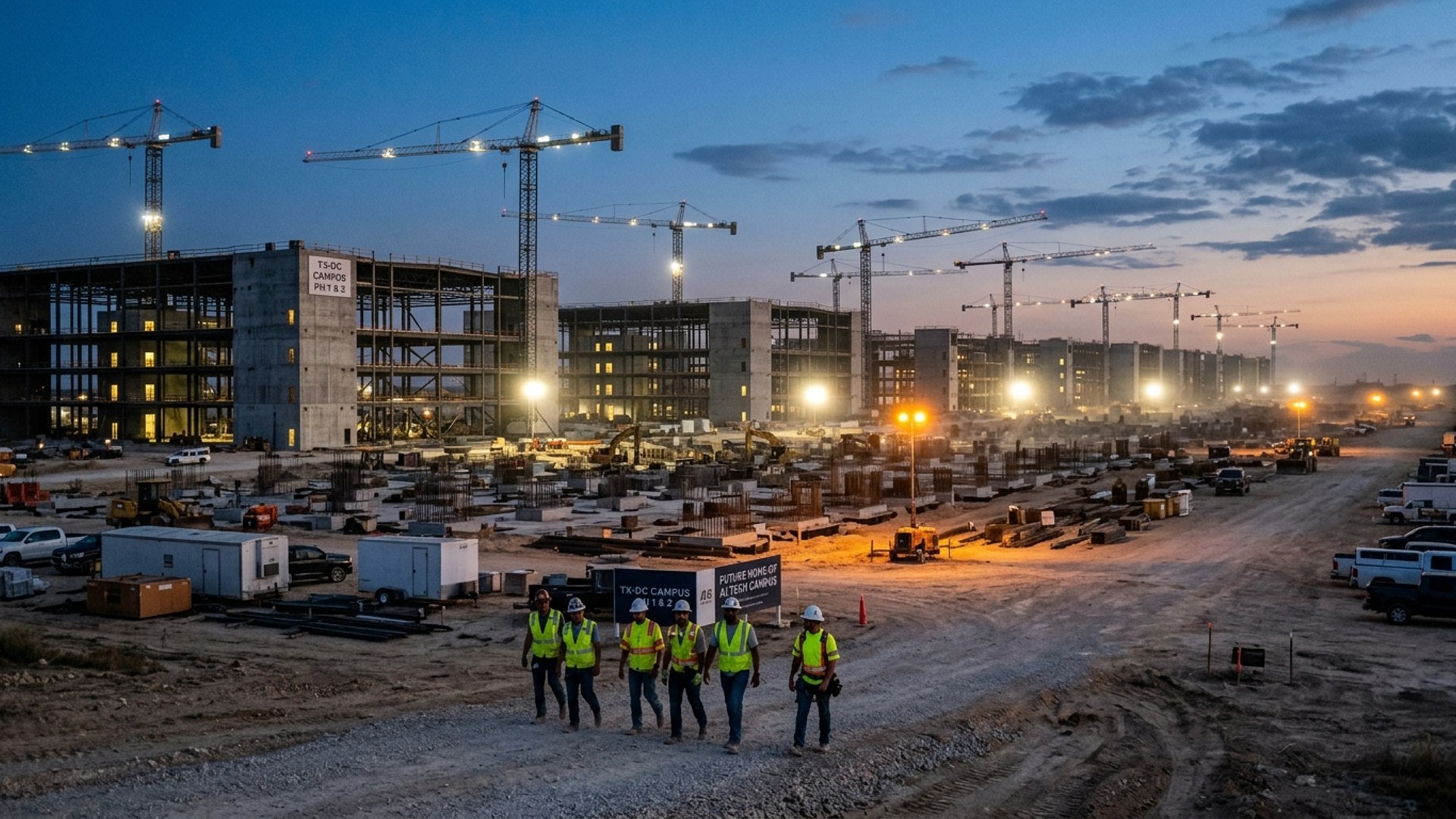
The larger of the two facilities, providing up to $1.85 billion through a dedicated special-purpose vehicle (Nscale Ward County Borrower SPV, LLC), is directed toward a purpose-built AI infrastructure site in Ward County, Texas.
As artificial intelligence models scale past parameters in the tens of trillions, traditional air-cooled data centers have hit thermodynamic walls. To circumvent this, the Texas campus is purpose-engineered from the ground up for high-density, next-generation compute deployments. The facility integrates closed-loop direct liquid cooling (DLC) paired with rear-door heat exchangers (RDHx). This dual thermal-management approach allows Nscale to densely pack advanced AI accelerators without triggering thermal throttling or exorbitant power usage effectiveness (PUE) penalties.
The Ward County capital will directly fund the procurement and deployment of two successive generations of NVIDIA data center platforms:
- NVIDIA GB300 (Blackwell Ultra) systems.
- NVIDIA VR200 (Vera Rubin) systems.
Supporting approximately 275 MW of IT load, this massive power allocation places the Texas site among the largest single-site GPU deployments Nscale has publicly detailed to date. The sheer scale of the 275 MW load underscores the reality of modern grid demands, requiring sophisticated local energy procurement strategies and robust electrical substation integration.
Madison, North Carolina: The Adaptive Retrofit
In contrast to the sprawling greenfield development in Texas, Nscale’s second facility focuses on speed-to-market through adaptive reuse. The Madison, North Carolina project centers on a 96-acre colocation property capable of supporting up to 40 MW of capacity.
Backed by an up to $1.2 billion senior secured delayed draw term loan, this project will finance comprehensive site retrofit capital expenditures, GPU infrastructure installation, and high-performance networking fabrics.
While greenfield builds offer optimal clean-sheet layouts, they are frequently constrained by lengthy permitting, zoning, and utility interconnection timelines. By retrofitting an existing colocation asset in North Carolina, Nscale can fast-track operational readiness, bringing vital AI compute online to service enterprise and hyperscale clients while the longer-lead Texas campus continues its phased construction.
Financing Structure and Institutional Arrangers
The structural sophistication of Nscale’s debt package merits close inspection. Both the Texas and North Carolina facilities are structured as senior secured delayed draw term loans (DDTLs).
The Advantages of Delayed Draw Facilities
For a capital-intensive data center developer, taking down billions of dollars in cash upfront is financially inefficient due to negative carry—paying interest on capital before it is deployed into revenue-generating assets. A delayed draw structure allows Nscale to lock in its financing commitments today while drawing down funds incrementally over time as specific construction milestones, hardware deliveries, and deployment phases are achieved.
Furthermore, the creation of Nscale Ward County Borrower SPV, LLC isolates financial liabilities and ring-fences project-specific cash flows, a mechanism that helps secure the investment-grade ratings assigned to the debt.
Syndicate Leadership
Executing a multi-billion-dollar debt package of this complexity requires elite financial orchestration. J.P. Morgan and Goldman Sachs stepped up as joint lead arrangers, joint bookrunners, and co-structuring agents for both the Ward County and Madison facilities.
Labor was divided strategically between the two banking giants:
- J.P. Morgan served as the lead left arranger for the Ward County, Texas facility.
- Goldman Sachs served as the lead left arranger for the Madison, North Carolina facility.
The ability of these institutions to syndicate and secure investment-grade ratings for the debt highlights a major maturation point in the AI infrastructure sector: Wall Street no longer views AI data centers as speculative tech plays, but as core, utility-like infrastructure assets capable of generating predictable, long-term cash flows.
Future Outlook: The Full-Stack AI Vision
Nscale positions itself not merely as a real estate landlord or a colocation provider, but as a full-stack AI cloud platform. The company bridges the gap between foundational physical assets—such as real estate, power grids, liquid-cooling systems, and enterprise-grade networking—and an abstracted unified cloud platform tailored specifically for AI model training and inference.
By combining owned and colocated data centers with managed software, compute, and storage services, Nscale aims to capture value across the entire AI value chain.
Industry Implications
As we look toward the remainder of 2026 and into 2027, Nscale’s $3 billion U.S. debt close serves as a bellwether for the artificial intelligence industry at large:
- Hardware Transitions are Well-Funded: The explicit commitment to fund NVIDIA GB300 (Blackwell Ultra) and VR200 (Vera Rubin) architectures proves that infrastructure providers are already engineering for post-Blackwell silicon generations.
- The Liquidity Divide: Securing investment-grade ratings for debt backed by compute hardware demonstrates that institutional capital is increasingly accessible, provided the developer possesses deep operational expertise, strong power purchase agreements (PPAs), and tier-one banking partnerships. Smaller players without these credentials may find it increasingly difficult to compete against well-capitalized giants like Nscale.
- Geographic Diversification: By balancing mega-scale greenfield projects in energy-rich states like Texas with rapid-deployment retrofits in North Carolina—while maintaining massive international clusters across Europe and APAC—Nscale is building a resilient, geographically distributed compute fabric designed to withstand regional grid constraints, regulatory shifts, and shifting enterprise demands.
Ultimately, Nscale’s aggressive capitalization strategy illustrates that the race to build the intelligence economy is fundamentally a race for capital, power, and engineering execution. With $3 billion in new senior secured commitments locked in, Nscale has armed itself with the financial firepower necessary to remain at the forefront of the global AI compute revolution.

