

Executive Overview
The landscape of enterprise cloud security is undergoing a profound and structural transformation. According to the Cloud Security Alliance’s (CSA) highly anticipated Top Threats to Cloud Computing Survey Report 2026, the foundational paradigms governing digital infrastructure protection have shifted dramatically. For years, the primary anxieties of Chief Information Security Officers (CISOs) and cloud architects centered on infrastructural configuration errors—the accidental exposure of S3 buckets, mismanaged firewall rules, or lax oversight during manual infrastructure-as-code deployments. However, the latest threat landscape paints an entirely different picture.
Identity and Access Management (IAM) has officially dethroned misconfiguration to claim the number-one spot as the foremost cloud security concern. Simultaneously, the rapid, unchecked integration of artificial intelligence (AI) across corporate architectures has forced two AI-related vulnerabilities directly into the top rankings for the very first time.
The CSA’s Top Threats Working Group arrived at these conclusions by surveying 507 qualified cybersecurity professionals. These experts evaluated and ranked 23 distinct cloud security issues, distilling them into a definitive Top 11 list led by identity management, AI integration, compromised third-party resources, and Application Programming Interface (API) vulnerabilities. This strategic report is designed to provide risk managers, compliance officers, technology executives, and information security personnel with an authoritative roadmap. By highlighting how threats have mutated since the previous 2024 assessment, the report underscores a pivotal macro-trend: organizations are no longer primarily imperiled by flaws in the underlying hardware or the cloud service providers (CSPs) themselves. Instead, vulnerabilities now stem from how humans, software supply chains, interconnected ecosystems, and autonomous algorithms interact within the cloud.
Detailed Chronology: The Shifting Architecture of Cloud Risk
To fully comprehend the gravity of the 2026 findings, one must analyze the trajectory of cloud threats over recent cycles. The transition from the 2024 survey results to the 2026 index illustrates a fundamental realignment of operational priorities among enterprise defenders.

The 2024 Baseline: Infrastructure and Configuration Dominance
During the 2024 survey cycle, the cloud security conversation was dominated by tangible configuration oversight. "Misconfiguration and inadequate change control" reigned supreme as the industry’s number-one threat. In complex multi-cloud and hybrid environments, the sheer volume of moving parts meant that human error during manual updates or automated rollouts frequently left massive enterprise perimeters exposed.
Back in 2024, Identity and Access Management sat comfortably—yet anxiously—at the number-two position. While security teams recognized that compromised credentials and overly permissive roles were dangerous, the immediate panic of an unpatched server or an open cloud storage bucket usually took precedence. Furthermore, third-party resource risks hovered around the number-five spot, and Advanced Persistent Threats (APTs) were buried lower down the list at number 11. Most importantly, AI-specific risks were nascent, fragmented, and largely absent from formal top-tier consensus rankings.
The 2026 Paradigm Shift: Identity, AI, and Interconnectivity
Fast-forward to the 2026 report, and the hierarchy has been upended. Identity and Access Management has surged past misconfigurations to capture the number-one rank. This change reflects the reality of the modern corporate perimeter: with the physical network boundary dissolved by remote work and Software-as-a-Service (SaaS) adoption, identity has become the new perimeter.
Concurrently, misconfiguration and inadequate change control have dropped to number five. This is not because misconfigurations have ceased to matter, but rather because organizations have automated baseline hardening and posture management tools (such as CSPM), effectively taming the chaos of raw configuration errors.
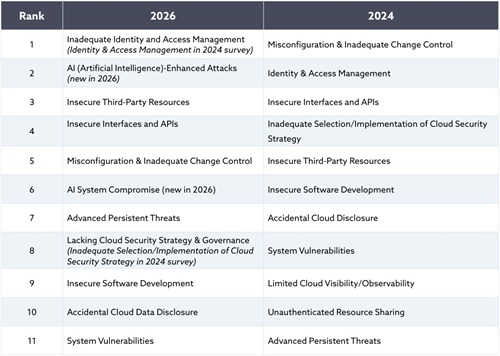
In their place, new and more insidious vectors have risen. Insecure third-party resources climbed significantly from number five to number three, driven by relentless supply chain attacks targeting open-source repositories and third-party vendors. Meanwhile, Advanced Persistent Threats jumped from number 11 to number 7, demonstrating that sophisticated state-sponsored actors and cybercriminal syndicates are aggressively targeting cloud environments for long-term espionage and financial extortion.
Most notably, 2026 marks the watershed moment when artificial intelligence officially enters the CSA Top 11 matrix. The integration of large language models (LLMs), machine learning pipelines, and automated decision-making frameworks has introduced entirely new attack surfaces—ranging from prompt injection and model poisoning to data exfiltration via AI agents—that security teams are ill-equipped to handle.
Supporting Context & Metrics: Deconstructing the 2026 Top 11
The data compiled by the CSA underscores a remarkably compressed threat landscape. The survey scores—derived from the weighted responses of 507 cybersecurity professionals—were tightly clustered, indicating that modern organizations are besieged on multiple fronts simultaneously rather than fighting a single dominant enemy. The scores range from a high of 7.95 for the top-ranked issue down to 7.45 for the number-11 position.
Moving Beyond the Traditional Infrastructure Stack
A striking revelation of the 2026 report is what was left out of the Top 11. Traditional infrastructure-level vulnerabilities and hyperscaler-dependent risks have dropped below the cutoff line. Issues such as:

- Denial-of-Service (DoS) attacks
- Shared technology vulnerabilities
- Cloud service provider (CSP) data loss events
- Unauthenticated resource sharing
- Limited cloud visibility and observability
…all ranked below the top tier this year. This downward migration signifies a maturing cloud ecosystem. Enterprise leaders have largely gained confidence in the foundational security posture of major hyperscalers (such as Amazon Web Services, Microsoft Azure, and Google Cloud Platform). Consequently, security budgets and risk management frameworks are pivoting away from infrastructure resilience and toward application logic, identity governance, API security, and AI governance.
The Anatomy of the Top Threats
While the CSA report encompasses all 23 evaluated issues, the elevation of Identity, AI, third-party dependencies, and APIs paints a vivid picture of the modern threat vector:
- Identity and Access Management (IAM): The crown jewel of modern risk. Over-privileged service accounts, dormant user credentials, lack of multi-factor authentication (MFA) enforcement, and complex permission inheritance models within cloud environments create gaping holes that attackers routinely exploit via credential stuffing and session hijacking.
- Artificial Intelligence (AI) Risks: Entering the rankings for the first time as a dual-threat category, AI encompasses both the security of the AI infrastructure itself (protecting model weights, training data, and pipelines) and the malicious deployment of AI by adversaries to scale up automated social engineering and vulnerability discovery.
- Insecure Third-Party Resources: Modern cloud native applications are assembled, not built from scratch. Relying on thousands of third-party libraries, container images, and external SaaS integrations creates a sprawling software supply chain where a single compromised vendor compromises downstream enterprise clients.
- API Insecurity: APIs are the nervous system of the cloud, facilitating communication between microservices, mobile apps, and third-party platforms. Inadequate authentication, broken object-level authorization (BOLA), and excessive data exposure make APIs prime targets for data harvesting.
Official Statements and Expert Analysis
Industry leaders and authors of the CSA report have been vocal about what these findings mean for the future of enterprise architecture.
Security analysts note that the 2026 data reflects a psychological maturation within the cybersecurity industry. For years, organizations suffered from "infrastructure anxiety," pouring capital into hardening the underlying cloud fabric while ignoring the software applications and identity ledgers running on top of it. The new ranking proves that the cloud is secure as a platform, but insecurely configured and governed by its human and algorithmic users.

"The cloud threat landscape has fundamentally mutated," remarked a lead researcher involved with the CSA Top Threats Working Group. "We are no longer fighting battles over whether the cloud provider’s servers are secure. We are fighting wars over who has access to the keys (Identity), what autonomous software we are trusting with our enterprise data (AI), and how deeply integrated our supply chains are with untrusted third parties."
Furthermore, governance experts emphasize that the inclusion of AI-related threats is a wake-up call for corporate boards. Many enterprises rushed to deploy generative AI tools and enterprise LLMs to maintain a competitive edge, often bypassing traditional security review boards. The CSA report serves as official validation that AI is not a peripheral tech experiment; it is an enterprise-grade attack surface that demands rigorous compliance, continuous monitoring, and structured risk-prioritization frameworks.
Future Outlook: Navigating Risk in the Age of Cloud-Native AI
As organizations look toward the remainder of the decade, the 2026 CSA report provides a clear blueprint for where capital and engineering hours must be allocated.
1. Zero Trust as a Non-Negotiable Standard
With Identity reigning as the number-one threat, organizations must accelerate their transition to a Zero Trust Architecture (ZTA). Implicit trust based on network location or initial authentication must be replaced by continuous, context-aware verification. Micro-segmentation, dynamic access controls, and automated identity governance (such as just-in-time privilege escalation) will become the baseline defenses required to keep credential-based breaches at bay.

2. Operationalizing AI Security (AI-SPM)
The arrival of AI in the threat rankings signals the birth of a new discipline: AI Security Posture Management (AI-SPM). Enterprises must inventory their AI assets just as rigorously as they inventory servers and databases. Security teams will need to implement specialized tooling to scan training datasets for poisoning, monitor LLM inputs and outputs for prompt injection attacks, and enforce strict data loss prevention (DLP) policies to prevent proprietary corporate data from leaking into public foundational models.
3. Fortifying the Software Supply Chain
Because insecure third-party resources and APIs occupy prominent positions in the 2026 index, visibility must extend far beyond the corporate perimeter. Software Bill of Materials (SBOMs) and automated dependency-scanning pipelines must become mandatory for all cloud-native application development. Knowing every line of third-party code and every external API connection is no longer an optional best practice—it is an existential survival metric.
Conclusion
The Cloud Security Alliance’s 2026 Top Threats report is more than a survey; it is an evolutionary milestone. It signals that the era of treating cloud security as a mere infrastructural checklist is over. As identity takes center stage and artificial intelligence reshapes the threat horizon, enterprises must adapt their governance models, security tooling, and risk appetites. Those that fail to secure their identities and govern their AI deployments will find themselves uniquely vulnerable in an increasingly automated and interconnected digital world.

