
By Theo Nash
AI Infrastructure Specialist, Unite.AI
Executive Overview
In a decisive strategic pivot that signals a fundamental shift in venture capital focus, Silicon Valley titan Andreessen Horowitz (a16z) has officially announced the launch of the Machine Age Fund—a massive $1.1 billion vehicle dedicated entirely to the physical infrastructure underpinning the artificial intelligence revolution. Unveiled on August 28, 2026, the fund represents a departure from the firm’s historical identity as a software-first powerhouse, cementing its aggressive entry into heavy hardware, advanced manufacturing, and deep-tech scaling.
Authored jointly by general partners Ben Horowitz, Martin Casado, Raghu Raghuram, David Ulevitch, and David George, the official launch manifesto bluntly characterizes the initiative: "It’s time to open the throttle and accelerate the physical buildout of AI."
For years, the generative AI boom has been defined by algorithmic leaps, parameter scaling, and software breakthroughs. However, as frontier models demand unprecedented quantities of compute, electricity, and raw materials, the primary bottleneck to artificial intelligence has shifted decisively from code to concrete, silicon, and copper. With the Machine Age Fund, a16z is positioning itself at the epicenter of this hardware-driven industrial transformation, targeting everything from foundational semiconductor fabrication and hyper-scale data center design to next-generation robotics and electrical grid integration.
Detailed Chronology: The Evolution of a Hardware-First Vision
While the formal unveiling of the $1.1 billion Machine Age Fund on August 28, 2026, marks a watershed moment, it is the culmination of a multi-year institutional evolution at a16z. To understand how a software-centric venture capital firm mustered the appetite and technical depth to deploy over a billion dollars into heavy hardware, one must trace the convergence of venture deal flow, internal talent acquisition, and compounding global infrastructure constraints.
The Shift in Deal Flow
Over the preceding two years, leadership at a16z noted a profound structural shift in inbound entrepreneurship. Historically, hardware startups represented a marginal fraction of the firm’s overall deal flow—overshadowed by SaaS platforms, consumer apps, and decentralized software protocols. However, as the computational requirements of deep learning models exploded, the percentage of hardware and deep-tech pitches crossing the firm’s desks surged past 20%. Founders were no longer just building wrappers or apps; they were designing custom ASICs, developing novel thermal cooling loops, and inventing new paradigms for power distribution.
Strategic Early Bets
This rising tide of hardware innovation did not catch a16z unawares. The firm had quietly spent the preceding decade building a robust muscle memory in physical systems investing. Key milestones in this trajectory included:
- 2016: Leading the Series A funding round for drone innovator Skydio, recognizing early on the intersection of autonomous flight software and specialized hardware.
- The Defense & Autonomy Push: Directing capital into marquee defense tech and autonomy leaders, including strategic checks into SpaceX, pioneering defense contractor Anduril in 2019, and securing a front-row seat as an early-stage venture investor in Waymo’s landmark 2020 funding round.
- The "American Dynamism" Practice: Establishing a specialized investment thesis championed by partners like David Ulevitch and Erin Price-Wright, focusing heavily on U.S. manufacturing, aerospace, supply chain resilience, and defense infrastructure.
Assembling the Technical Dream Team
Recognizing that investing in sub-atomic silicon design, high-voltage electrical architecture, and modular data center construction requires more than traditional financial acumen, a16z systematically fortified its internal bench with seasoned industry veterans.
- Guido Appenzeller, former Chief Technology Officer of Intel’s Data Center Group, brought deep enterprise-grade hardware and silicon insights to the firm.
- Raghu Raghuram and Martin Casado contributed decades of executive and operational experience navigating the complexities of data center scaling and enterprise networking.
- Shangda Xu and David George spearheaded investments spanning the full breadth of the AI compute stack—bridging foundational silicon, optical networking, and distributed compute platforms.
By mid-2026, this fusion of technical pedigree, specialized go-to-market teams, and surging market demand created the exact conditions necessary to operationalize the Machine Age Fund.
Supporting Context & Metrics: Navigating the Physical Limits of Compute
The rationale behind the Machine Age Fund is not merely speculative; it is anchored in hard, unforgiving engineering metrics. In their launch announcement, the a16z partners detailed the staggering scaling trajectory of AI infrastructure, highlighting how contemporary compute demands are colliding violently with the laws of physics and the capabilities of legacy supply chains.
Compute Density and Thermal Escalation
The evolution of accelerated computing hardware over just a few generations illustrates an exponential curve that legacy facilities were never engineered to support:
- Rack Density Multipliers: Compute density per rack has catapulted forward. Transitioning from traditional architectures to advanced NVIDIA-class platforms (such as the shift from H100 configurations to Rubin generations) has driven a 28-fold increase in compute density per rack.
- The Power Wall: Rack power requirements have undergone a seismic shift. While standard enterprise server racks historically operated within a modest 5 to 10-kilowatt envelope, current high-performance AI clusters demand 100 to 250 kilowatts per rack. Industry projections indicate that rack power draw will breach the 1-megawatt threshold within the next three years.
- Campus-Scale Expansion: Data center footprints are correspondingly expanding from tens of megawatts to hundreds of megawatts, with hyper-scalers now routinely planning and constructing gigawatt-scale campuses.
The Copper and Voltage Crisis
To visualize the severity of these constraints, one need only examine the physical limitations of legacy power distribution within data centers. According to technical documentation referenced from NVIDIA’s 800V DC (Direct Current) architecture initiative—designed specifically to support 1-megawatt IT racks starting in 2027—traditional data center designs are reaching their absolute physical limits.
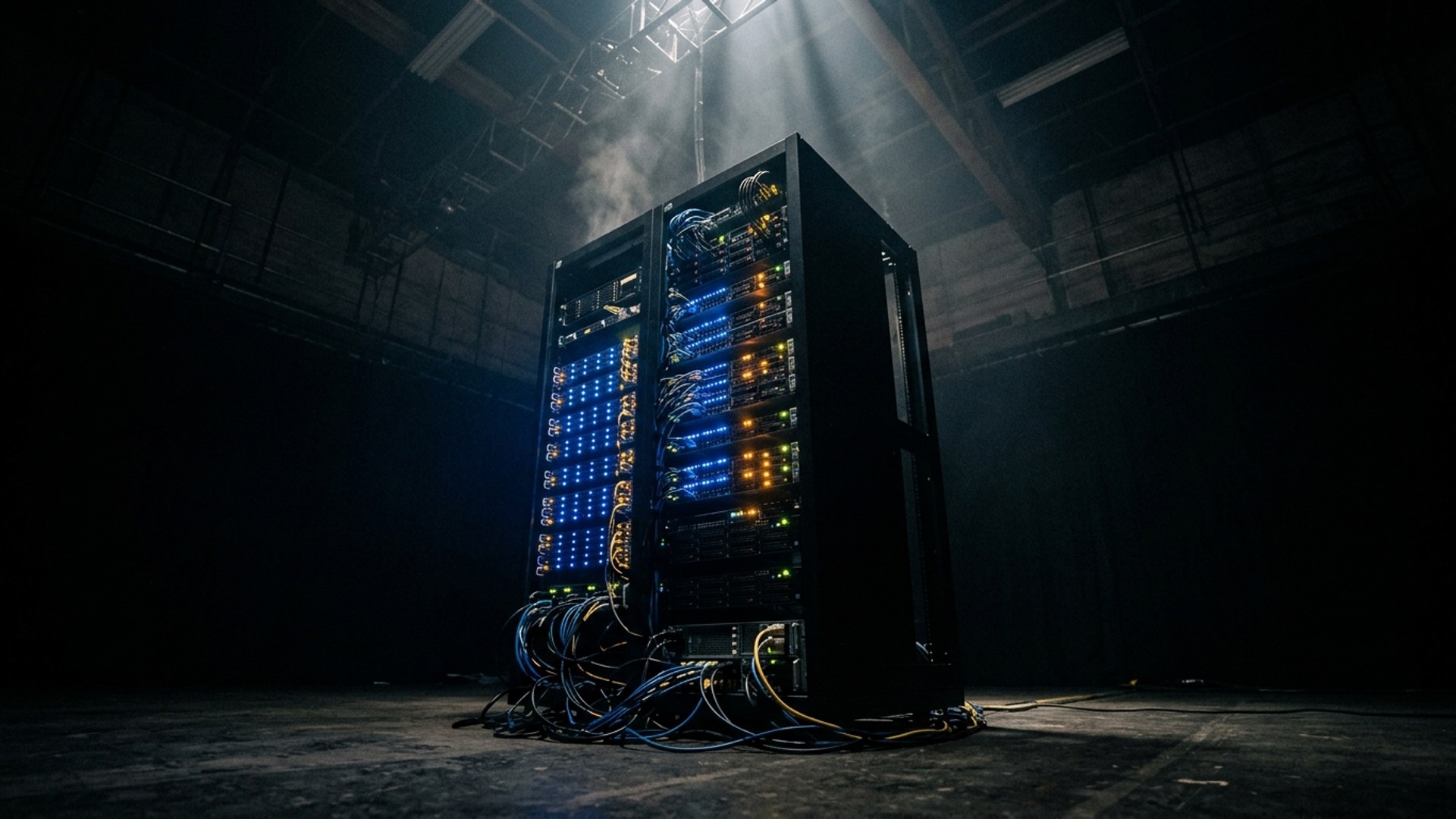
For decades, data centers have relied on 54-volt in-rack power distribution, which is well-suited for kilowatt-scale workloads. However, attempting to power a 1-megawatt rack using legacy 54-volt distribution creates an insurmountable physical barrier: it would require up to 200 kilograms of copper busbar per single rack, rendering the design structurally and economically unviable due to weight, resistance, and space constraints. Overcoming this requires a complete re-architecting of power delivery down to the sub-station and electrical busbar level.
[Legacy 54V Architecture] ---> 1MW Rack = ~200 kg of Copper Busbar (Unsustainable)
[Next-Gen 800V DC Architecture] ---> 1MW Rack = Optimized High-Voltage Delivery (2027+)
The Supply Chain Disconnect
Compounding these electrical hurdles is a fundamental mismatch in velocity between traditional hardware manufacturing and software-era growth expectations. The hardware supply chain—encompassing semiconductor foundries, packaging facilities, rare-earth material refiners, and precision cooling manufacturers—has historically been accustomed to steady, compounding annual growth rates of 20% to 30%.
Today’s generative AI ecosystem, however, demands sustained triple-digit growth. Bridging this chasm requires an unprecedented injection of capital, engineering ingenuity, and entrepreneurial grit to overhaul the entire physical stack.
Official Statements: Inside the Mind of the General Partners
The launch announcement serves as both an investment thesis and a clarion call to the engineering community. Authored by Ben Horowitz, Martin Casado, Raghu Raghuram, David Ulevitch, and David George, the manifesto emphasizes that the challenges facing the AI industry run far deeper than chip shortages.
"Every layer of this stack is hitting the limits of today’s supply chain capability, and of physics and computer science," the partners wrote.
The scope of the Machine Age Fund explicitly extends down to the sub-electrical level, treating the current technological epoch as a generational opportunity to re-engineer foundational platforms. According to the firm, the ecosystem requires a coordinated overhaul across multiple verticals:
- Silicon and Accelerators: Faster, more efficient compute systems, specialized application-specific integrated circuits (ASICs), and advanced heterogeneous packaging.
- Memory Architectures: Cheaper, higher-bandwidth memory subsystems capable of feeding data-hungry transformer models without introducing latency bottlenecks.
- Interconnects and Networking: Faster, highly scalable interconnect fabrics capable of moving past the physical limits of traditional copper cabling—accelerating the shift toward advanced optical networking and photonics.
- Power and Thermal Management: Breakthroughs in liquid cooling, advanced phase-change materials, high-voltage electrical distribution systems, and efficient edge devices.
- Real Estate and Energy Integration: Innovative approaches to data center real estate, including behind-the-meter and captive power generation sources (ranging from advanced nuclear small modular reactors to localized renewables) operating in tandem with strained public electrical grids.
Portfolio Preview: Early Bets and Future Focus
Even prior to the formal announcement of the $1.1 billion fund, a16z had begun quietly populating its hardware pipeline with high-potential early-stage ventures. The firm highlighted several key portfolio companies already addressing critical bottlenecks in the physical AI stack:
- Unconventional AI: Pioneering novel approaches to semiconductor design and computing efficiency.
- Nexthop: Engineering advanced networking and interconnect solutions to eliminate data bottlenecks in large-scale GPU clusters.
- Volta & Atoms: Building infrastructure and manufacturing technologies designed to streamline industrial processes.
- Heron Power & Mind Robotics: Innovating at the intersection of heavy-duty power delivery, grid integration, and physical automation.
These companies join a storied lineage of deep-tech and hardware investments that prove a16z’s historical commitment to the physical world, validating that the firm’s pivot is built on a foundation of operational experience rather than a transient market trend.
Future Outlook: Reshaping the Global AI Landscape
The deployment of Andreessen Horowitz’s $1.1 billion Machine Age Fund arrives at a pivotal juncture in technological history. As software models approach asymptotic limits in intelligence driven purely by parameter scaling, the next frontier of artificial intelligence will be unlocked—or constrained—by physical reality.
By aggressively channeling capital into chips, memory, high-voltage power distribution, cooling systems, and robotics, a16z is effectively betting that the winners of the next decade of AI will not be determined solely by who writes the best transformer architecture, but by who controls the physical factories, energy sources, and silicon supply chains powering them.
For hardware founders, semiconductor engineers, and deep-tech innovators operating in the trenches of thermal dynamics and electrical engineering, the message from Silicon Valley is unambiguous: the throttle is open, the capital is secured, and the race to build the physical foundation of the Machine Age has officially begun.

