

Executive Overview
In a landmark collaborative effort that brings together thirty-seven of the world’s most influential technology, cloud, cybersecurity, and enterprise software organizations, NVIDIA has spearheaded the launch of the Open Secure AI Alliance. This major industry initiative is designed to address a critical, rapidly escalating vulnerability in the modern enterprise architecture: the security infrastructure surrounding autonomous AI agents.
While the broader conversation surrounding artificial intelligence security has historically focused inward—primarily fixated on algorithmic safety, data poisoning, prompt injection defenses, and the foundational integrity of the models themselves—the Open Secure AI Alliance takes a radically expansive approach. It shifts the protective lens toward the peripheral ecosystem. The alliance aims to secure the surrounding infrastructure that allows AI agents to interact with enterprise networks, databases, and external APIs. This includes identity management, granular permissions, rigorous process isolation, execution harnesses, systemic guardrails, comprehensive logging, and advanced evaluation systems.
The underlying thesis of the alliance is built upon the foundational principles of open-source collaboration and zero-trust architecture. As artificial intelligence transitions from conversational novelty to autonomous execution—deploying "agents" capable of performing multi-step business workflows, modifying software code, and directly executing financial or administrative transactions—the attack surface of the enterprise has expanded exponentially. Traditional perimeter defenses are no longer sufficient to govern software entities that possess dynamic decision-making capabilities.
To combat this, the coalition argues that defenders require transparent systems that they can thoroughly inspect, adapt, and operate on infrastructure they completely control. By establishing a multi-vendor ecosystem, the Open Secure AI Alliance seeks to prevent catastrophic single points of failure, ensuring that no proprietary black-box security framework dictates the operational safety of global enterprise infrastructure.
The roster of inaugural partners reads as a comprehensive "Who’s Who" of the global technology sector. It includes corporate heavyweights such as Adobe, Capital One, Cisco, Cloudera, Cloudflare, CrowdStrike, Databricks, Dell Technologies, Hewlett Packard Enterprise (HPE), Hugging Face, IBM, the Linux Foundation, Microsoft, NetApp, Palo Alto Networks, Red Hat, Salesforce, SAP, ServiceNow, Siemens, Snowflake, and Synopsys.
Despite the immense star power of its founding members, the alliance currently operates with a strategic focus on collaboration rather than immediate product delivery. As of its launch, the group has not yet unveiled a single integrated platform, a definitive reference architecture, or a rigid release schedule. Instead, the immediate focus is on establishing open defense stacks, standardizing cryptographic verifications, and porting proven cloud-native security paradigms—most notably, cloud workload identity frameworks—directly into the emerging agent layer.
Detailed Chronology: The Road to the Open Secure AI Alliance
The genesis of the Open Secure AI Alliance cannot be understood in a vacuum; it is the culmination of years of escalating security challenges brought on by the rapid convergence of cloud computing, microservices, and generative artificial intelligence.

Phase 1: The Cloud-Native Foundation (Pre-2023)
Long before autonomous AI agents became ubiquitous in enterprise software, the technology sector was grappling with the security complexities of distributed systems. The widespread adoption of containerization (via Docker and Kubernetes) and microservices architectures fractured the monolithic application. In doing so, it rendered traditional network-perimeter security models obsolete.
During this era, projects like the Secure Production Identity Framework for Everyone (SPIFFE) and its reference implementation, SPIRE, were developed under the Cloud Native Computing Foundation (CNCF) umbrella. These frameworks were engineered to solve a fundamental problem: how to cryptographically verify the identity of a microservice operating in a heterogeneous, ephemeral cloud environment without relying on static secrets or passwords. These open standards quietly laid the groundwork for modern zero-trust infrastructure, proving that interoperable, cryptographic identity layers could successfully span multi-cloud deployments, virtual machines, and private data centers.
Phase 2: The Generative AI Boom and the Agentic Shift (2023–2025)
The release of OpenAI’s ChatGPT in late 2022 catalyzed an unprecedented gold rush into generative artificial intelligence. For the first eighteen months of the AI boom, the industry was consumed by a race for scale. Companies poured capital into compute infrastructure, expanded parameter counts, and optimized large language models (LLMs) for reasoning and latency.
However, by late 2024 and throughout 2025, the enterprise priority shifted from passive generation to active execution. Organizations moved away from static chat interfaces and began deploying "AI agents"—software constructs capable of autonomously chaining prompts, querying databases, executing API calls, and performing complex, multi-step workflows with minimal human oversight.
This architectural shift introduced unprecedented security vulnerabilities. AI agents were no longer just reading text; they were writing code, executing database queries, transferring funds, and interacting with customer records. Cybersecurity researchers quickly identified that these agents were susceptible to sophisticated manipulation, including indirect prompt injection, unauthorized data exfiltration, and privilege escalation. Crucially, organizations realized that securing the LLM itself was inadequate if the surrounding plumbing—the execution harnesses, permission boundaries, and logging systems—was left exposed or managed through fragmented, proprietary silos.
Phase 3: Conception and Coalition Building (Late 2025 – Mid 2026)
Recognizing that no single vendor possessed the breadth required to secure the entire AI agent lifecycle, industry leaders began behind-the-scenes discussions to establish a unified, open-source defense standard. NVIDIA, leveraging its central position in the AI hardware and software ecosystem, acted as the primary convener.
Discussions centered on the necessity of moving beyond walled gardens. Cloud providers, cybersecurity firms, database giants, and enterprise software vendors recognized that a fragmented security landscape would inevitably lead to systemic vulnerabilities, exploitable gaps between vendor integrations, and heavy vendor lock-in.
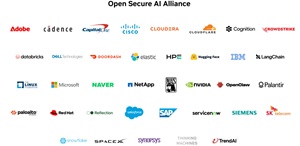
Over a period of several months, thirty-seven organizations coalesced around a shared charter: to build an open defense stack for AI agents that prioritizes user control, cryptographic transparency, and multi-vendor interoperability.
Phase 4: The Official Launch (July 2026)
In July 2026, the alliance formally broke cover. NVIDIA and its thirty-six inaugural partners published simultaneous announcements detailing the formation of the Open Secure AI Alliance. The launch emphasized that open-source methodologies must underpin the security of AI infrastructure, mirroring the historical trajectory of cloud computing.
Simultaneously, key partners like Hewlett Packard Enterprise stepped forward to announce specific technological contributions, most notably the integration of SPIFFE/SPIRE frameworks to bring zero-trust cryptographic workload identity to the agent layer. While concrete product release schedules and unified platforms remained intentionally undefined at launch, the initiative immediately established itself as the definitive industry forum for AI agent security.
Supporting Context & Metrics: The Mechanics of Agent-Layer Security
To understand why thirty-seven global technology leaders felt compelled to form a formal alliance, one must examine the mechanics of modern cloud-native architectures and the unique threat vectors introduced by autonomous AI agents.
The Shift from Model Security to Infrastructure Security
For years, AI security was synonymous with "AI safety"—a discipline dominated by alignment research, toxicity filtering, red-teaming, and jailbreak prevention. While these components remain vital, they address only the cognitive layer of the AI system.
The Open Secure AI Alliance identifies a critical blind spot: the operational layer. An AI model can be perfectly aligned and completely sanitized, yet still wreak havoc on an enterprise if the agent layer wrapping it possesses over-permissioned access to corporate resources.
Consider a typical enterprise deployment:

- The Model: Processes natural language and determines an intent.
- The Harness/Agent Framework: Translates that intent into executable code or API calls.
- The Permissions/Identity Layer: Determines whether the agent is authorized to execute the command.
- The Infrastructure: The cloud containers, databases, and microservices executing the command.
If an attacker successfully executes an indirect prompt injection attack against the model (e.g., hiding malicious instructions within a webpage that the agent is instructed to summarize), the model may inadvertently direct the agent to invoke administrative APIs. If the infrastructure lacks robust identity verification and process isolation, the agent inherits the broad permissions of the human user or the over-provisioned service account it is running under. The Open Secure AI Alliance aims to interlock these components into a hardened, observable pipeline.
Cloud Workload Identity Migrates to the Agent Layer
One of the most profound technical contributions highlighted during the launch is HPE’s integration of the SPIFFE and SPIRE projects into the agent security architecture.
In traditional cloud-native computing, SPIFFE and SPIRE solve the "who am I?" problem for microservices. Using platform-independent cryptographic identities (SPIFFE IDs, often issued as X.509 certificates or JSON Web Tokens), SPIRE ensures that Service A can cryptographically prove its identity to Service B before any data is exchanged. This eliminates the vulnerability of static API keys, hardcoded passwords, and long-lived tokens that can be intercepted or abused if leaked.
By migrating this paradigm to the agent layer, the alliance is effectively treating AI agents and their associated harnesses as autonomous microservices. Through cryptographic verification:
- An AI agent can be assigned a unique, verifiable identity.
- Communication between the agent and downstream enterprise resources (such as a customer relationship management database or a financial ledger) can be subjected to mutual TLS (mTLS) authentication.
- Security policies can be enforced dynamically, ensuring that even if an agent is compromised or tricked, its blast radius is strictly confined to its minimal required permissions.
The SPIFFE/SPIRE infrastructure acts as a uniform identity control plane capable of spanning heterogeneous enterprise environments. Whether an AI agent is running on a virtual machine in AWS, an Azure container instance, a Google Cloud Kubernetes cluster, or an on-premises private data center, the cryptographic attestation remains consistent. Furthermore, SPIFFE’s documented integrations with industry standards—such as Istio, Envoy, Sigstore, Open Policy Agent (OPA), Dapr, and HashiCorp Consul—allow enterprises to weave agent security directly into their existing zero-trust service meshes without rebuilding their entire networking stack from scratch.
Official Statements and Industry Perspectives
The formation of the Open Secure AI Alliance elicited strong statements from key leadership across the technology sector, underscoring the urgency and collaborative spirit of the initiative.
NVIDIA’s Perspective on Open Infrastructure
In its foundational announcements, NVIDIA emphasized the philosophical parallels between the rise of cloud computing and the current trajectory of artificial intelligence. Highlighting that open source has historically been the bedrock of resilient cloud infrastructure, NVIDIA argued that modern cybersecurity defenders cannot afford to rely on closed, opaque, black-box security solutions.

"Defenders need systems they can inspect, adapt, and run on infrastructure they control," the alliance announcement noted.
By pushing for a multi-vendor ecosystem, NVIDIA and its co-founders are actively working to prevent the concentration of security control within any single proprietary platform, ensuring that the foundational guardrails of autonomous agents remain adaptable and transparent to the enterprises deploying them.
HPE and the Zero-Trust Imperative
Hewlett Packard Enterprise emerged as an early technical voice within the alliance, focusing heavily on the operational realities of modern enterprise environments. In its official statement detailing its participation, HPE pointed out that contemporary AI systems are rarely monolithic; they are complex, sprawling assemblies of agent frameworks, execution harnesses, guardrails, governance mechanisms, and models interacting simultaneously across hybrid clouds.
"Modern AI systems depend on agent frameworks, harnesses, guardrails, governance mechanisms, and models that interact with complex enterprise environments," HPE stated.
By contributing its expertise in the SPIFFE and SPIRE projects, HPE underscored its commitment to establishing rigorous, zero-trust identity standards that can mathematically verify agents, services, and workloads before granting access to sensitive corporate data.
The Broad Coalition Landscape
The inclusion of diverse industry players—ranging from cloud giants (Microsoft, IBM) and cybersecurity leaders (CrowdStrike, Palo Alto Networks, Cloudflare) to enterprise software titans (SAP, Salesforce, ServiceNow) and foundational standard-bearers (The Linux Foundation)—signals a unified industry recognition that AI security cannot be solved in vertical silos.
While the alliance has deliberately withheld immediate product announcements or rigid reference architectures, the collective weight of its thirty-seven inaugural partners ensures that whatever standards, protocols, or open-source defense stacks emerge from the collaborative working groups will carry immense gravity across the global enterprise software market.

Future Outlook: What Lies Ahead for the Open Secure AI Alliance
As the Open Secure AI Alliance moves past its initial launch phase, the technology sector is watching closely to see how the organization translates its broad philosophical charter into concrete technical deliverables.
1. Standardization of Agent Interoperability Protocols
The most immediate challenge facing the alliance is the establishment of universal standards for agent communication and telemetry. As enterprises deploy multi-agent systems—where agents built by different vendors must collaborate to complete complex tasks—standardized protocols for passing context, logging actions, and verifying permissions will be paramount. Expect the alliance to form specialized working groups focused on defining open specifications for agent harnesses, log formats, and evaluation metrics.
2. Deepening Integration with Cloud-Native Security Stacks
With HPE spearheading the integration of SPIFFE/SPIRE, the alliance has laid a strong identity foundation. The natural next step will be expanding these integrations across the broader cloud-native landscape. We can anticipate deeper alignment with policy engines like Open Policy Agent (OPA), service meshes like Istio and Linkerd, and software supply chain security tools like Sigstore. This will enable enterprises to govern AI agents using the exact same policy-as-code frameworks they already use for traditional microservices.
3. Overcoming the "Too Many Cooks" Dilemma
With thirty-seven powerful, often competing technology giants seated at the same table, governance and velocity will be critical hurdles. The primary risk facing open consortia of this scale is design-by-committee inertia—where competing commercial interests slow down the standardization process, resulting in bloated frameworks or watered-down specifications. To maintain relevance, the alliance will need to prioritize agility, encouraging open-source code contributions and rapid prototyping over protracted bureaucratic debate.
4. Enterprise Adoption and Regulatory Alignment
Ultimately, the success of the Open Secure AI Alliance will be measured by enterprise adoption. As global regulatory bodies—such as the European Union with its Artificial Intelligence Act—increasingly demand verifiable accountability, transparency, and robust risk management for high-risk AI deployments, enterprises will urgently need turnkey technical solutions to prove compliance. If the alliance can successfully deliver open, inspectable, and multi-vendor-supported defense stacks, it will position itself as the indispensable security backbone for the next generation of autonomous enterprise computing.

