
Executive Overview
For decades, modern education has championed the philosophy of differentiated learning—the understanding that students possess diverse cognitive profiles, sensory needs, and processing speeds that require tailored instruction. Yet, the architectural blueprint of the contemporary school system rarely extends this philosophy to the adults standing at the front of the classroom.
An emerging national conversation, punctuated by insights from expert educators and advocates like Emily Kircher-Morris, has cast a sharp light on a historically overlooked demographic: neurodivergent teachers. Encompassing individuals with Attention-Deficit/Hyperactivity Disorder (ADHD), autism, dyslexia, dyscalculia, and other cognitive variations, neurodivergent educators are vital pillars of modern school communities. They bring exceptional empathy, hyper-focus, creative problem-solving, and authentic representation to their students.
However, they frequently do so at an unsustainable personal cost. Operating within rigid, neuronormative systems that demand relentless multitasking, rapid transitions, and heavy executive functioning, many neurodivergent educators find themselves trapped in cycles of chronic stress, deep-seated self-blame, and professional burnout.
This article explores the realities faced by the "lost generation" of adult educators who grew up without modern frameworks of neurodiversity, the structural mismatches that drain their cognitive reserves, and the actionable, systemic changes required to build a sustainable, equitable teaching profession.
Detailed Chronology: From Silent Struggles to the Modern Awareness Shift
To understand the current landscape of neurodivergence in education, one must trace the evolution of diagnostic criteria and societal awareness over the past several decades.

The Era of Oversights: Childhood in the 1970s through the 1990s
Teachers currently in their 30s, 40s, and 50s—the core demographic of mid-career and veteran educators—grew up during a vastly different medical and cultural era. Throughout the late 20th century, diagnostic paradigms for conditions like ADHD and autism were narrow and heavily gendered. ADHD was routinely viewed through a behavioral lens, stereotyped as hyperactive, disruptive behavior predominantly observed in young boys. Girls, quiet achievers, and individuals whose symptoms were internalized rather than externalized were systematically missed.
Similarly, autism diagnoses were largely restricted to early childhood presentations involving severe communication or developmental differences. High-masking individuals, particularly women and girls who learned early to mimic social norms and suppress natural behaviors to fit in, slipped completely through the diagnostic net. Consequently, thousands of individuals who would later enter the teaching profession navigated their formative academic and professional years without a framework for why basic organizational tasks, sensory environments, or transitions felt disproportionately exhausting.
The Turning Point: Parenthood, Podcasts, and Peer Awareness
In recent years, a massive cultural shift has occurred. Fueled by accessible digital media, podcasts, social platforms, and progressive psychological research, public awareness of adult neurodivergence has skyrocketed.
For many educators, the realization of their own neurodivergence arrived serendipitously. Often, it was triggered by their own children receiving formal evaluations for ADHD or autism. As parents sat through diagnostic appointments and reviewed developmental checklists, they recognized eerily familiar lifelong patterns in themselves. For others, exposure to neurodiversity-affirming content on digital platforms provided the missing vocabulary to describe decades of chronic overwhelm, inconsistent productivity, and acute burnout.
This moment of self-discovery is frequently characterized by a complex emotional duality. It brings profound relief—a sudden, validating explanation for why traditional expectations felt insurmountable—intertwined with deep grief for the years spent internalizing failure, masking vulnerabilities, and exhausting oneself to keep pace with neuronormative standards.
Supporting Context & Metrics: The Paradox of the Profession
The irony of the modern educational landscape is striking: educators are formally trained to identify learning differences, document behavioral traits, and implement specialized accommodations for their students. Yet, they are rarely equipped to recognize those exact same traits within themselves, nor are schools structured to accommodate faculty members who operate differently.
The Cognitive Toll of Executive Functioning
Teaching is fundamentally an executive functioning marathon. On any given day, an educator must juggle hundreds of micro-decisions: managing classroom dynamics, remembering to document student interventions, adhering to rigid bell schedules, processing sensory stimuli from dozens of children, and keeping up with endless paperwork and grading.
For a neurodivergent brain—which may struggle with working memory, cognitive flexibility, impulse control, or emotional regulation—this constant shifting of mental gears is deeply taxing.
- The Masking Penalty: To maintain professional standing, many neurodivergent teachers engage in "masking"—suppressing stimming behaviors, forcing eye contact, and overcompensating for executive dysfunction through frantic, last-minute preparation. This continuous self-monitoring consumes vast amounts of cognitive energy, leaving little left for actual instruction or personal well-being.
- The Stigma Barrier: Despite rhetorical commitments to mental health and diversity, institutional stigma remains pervasive. Admitting to difficulties with organization, time management, or sensory overload is often perceived by weary administrators as a lack of competence or professionalism. Consequently, many educators remain silent, choosing quiet burnout over transparent vulnerability.
Strengths That Transform Schools
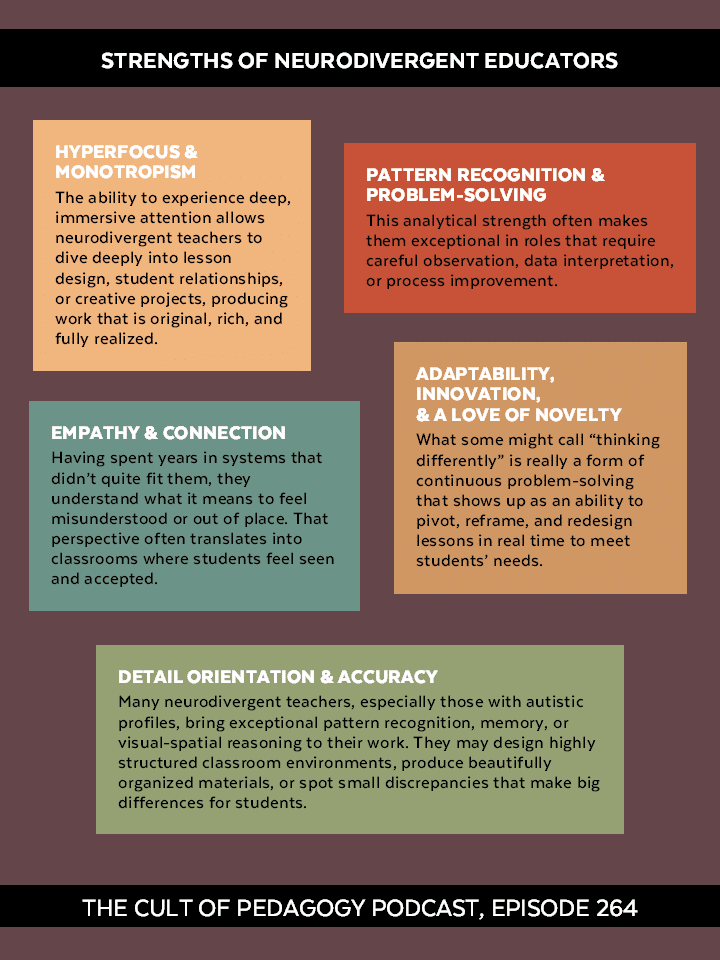
When neurodivergent educators are permitted to work in environments that minimize friction and embrace their cognitive styles, their unique traits become profound professional assets:
- Unmatched Empathy and Validation: Teachers who navigate their own cognitive differences often possess an innate, deep-seated understanding of struggling students. They create psychologically safe classrooms where students realize that diverse ways of thinking are celebrated, not penalized.
- Creative Problem-Solving and Novelty: Neurodivergent brains often thrive on outside-the-box thinking. These educators frequently design dynamic, engaging, and multi-modal lessons that break the monotony of traditional lecture formats.
- Hyper-Focus and Passion: When captivated by a subject or a student-centered initiative, neurodivergent teachers bring a level of intense dedication, energy, and advocacy that revitalizes entire school cultures.
Official Perspectives and Strategies for Sustainable Practice
Addressing the systemic mismatch between neurodivergent educators and traditional school structures requires a dual approach: individual protective strategies and macro-level institutional reforms.
1. Strategies for Neurodivergent Educators
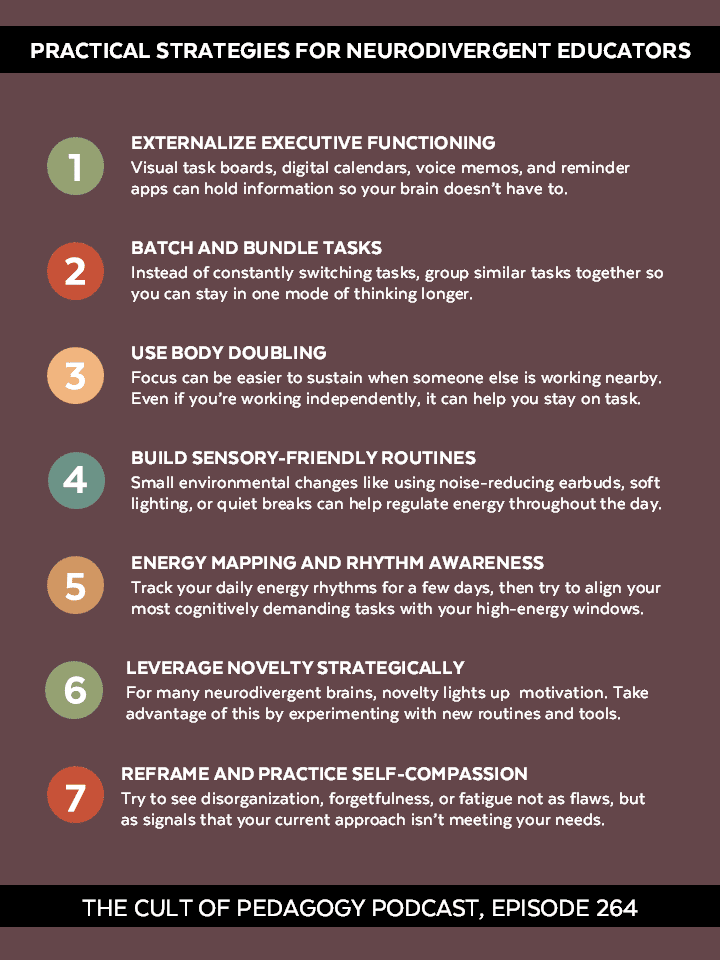
While systemic change remains the ultimate goal, educators can implement practical tools to protect their cognitive energy and reduce daily friction:
- Externalizing Executive Functioning: Relieve working memory by offloading tasks onto digital calendars, visual task boards, voice-memo capture apps, and automated workflows. Make invisible mental workloads visible and tangible.
- Task Batching and Bundling: Minimize the cognitive drain of "gear-shifting" by grouping similar tasks together. Dedicate specific, uninterrupted blocks of time exclusively to grading, answering parent emails, or drafting lesson plans.
- Utilizing Body Doubling: Leverage the psychological momentum of working alongside a colleague or participating in virtual co-working sessions to maintain focus and initiate challenging administrative tasks.
- Building Sensory-Friendly Routines: Mitigate sensory overload by introducing noise-reducing earbuds, softening harsh overhead fluorescent lighting with lamps or natural light, and scheduling intentional, grounding micro-breaks between classes.
- Energy Mapping and Rhythm Awareness: Track daily energy levels over two weeks to identify natural peaks and valleys. Align cognitively demanding work with high-energy windows and reserve low-energy periods for routine tasks.
- Cultivating Radical Self-Compassion: Reframe organizational struggles or fatigue not as personal moral failures, but as objective feedback indicating that current environmental systems are misaligned with personal needs.
2. Responsibilities of School Administrators
Systemic equity requires school leaders to actively differentiate support for staff members just as they expect teachers to differentiate for students:
- Flexible Working Conditions: Allow flexibility in administrative compliance where possible, focusing on instructional outcomes rather than rigid, superficial markers of organization.
- Transparent Communication: Provide clear, explicit expectations and written instructions for institutional policies to eliminate ambiguity and reduce anxiety for neurodivergent staff.
- Sensory-Conscious Spaces: Design staff rooms and workspaces that offer quiet zones, lower lighting options, and relief from constant sensory stimulation.
- Cultivating Psychological Safety: Foster a leadership culture where vulnerability is welcomed, mental health is openly prioritized, and asking for support is treated as standard professional practice rather than a weakness.
Future Outlook: Redefining Professionalism in Education
The ongoing conversation surrounding neurodivergent educators signals a broader, much-needed transformation in how the education sector defines professionalism and success.
True systemic inclusion transcends superficial awareness campaigns or celebratory heritage months. It requires building school environments that prize sustainability, authenticity, and human well-being over perfectionistic compliance. When school districts intentionally redesign their structures to support neurodivergent staff, the positive ripple effects are felt universally.
Students who witness their teachers openly utilizing visual schedules, taking sensory breaks, or discussing cognitive patterns learn an invaluable lesson: diversity is a natural, beautiful facet of the human condition, and accommodation is a tool for strength, not shame.
By shifting the focus away from trying to "fix" neurodivergent educators and placing the emphasis squarely on fixing rigid, outdated institutional systems, schools can cultivate environments of genuine belonging. In doing so, they not only stem the tide of teacher burnout but also build vibrant, resilient communities where every educator and every student can thrive exactly as they are.

