
EXECUTIVE OVERVIEW
In an era characterized by hyper-digital saturation, shortened attention spans, and an unprecedented rise in childhood anxiety, educators, clinicians, and researchers are increasingly looking backward to move forward. The great outdoors—long recognized for its restorative aesthetic—is rapidly emerging as a powerful, empirically supported cognitive laboratory. At the center of this movement is the intersection between the natural world and the development of executive functioning (EF) skills: the foundational, brain-based management system of the mind.

Executive functioning encompasses the neurocognitive processes that allow humans to plan, focus attention, remember instructions, juggle multiple tasks successfully, and regulate impulses. Often managed by the prefrontal cortex, these skills are not fully innate; they must be cultivated, practiced, and strengthened over time. While traditionally addressed in structured, indoor classroom settings through worksheets and targeted behavioral interventions, a growing body of scientific literature suggests that green spaces provide an optimal, highly motivating ecosystem for wiring and strengthening these exact mental muscles.
This comprehensive report explores the neurological mechanisms linking nature to cognitive enhancement, details a robust framework of outdoor and nature-based interventions for children and adolescents, and outlines how schools and families can integrate these practices to foster resilience, self-regulation, and academic success.

DETAILED CHRONOLOGY: THE SHIFT FROM INDOOR REMEDIATION TO ECO-COGNITIVE THERAPY
The integration of the natural world into clinical psychology and educational frameworks did not happen overnight. It represents a paradigm shift born from decades of interdisciplinary research tracking the detriments of indoor sedentarism and the corresponding benefits of ecological exposure.
Phase 1: The Recognition of Attention Fatigue (Late 20th Century)
In the 1980s and 1990s, environmental psychologists Rachel and Stephen Kaplan formulated Attention Restoration Theory (ART). They posited that urban environments and modern tasks require "directed attention," a finite resource that leads to mental fatigue and directed attention fatigue. Conversely, nature elicits "soft fascination"—effortless attention held by clouds, moving water, or rustling leaves—which allows the brain’s executive control network to replenish itself. This foundational work laid the groundwork for viewing nature not merely as a recreational outlet, but as a cognitive restorative.

Phase 2: The Digital Revolution and the Executive Function Crisis (2000–2015)
As smartphones, tablets, and structured indoor schedules came to dominate the daily lives of children and teens, educators noted a simultaneous decline in foundational self-regulation skills. Classrooms reported rising rates of deficits in task initiation, emotional control, and working memory. During this period, researchers began mapping these behavioral challenges directly to underdeveloped executive functioning. Clinical interventions traditionally relied on cognitive-behavioral therapy (CBT) and specialized desk-based curricula. However, compliance and engagement remained hurdles for youth suffering from burnout and frustration.
Phase 3: The Empirical Boom and the "Green Gymnasium" Model (2015–Present)
Recent years have seen a surge in large-scale epidemiological and neuroimaging studies validating the cognitive dividends of green time. Landmark studies—including a 20-thousand-person study published in Scientific Reports linking two weekly hours in nature to enhanced well-being, alongside extensive meta-analyses in public health journals—have moved nature-based interventions from the fringes of alternative education to the forefront of evidence-based developmental practices. Today, educators refer to the outdoors as a "green gymnasium," where executive functioning skills like cognitive flexibility, working memory, and impulse control are systematically trained through experiential, immersive play and observation.

SUPPORTING CONTEXT & METRICS: THE SCIENCE OF THE OUTDOOR BRAIN
Why is nature uniquely positioned to build executive functioning skills? The answer lies in both neurology and physiology.
- Stress Hormone Reduction: Clinical data demonstrates that spending as little as 20 minutes in a natural environment significantly reduces salivary cortisol levels—the primary stress hormone. High stress hijacks the prefrontal cortex, shutting down executive functioning and shifting the brain into a survival-driven "fight or flight" mode. By calming the nervous system, nature creates the biological safety required for higher-order thinking.
- Cognitive Load Balancing: Unlike digital media, which bombards the brain with rapid, high-intensity stimuli designed to trigger dopamine loops, nature provides a balanced sensory diet. This allows children to practice self-regulation without feeling overwhelmed, building their tolerance for sustained, independent focus.
- Enhanced Neuroplasticity through Physical Activity: Natural terrains—uneven ground, trails, dirt, and gradients—require constant, micro-adjustments in motor planning, spatial awareness, and balance. This physical engagement stimulates neuroplasticity, reinforcing the neural pathways shared by motor control and executive planning.
OFFICIAL STATEMENTS & EXPERT PERSPECTIVES
Child development specialists and educational researchers emphasize that executive functioning is the single best predictor of lifelong success, often outweighing IQ in determining academic achievement, emotional health, and vocational stability.

"Executive functioning skills are the air traffic control system of the brain," notes a leading developmental psychologist specializing in childhood self-regulation. "When children are trapped indoors under fluorescent lights, trying to sit still and process abstract concepts, their mental air traffic control towers are easily overwhelmed. Nature acts as an organic control tower reset, teaching kids how to navigate distractions, shift gears flexibly, and stay anchored to a goal."
Educators implementing outdoor curricula echo these sentiments, noting a marked decrease in behavioral referrals and an increase in peer collaboration.

"When we take children outside and give them a structured yet open-ended challenge—like mapping a garden, tracking the lifecycle of a plant, or managing an unstructured group game—we aren’t just giving them fresh air," states an educational program director. "We are forcing them to practice task initiation, problem-solving, and impulse control in real-time, high-motivation environments."
PRACTICAL FRAMEWORK: 13 NATURE-BASED ACTIVITIES TO BUILD EXECUTIVE FUNCTIONING
To bridge the gap between theory and practice, educators, counselors, and parents can utilize a wide array of structured outdoor activities designed to target specific executive functioning domains. Any green space—ranging from a school courtyard to a local park or wooded trail—can serve as the venue.

1. The Wonder Walk (Focus: Metacognition, Attention, Flexibility)
A Wonder Walk invites participants to abandon rigid itineraries and focus entirely on elements that spark curiosity. As children walk, they compile a "wonder list"—voicing questions about why the sky is a particular shade or how birds communicate. This activity trains cognitive flexibility and intrinsic motivation by encouraging learners to generate their own lines of inquiry and pursue answers through subsequent research.
2. Finding the ABCs (Focus: Metacognition, Attention, Self-Control)
This exercise leverages alphabetization to anchor attention in the physical environment. Participants must locate a natural object corresponding to each letter of the alphabet sequentially (e.g., "A" for acorns or air, "B" for bark). If distractions pull a child off-task, the alphabet structure provides a clear scaffolding to pull their focus back on track, exercising inhibitory control.

3. Outdoor Mindful Breathing (Focus: Self-Control, Attention)
Using natural props like blowing bubbles, spinning pinwheels in the breeze, or practicing animal-inspired breathing techniques (such as "bear breathing" or "butterfly breathing" in spring), children learn somatic self-regulation. These tangible routines give youth an accessible, portable self-soothing tool to deploy whenever emotional regulation wavers.
4. Planning and Planting a Garden (Focus: Planning, Organization, Task Initiation)
Gardening is a masterclass in executive functioning. The multi-step process requires children to research plant needs, compile material lists (soil, seeds, tools, water), organize a timeline, and initiate physical labor. Because gardening requires sustained effort over weeks and months, it builds exceptional perseverance and long-term planning capabilities.

5. Unstructured Free Play (Focus: Flexibility, Attention, Perseverance, Time Management)
In an over-scheduled world, unstructured free play allows children to negotiate social rules, invent games, and solve interpersonal conflicts organically. This autonomy requires high-level cognitive flexibility as children adapt to changing play dynamics and manage their time without adult oversight.
6. Nature-Focused Brain Breaks (Focus: Self-Control, Attention)
When outdoor access is limited, bringing nature indoors via guided visualization—such as imagining soaring over a landscape like a hawk while practicing deep breathing—replenishes mental energy and provides a neurological reset for tired students.

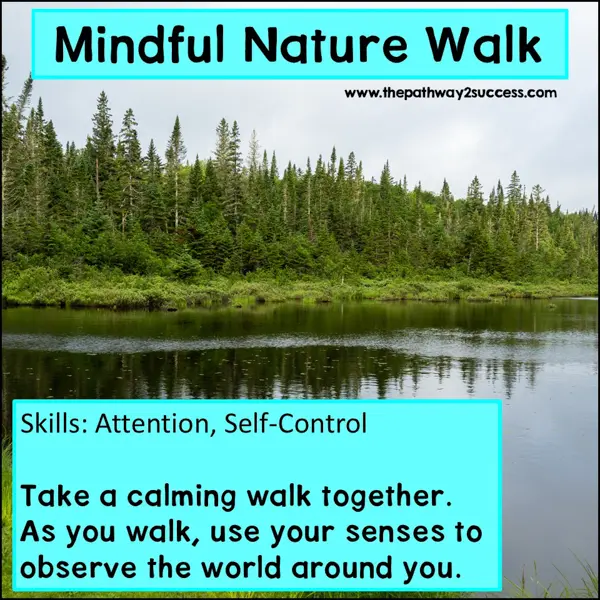
7. The Mindful Nature Walk (Focus: Attention, Self-Control)
Unlike a fitness walk, a mindful nature walk requires participants to slow down completely, engaging all five senses to observe textures, smells, sounds, and sights. Post-walk reflection prompts children to articulate at least three distinct observations, strengthening working memory and reflective processing.
8. Nature Journaling (Focus: Time Management, Attention, Flexibility)
Daily entries combining sketching and descriptive writing train students to commit short intervals of time to focused observation. Over time, nature journals document changes in the environment, teaching children to track progress and adapt their perspectives based on seasonal shifts.

9. Nature Scavenger Hunts (Focus: Attention, Self-Control, Metacognition)
Collaboratively generating a checklist of outdoor items (leaves, moss, feathers, puddles) activates background knowledge. Once outside, children must exercise inhibitory control and sustained attention to locate and document each item successfully.
10. Movement Games: "Follow the Beat" and "Stoplight" (Focus: Attention, Self-Control, Working Memory)
Rhythmic and movement-based games played outdoors—such as repeating complex clapping patterns or playing classic impulse-control games like Simon Says—demand rapid auditory processing, working memory storage, and immediate motor inhibition.

11. Shades of Nature (Focus: Organization, Attention)
Using clipboards to categorize found objects by color gradients (such as tracking every shade of green or blue in a landscape) teaches visual-spatial organization and systematic categorization.
12. Quiet Observation (Focus: Attention, Self-Control)
Sitting completely still to watch an active ecosystem—such as an ant colony or a blossoming flower—trains profound levels of patience, delayed gratification, and impulse control.

13. Live Wildlife Cams and Virtual Nature Integration (Focus: Attention, Flexibility)
When inclement weather or urban environments prevent outdoor access, bookmarked live streams of nesting ospreys, eagles, or global zoo habitats allow learners to observe natural processes unfolding over extended time horizons, exercising sustained visual attention.
FUTURE OUTLOOK: THE INTEGRATION OF ECO-EDUCATION IN MODERN CURRICULUM
As the empirical case for nature-based interventions solidifies, the future of educational and therapeutic architecture is shifting toward eco-literacy and outdoor-integrated learning models. Forward-thinking school districts are redesigning asphalt-heavy schoolyards into green spaces featuring edible gardens, sensory trails, and outdoor classrooms.

Furthermore, pediatric clinicians are increasingly utilizing "parks prescriptions," officially recommending green time as a frontline therapeutic intervention for attention-deficit disorders, anxiety, and executive dysfunction. By treating nature not as a luxury, but as an essential developmental infrastructure, society can equip the next generation with the cognitive flexibility, emotional resilience, and self-regulation needed to thrive in an increasingly complex world.

