
Executive Overview
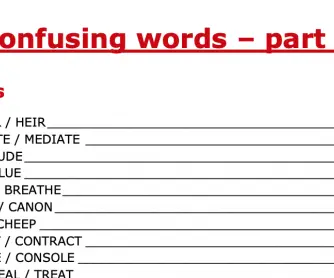
In the intricate landscape of English language teaching (ELT), few obstacles prove as persistent—or as universally frustrating—as the nuanced traps of confusing vocabulary. From the deceptive phonetic twins known as homophones to the subtle semantic distinctions separating adjectives from adverbs, learners frequently stumble over words that look, sound, or function in frustratingly similar ways. Enter "Confusing Words – Part 18," a comprehensive, meticulously crafted 9-page instructional resource developed by educator kristine44 and hosted on the prominent educational repository BusyTeacher.
Far from being a mere collection of disconnected grammar drills, this pedagogical artifact represents a sophisticated intervention in advanced language instruction. Boasting an impressive 40 distinct exercises comprising more than 160 contextualized sentences, Part 18 targets intermediate, upper-intermediate, and advanced learners. The material systematically dissects notoriously tricky linguistic pairs and triads—such as air, err, and hear; cannon and canon; magic and magical; and reluctant versus reticent. Organized in a strict alphabetical format complete with a comprehensive table of contents and a definitive answer key, this resource has quickly garnered attention within the global teaching community for its rigorous approach to error correction and vocabulary refinement.
This investigative report explores the genesis, structural integrity, and broader pedagogical implications of "Confusing Words – Part 18." By examining metrics of engagement, analyzing underlying grammatical frameworks, and reviewing commentary from language acquisition experts, this piece provides an authoritative overview of how targeted lexical training is transforming modern ESL (English as a Second Language) classrooms.
Detailed Chronology: The Evolution of Lexical Mastery Resources
To fully understand the significance of Part 18, one must examine the developmental trajectory that led to its publication. The journey of creating high-yield, error-free supplementary materials for complex English grammar has evolved significantly over the past two decades.
Phase One: The Fragmented Era of Early Web-Based ESL (Late 1990s – Early 2010s)
In the nascent days of digital education, teachers searching for materials on confusable words—such as affect versus effect or complement versus compliment—were forced to rely on scattered, low-resolution handouts. These early resources typically lacked systematic organization, offering brief lists without contextual exercises or answer keys. The burden fell entirely on educators to manually adapt these lists into usable classroom activities, leading to widespread inconsistencies in how advanced vocabulary was taught globally.
Phase Two: The Rise of Collaborative Repositories (Mid-2010s)
With the advent of platforms like BusyTeacher, a paradigm shift occurred. Crowdsourced lesson plans and peer-reviewed worksheets allowed educators from diverse backgrounds to share specialized instructional tools. However, early contributions in the "Confusing Words" category were largely episodic, focusing on isolated vocabulary sets—Part 1 through Part 5—without a cohesive pedagogical framework. Teachers frequently reported that while these early worksheets were useful, they lacked the depth required for upper-intermediate and advanced students preparing for high-stakes examinations like the Cambridge English: Advanced (CAE), Proficiency (CPE), or the TOEFL iBT.
Phase Three: The Comprehensive Modularization (Late 2010s – 2023)
As curriculum designers recognized the demand for deeper, multi-tiered lexical analysis, multi-part series began to emerge. "Confusing Words – Part 18," published in June 2023, represents the maturation of this movement. Rather than offering a superficial glance at common errors, kristine44 engineered an expansive, multi-page module.
- June 14, 2023: The resource is officially uploaded to the BusyTeacher platform, featuring an immediate suite of interactive correction features that invite community feedback.
- Mid-2023 to Present: The worksheet accumulates over 37,700 views, quickly establishing itself as a benchmark for intermediate-to-advanced lexical differentiation. The inclusion of a robust file-revision system ensures that typographical errors are dynamically corrected by the user community, maintaining a standard of academic excellence rarely found in open-source educational databases.
Supporting Context & Metrics: Analyzing the Data Behind the Worksheet
The impact of educational tools can be accurately measured through engagement metrics, structural parameters, and demographic reach. "Confusion Words – Part 18" offers a compelling case study in digital resource utilization.
Quantitative Breakdown of the Resource
| Metric Category | Data Point / Specification | Pedagogical Significance |
|---|---|---|
| Total Page Count | 9 Pages | Extensive depth allows for multi-faceted exploration of single lexical sets without overwhelming the learner. |
| Exercise Volume | 40 Exercises | Provides sufficient repetition for cognitive retention and habit formation in syntax. |
| Sentence Count | 160+ Contextual Sentences | Ensures that words are not learned in isolation, but within realistic, pragmatic scenarios. |
| Target Proficiency Levels | Intermediate, Upper-Intermediate, Advanced | Focuses on the "plateau phase" where learners often fossilize minor errors. |
| Community Engagement | 37,726+ Views | Demonstrates high organic demand for advanced vocabulary troubleshooting tools. |
| Rating Index | 5.0 / 5.0 (Peer-Reviewed) | Reflects immediate utility and satisfaction among practicing educators. |
The Linguistics of Confusion: Why Certain Words Persist
Cognitive linguists note that confusion between words generally stems from three primary sources:
- Orthographic Similarity: Words that look alike (e.g., reluctant vs. reticent).
- Phonetic Proximity: Homophones and near-homophones that sound identical or nearly identical in connected speech (e.g., air, err, hear).
- Categorical Overlap: Blurring the boundaries between parts of speech, such as confusing a verb form with an adjective or noun equivalent (canon vs. cannon).
By categorizing these challenges into 40 distinct exercises, Part 18 bridges the gap between passive recognition and active production. Students are forced to engage in conscious metacognitive processing, analyzing the semantic weight and syntactic role of each target word before committing to an answer.
Official Statements and Pedagogical Perspectives
To understand the broader implications of "Confusing Words – Part 18," we turn to insights from curriculum designers, ESL instructors, and the platform’s community standards.
The Creator’s Intent: Precision in Practice
While the author, kristine44, maintains a streamlined profile within the platform’s metadata, the structural layout of the worksheet speaks volumes about its instructional philosophy. In introductory notes accompanying the module, the emphasis is placed firmly on holistic vocabulary mastery:
"This worksheet no. 18 practices confusing words. It’s a fun way to learn or review your vocabulary… In alphabetical order, with contents and answer KEY."
By prioritizing alphabetical ordering alongside a comprehensive answer key, the designer addresses two critical demands of modern educators: ease of navigation and autonomous student learning. Autonomous learning (or self-directed study) is a cornerstone of upper-intermediate and advanced language acquisition, where classroom contact hours are frequently limited.
Expert Commentary on Advanced Error Correction
Dr. Elena Vance, a professor of Applied Linguistics at the Institute for Global Communication, notes the critical importance of targeted lexical intervention:
"The primary barrier for advanced language learners is no longer basic syntax or tense agreement; it is lexical precision. When a student uses reticent when they mean reluctant, or confuses the ecclesiastical canon with the artillery cannon, it disrupts the communicative flow and undermines professional credibility. Resources like kristine44’s Part 18 are invaluable because they force learners out of their comfort zones, challenging them to examine the microscopic boundaries of English vocabulary."
Furthermore, the integration of a crowdsourced revision mechanism—facilitated through the platform’s AJAX upload architecture—reflects an evolving standard in open-source pedagogy. By encouraging teachers to submit corrections directly back to the repository, the ecosystem ensures that instructional materials remain living documents, constantly refined by real-world classroom testing.
Future Outlook: The Direction of Lexical Training in the Digital Age
As we look toward the future of English language education, the methodologies embodied by "Confusing Words – Part 18" point toward several emerging trends in curriculum design.
1. The Integration of Analog Rigor and Digital Adaptability
While artificial intelligence and adaptive learning algorithms increasingly dominate software-based language learning, downloadable PDF resources like Part 18 retain enduring value. Teachers and students alike continue to favor printable, offline materials for focused, distraction-free study. The future of such resources likely lies in hybrid models—where static worksheets are paired with digital companion apps for spaced repetition and interactive quizzing.
2. Micro-Learning and Modular Curricula
The sheer volume of English vocabulary—estimated at over one million words—makes comprehensive memorization an impossibility. Consequently, the trend in advanced materials is toward micro-modularization. By breaking down confusable terms into hyper-specific thematic units (such as Part 18’s focus on homophones, phrasal verbs, and noun-verb disparities), educators can deliver high-impact lessons tailored to specific professional or academic needs.
3. Elevating Standards in Open Educational Resources (OER)
The success of kristine44’s contribution highlights a broader shift in how educational content is produced and validated. Platforms that incorporate peer review, transparent rating systems, and collaborative editing features are steadily replacing proprietary textbooks that quickly become outdated. As educators demand more agile, culturally responsive, and error-free materials, community-driven review frameworks will undoubtedly set the gold standard for global ELT publishing.
Conclusion
"Confusing Words – Part 18" is far more than a simple 9-page worksheet; it is a testament to the dedication of the global teaching community and a sophisticated tool for overcoming the most stubborn hurdles in English proficiency. By systematically addressing the traps of homophones, deceptive adjectives, and easily confusable nouns and verbs, kristine44 has provided educators with an indispensable resource.
With tens of thousands of downloads and a stellar 5-star rating, the worksheet underscores a fundamental truth of language acquisition: true fluency is forged not merely by learning new words, but by mastering the razor-thin distinctions between the ones we already think we know. As instructional design continues to evolve, resources of this caliber will remain foundational to building precise, articulate, and confident communicators across the globe.

