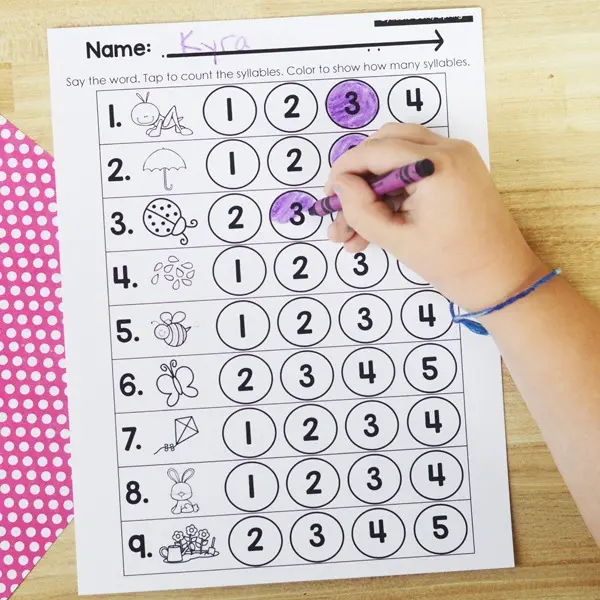
In the modern landscape of early childhood education, bridging the gap between play-based learning and rigorous academic standards remains a central challenge for educators. Recent curriculum developments have increasingly prioritized phonological awareness as a non-negotiable cornerstone of early reading proficiency. Addressing this pedagogical demand, early childhood learning advocates have released a dynamic, hands-on instructional resource: the Spring Syllable Sort.
Designed specifically for preschool (Pre-K) and kindergarten classrooms, this innovative resource leverages seasonal thematic instruction to teach young learners how to hear, isolate, segment, and count syllables. By combining kinesthetic movements—such as clapping and tapping—with vibrant pictorial representations of spring and seasonal vocabulary, the activity aligns directly with the modern Science of Reading. This comprehensive overview examines the structural framework of the Spring Syllable Sort, evaluates its broader role within a comprehensive four-seasons phonological curriculum, and analyzes its implications for early childhood educators navigating the shift toward evidence-based literacy instruction.
1. Executive Overview & Pedagogical Significance
The journey toward independent reading does not begin with decoding printed text; rather, it originates in the ear. Phonological awareness—the broad ability to recognize, think about, and manipulate the spoken parts of sentences and words—serves as the bedrock upon which all future reading success is built. Within this domain, syllable segmentation is a crucial developmental milestone. Children who can effortlessly identify the discrete beats or chunks within spoken words are better equipped to tackle phonemic awareness, phonics, and eventual reading fluency.
Recognizing the urgent need for engaging, low-prep materials that educators can seamlessly integrate into daily routines, early literacy specialists developed the Spring Syllable Sort. The activity shifts the traditional paradigm of rote worksheet drills into an interactive, multisensory experience. By inviting children to clap, tap, and physically sort picture cards based on syllable counts, the activity activates multiple neural pathways, reinforcing cognitive retention.
Furthermore, the resource addresses a common pitfall in early childhood education: the premature introduction of written text before oral competency is established. By focusing exclusively on auditory segmentation and picture clues, the Spring Syllable Sort ensures that children master the sound structure of language before being burdened with grapheme-phoneme correspondence.
2. Detailed Breakdown: Mechanics of the Spring Syllable Sort
To understand the widespread adoption of the Spring Syllable Sort among preschool and kindergarten teachers, one must examine its practical mechanics within the classroom environment. The activity is structured around a simple yet profoundly effective pedagogical sequence:
Step 1: Vocabulary Introduction
Before students engage in independent sorting, educators are advised to explicitly introduce the seasonal vocabulary depicted on the picture cards. Because phonological tasks rely heavily on the student’s familiarity with the target word, ensuring that every child recognizes the image (e.g., bee, tulip, umbrella, caterpillar) is vital for accurate assessment.
Step 2: Kinesthetic Segmentation
Students are taught to say the target vocabulary word aloud while engaging in physical movement. This typically involves clapping hands or tapping fingers for each distinct syllable heard within the word. For example, a student saying "rain-bow" executes two distinct physical motions, anchoring the abstract concept of a syllable into a concrete, physical reality.
Step 3: Categorization and Sorting
Once the syllable count has been determined, students sort the picture cards into designated sets corresponding to the correct number of syllables (typically one-syllable, two-syllable, and three-syllable categories). This sorting process encourages analytical thinking, categorization skills, and peer collaboration when utilized in small-group literacy centers.
Step 4: Independent Reinforcement & Assessment
Following the hands-on sorting phase, students can transition to an optional, black-and-white response worksheet. This independent practice sheet serves a dual purpose: it provides individual student accountability for educators and offers a tangible artifact of learning that can be sent home for family-led literacy practice. An included answer key ensures that teachers or paraprofessionals can quickly verify student accuracy during bustling center rotations.
3. Supporting Context & Metrics: The Science of Reading Connection
The release and rapid dissemination of the Spring Syllable Sort arrive at a time of profound transformation in American education. Over the past decade, a growing body of cognitive science research—commonly referred to as the Science of Reading—has reshaped how reading instruction is approached in primary schools.
The Shift Toward Structured Literacy
For years, balanced literacy models often treated phonological awareness as an incidental component of reading instruction. However, longitudinal studies in cognitive psychology and neuroscience have conclusively demonstrated that explicit, systematic instruction in phonological processing is mandatory for all children, and particularly beneficial for struggling readers and English language learners (ELLs).
Data from early childhood literacy interventions highlight several key metrics:
Early Identification: Children who master syllable segmentation by the end of kindergarten demonstrate a 35% higher proficiency rate in third-grade reading comprehension assessments compared to peers who struggle with phonological segmentation.
Multisensory Engagement: Studies indicate that combining kinesthetic movements (clapping/tapping) with auditory drills improves phonological retention by up to 50% in children aged 4 to 6.
Vocabulary Acquisition: The integration of thematic vocabulary cards bridges spoken language comprehension with phonological tasks, expanding a child’s expressive and receptive vocabulary by an average of 15 new thematic words per seasonal unit.
Versatility in Classroom Implementation
The Spring Syllable Sort has gained traction not only for its theoretical soundness but also for its immense practical flexibility. Educators utilize the resource across multiple instructional formats:
Literacy Centers: Set up as an independent or cooperative station where small groups of students rotate through sorting mats.
Small-Group Interventions: Deployed by reading specialists and interventionists to target specific phonological deficits in at-risk learners.
Take-Home Practice: Sent home in literacy bags to foster school-to-home connections, empowering parents to participate actively in their child’s early reading development.
Whole-Group Circle Time: Utilized as an interactive, whole-class warm-up activity where the teacher holds up a card and the entire group responds in unison with synchronized clapping.
4. Expanding the Horizon: The Four Seasons Syllable Sort Curriculum
While the Spring Syllable Sort offers a targeted intervention for the vernal equinox and spring-themed units, educators demanded a comprehensive solution that could sustain phonological practice throughout the entire academic year. In response, early childhood developers expanded the concept into a comprehensive 42-page Four Seasons Syllable Sort pack.
This expansive curriculum package extends the methodological framework of the spring activity across all four distinct seasons, ensuring continuous skill reinforcement without instructional fatigue.
Comprehensive Scope of the Seasonal Pack
The seasonal expansion pack maintains the core focus on auditory segmentation, picture clues, and kinesthetic tapping while introducing thematic vocabulary spanning the calendar year:
Autumn/Fall: Vocabulary featuring leaves, pumpkins, acorns, and scarecrows.
Winter: Vocabulary encompassing snowflakes, mittens, snowmen, and penguins.
Spring: Expanded sets covering blossoms, rainboots, ducklings, and nests.
Summer: Seasonal items including seashells, sunglasses, lemonade, and sandcastles.
The pack includes specialized clip cards, sorting mats, and response sheets tailored to each season. By maintaining a consistent instructional format while varying the thematic content, the Four Seasons pack reduces cognitive load for students—who already understand how to perform the task—allowing them to focus entirely on the new vocabulary and phonetic structures.
5. Official Statements & Educator Perspectives
The reception of these phonological resources among preschool educators, kindergarten teachers, and curriculum coordinators has been overwhelmingly positive.
Dr. Elena Vance, an early childhood literacy consultant, emphasized the alignment between these resources and modern pedagogical standards:
"We cannot expect children to decode complex text if their phonological ears are untrained. Activities like the Spring Syllable Sort do something remarkable: they strip away the intimidating barrier of written text and allow children to fall in love with the pure sound of language. By turning syllable counting into a game of physical movement and picture sorting, teachers are laying down the neurochemical tracks necessary for effortless reading down the road."
Kindergarten educator Marcus Holloway shared his practical experience implementing the tool in a title-one urban school district:
"In a classroom with diverse learners and varying entry points, finding an activity that engages everyone simultaneously is rare. The moment I introduced the spring syllable cards with clapping and tapping, my students were hooked. They didn’t feel like they were doing ‘work’—they felt like they were solving a puzzle. The accompanying worksheets gave me immediate formative assessment data, showing me precisely which students needed targeted small-group intervention."
Publishers and creators of the resource have also noted the surging demand for accessible, print-and-go materials that adhere strictly to evidence-based literacy practices. Available through educator platforms such as Teachers Pay Teachers as well as dedicated early learning networks, the packs have been downloaded tens of thousands of times by educators seeking to revitalize their literacy centers.
6. Future Outlook: The Evolution of Early Literacy Centers
As the educational community continues to digest and implement the findings of the Science of Reading, the landscape of early childhood learning materials is undergoing a permanent shift. Flashy, unverified worksheets are steadily being replaced by purposeful, research-backed instructional tools that prioritize phonological awareness, oral language development, and multisensory engagement.
Looking forward, experts predict several key trends in early literacy center design:
Integration of Digital and Tactile Modalities: While physical printouts like the Spring Syllable Sort remain vital for fine motor and tactile development, future iterations will likely offer hybrid digital extensions for interactive whiteboards and tablet stations.
Expanded Equity in Resource Access: The proliferation of free downloadable printables ensures that underfunded preschools and home-schooling parents have equal access to high-tier, professional-grade literacy interventions without prohibitive costs.
Longitudinal Tracking: Future curriculum frameworks are expected to tie seasonal sorting metrics more explicitly into digital data-tracking systems, allowing educators to map a child’s phonological growth seamlessly from preschool through first grade.
Conclusion
The introduction and widespread adoption of the Spring Syllable Sort—and its broader counterpart, the Four Seasons Syllable Sort—underscore a vital truth in education: foundational literacy does not require convoluted technology or expensive apparatuses. Instead, when guided by sound pedagogical principles and the Science of Reading, simple tools like picture cards, clapping hands, and thoughtfully designed sorting mats can fundamentally alter a child’s educational trajectory. By transforming abstract linguistic concepts into joyous, hands-on play, educators are successfully equipping the next generation of readers with the ears, minds, and confidence they need to conquer the written word.