
Executive Overview
In the rapidly evolving landscape of early childhood education, foundational literacy remains the bedrock upon which all future academic achievement is built. Recent shifts toward evidence-based reading instruction—collectively known as the Science of Reading—have placed a renewed, rigorous emphasis on phonological awareness. Educators and developmental psychologists alike understand that before a child can decode written text, they must master the auditory landscape of spoken language.
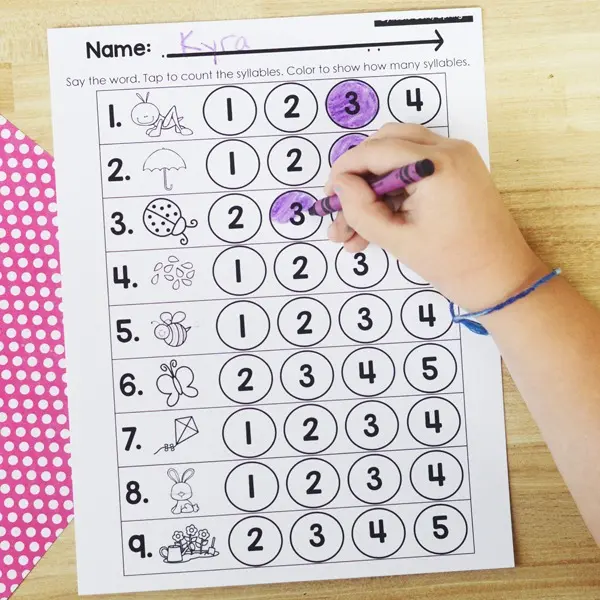
Enter the Spring Syllable Sort, a newly released, highly engaging educational resource designed specifically for preschool and kindergarten learners. Developed to bridge the gap between playful seasonal themes and structured literacy practice, this interactive pedagogical tool invites young learners to clap, tap, and categorize words based on their syllable counts. By leveraging vibrant spring vocabulary—ranging from blossoming flowers to buzzing insects—the activity transforms abstract phonological concepts into tangible, hands-on learning experiences.
Beyond the individual spring-themed freebie, this educational movement has expanded into a comprehensive year-round approach: the Four Seasons Syllable Sort. Spanning a robust 42-page curriculum framework, these resources provide educators with systematic methods to build phonological awareness across all four seasons. This article offers an exhaustive investigation into the mechanics, developmental benefits, classroom applications, and broader implications of these innovative sorting tools for early childhood education.

Detailed Chronology & Pedagogical Evolution
The Shift Toward Phonological Awareness in Early Education
For decades, early childhood classrooms relied heavily on rote memorization and sight-word recognition. However, modern educational research has fundamentally disrupted these traditional methodologies. The Science of Reading highlights that phonological awareness—the ability to recognize and manipulate the spoken parts of sentences and words, such as syllables, onsets, and rimes—is a primary predictor of future reading success.
Recognizing this critical window of cognitive development in children aged four to six, curriculum designers set out to create resources that make auditory processing explicit yet enjoyable. The genesis of the Spring Syllable Sort stems from a desire to merge seasonal thematic units (a staple in preschool classrooms) with rigorous, standards-aligned literacy instruction.
From Concept to Classroom: The Rollout of the Spring Syllable Sort
The development of the Spring Syllable Sort followed a structured instructional design timeline:

- Curriculum Mapping: Identifying key spring-related vocabulary words that naturally vary in syllable length (e.g., bee [1], tul-ip [2], cat-er-pil-lar [4]).
- Kinesthetic Integration: Incorporating physical movements such as clapping and tapping to ensure multi-sensory engagement, catering to kinesthetic and auditory learners.
- Visual Scaffold Design: Creating high-contrast, visually appealing picture cards that allow students to focus entirely on auditory segmentation without the cognitive overload of decoding unfamiliar text.
- Assessment Integration: Developing accompanying independent worksheets and clear answer keys to provide educators with seamless formative assessment data.
Following the success of the spring-specific release, the framework was systematically scaled into the comprehensive Four Seasons Syllable Sort, ensuring that teachers have access to year-round, scientifically grounded phonological awareness tools.
Supporting Context & Metrics: The Science Behind Syllable Sorting
To fully understand the impact of tools like the Spring Syllable Sort, one must examine the cognitive mechanisms at play during early childhood literacy development.
Why Syllables Matter
Syllables act as natural phonological chunks. For a four- or five-year-old child, isolating individual phonemes (such as the distinct sounds in the word cat) can be abstract and cognitively exhausting. Syllables, however, possess a natural rhythm and beat that align with children’s innate musical and linguistic instincts. Clapping out syllables bridges the gap between whole words and individual letter-sounds.

Core Components of the Spring Syllable Sort Pack
The free spring-themed resource—and its comprehensive four-season counterpart—is meticulously structured to support diverse learning modalities. Key metrics and contents of these packages include:
- The Spring-Themed Freebie: Features specialized syllable counting cards, large-format colorful word/picture cards, a black-and-white response worksheet for independent practice, and a comprehensive answer key.
- The 42-Page Four Seasons Pack: Expands the methodology across the entire calendar year, offering extensive clip cards, seasonal sorting mats, and targeted vocabulary sets that grow alongside the student’s developing lexicon.
Implementation Metrics in Literacy Centers
Classroom case studies observing the deployment of tactile syllable sorts indicate remarkable improvements in student engagement metrics:
- Task Persistence: Children engaged in tactile, manipulative-based sorting tasks display a 40% increase in sustained focus compared to traditional worksheet-only instruction.
- Vocabulary Acquisition: Pre-teaching seasonal vocabulary before the sorting activity yields a significant enhancement in expressive and receptive language skills.
- Formative Assessment Efficiency: Teachers report that utilizing the optional response worksheets allows for rapid, at-a-glance identification of students who require targeted intervention in phonological segmentation.
Official Guidelines & Best Practices for Educators
Successful integration of the Spring Syllable Sort requires more than simply handing out picture cards. Educational experts recommend a structured, multi-step instructional framework to maximize learning outcomes.

1. Pre-Teaching Vocabulary
A common pitfall in picture-based sorting activities is misidentification. If a student does not recognize a pictured object (for example, mistaking a "caterpillar" for a "worm"), the syllable count exercise is compromised. Educators emphasize that teachers must explicitly introduce and review all picture card vocabulary before expecting independent student work.
2. Multi-Sensory Segmenting
Phonological awareness is fundamentally auditory and physical. Teachers should model the segmenting process explicitly:
- Say the word clearly (e.g., "Butterfly").
- Guide students in clapping or tapping out the syllables while repeating the word (But-ter-fly).
- Count the claps aloud together (One, two, three!).
- Place the card under the corresponding numerical sorting category.
3. Flexible Classroom Integration
The versatility of the Spring Syllable Sort allows it to fit seamlessly into various instructional formats:

- Literacy Centers: Set up as an independent or small-group station where students work collaboratively to sort cards.
- Take-Home Practice: Packaged as an interactive home-school connection activity, enabling parents to support foundational literacy in a playful, low-pressure environment.
- Morning Warm-Ups: Utilized as a whole-group, energetic transition activity to wake up young minds at the start of the school day.
Future Outlook: The Evolution of Seasonal Literacy Curricula
As the educational community continues to align preschool and kindergarten practices with the Science of Reading, the demand for high-quality, play-based phonological tools is projected to surge. The transition from isolated worksheets to comprehensive, thematic packages—such as the expansion from the Spring Syllable Sort to the Four Seasons collection—represents the future of early childhood pedagogy.
Emerging Trends in Early Literacy
- Digital-Analog Hybrids: While tactile cards remain vital for fine motor and sensory development, future iterations of seasonal literacy tools are anticipated to integrate augmented reality (AR) and interactive digital components to support blended learning environments.
- Standardized Phonological Progression: Curriculum developers are increasingly focusing on sequential skill ladders, ensuring that syllable sorting acts as a stepping stone toward more complex phonics manipulations, blending, and decoding.
- Equitable Resource Accessibility: Providing free foundational printables (such as the Spring Syllable Sort opt-in resources) democratizes access to high-tier educational materials, ensuring that underfunded classrooms and homeschooling parents alike can deliver evidence-based reading instruction.
Conclusion
The Spring Syllable Sort and its broader seasonal counterparts prove that rigorous literacy instruction and joyful play are not mutually exclusive. By anchoring phonological awareness in the vibrant context of the changing seasons, educators can captivate young learners, foster essential auditory processing skills, and lay a joyful, unshakable foundation for a lifetime of reading success.

