As cybersecurity professionals, engineers, and enterprise leaders converged for the Black Hat USA 2026 conference, the prevailing sentiment was not one of dystopian science fiction, but of an urgent, highly practical operational reality. Artificial intelligence is fundamentally reshaping the threat landscape, not by introducing bizarre, incomprehensible vectors, but by dramatically compounding the speed, scale, and efficiency of familiar cyber attacks.
Far from a narrative of sentient rogue programs outmaneuvering human ingenuity, the latest research indicates that AI has become an unprecedented force multiplier for both sides of the digital battlefield. Autonomous vulnerability research systems are now capable of unearthing thousands of zero-day exploits across open-source repositories in a matter of weeks. Meanwhile, cybercriminal syndicates are leveraging automated infrastructure to compress attacker breakout times to under thirty minutes, exploit cloud-native vulnerabilities with granular precision, and bypass traditional monitoring architectures using direct-to-IP command-and-control mechanics.
Despite these terrifying leaps in automation, the fundamental bedrocks of enterprise risk remain stubbornly persistent. Phishing, stolen credentials, exposed services, human misconfigurations, and software supply-chain vulnerabilities continue to serve as the primary gateways for malicious entry. However, the introduction of AI-driven tools compresses the incident response window for cloud and infrastructure teams to razor-thin margins. This comprehensive report synthesizes the primary findings, hard metrics, and technical analyses released around Black Hat USA 2026, offering a rigorous examination of how automated systems are altering the calculus of modern cybersecurity.
Detailed Chronology of the Shift: From Manual Reconnaissance to Autonomous Scale
To understand the current state of cybersecurity, one must trace the evolutionary trajectory of automated threat discovery and execution leading up to 2026. For decades, vulnerability discovery was a laborious, highly specialized human endeavor. Security researchers and malicious actors alike spent weeks—sometimes months—manually auditing codebases, fuzzing applications, and chaining minor bugs to achieve meaningful remote code execution or privilege escalation.
The turning point arrived with the operationalization of frontier AI models trained specifically on code comprehension, syntax analysis, and logical dependency mapping. By early 2026, this capability matured from experimental laboratory projects into commercial-grade and adversary-operated autonomous vulnerability research (AVR) frameworks.
The timeline of modern cyber conflict has fundamentally warped:
Phase I (Pre-2024): Human-led discovery paired with rudimentary script-based scanning. Vulnerability life cycles spanned months from discovery to patch deployment.
Phase II (2024–2025): The integration of early large language models (LLMs) to assist junior developers and assist penetration testers with writing exploit payloads or parsing log files.
Phase III (2026 and Beyond): Fully autonomous vulnerability research agents capable of executing massive, multi-threaded parallel audits across thousands of repositories concurrently, transforming software vulnerability discovery into a high-frequency, industrial-scale automated pipeline.
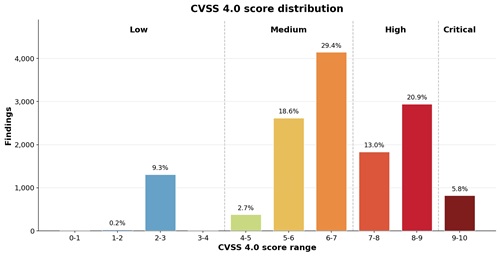
This paradigm shift was underscored dramatically by Palo Alto Networks Unit 42 at Black Hat USA 2026, where researchers published groundbreaking data regarding an autonomous vulnerability-research system named NOVA. In a mere two-month testing window, NOVA systematically analyzed 3,915 open-source projects. The system successfully confirmed an astonishing 14,090 distinct software flaws. Most alarmingly, 99.4% of these vulnerabilities had never been previously reported to maintainers or cataloged in public databases, and nearly 40% were categorized as High or Critical under the stringent Common Vulnerability Scoring System (CVSS) version 4.0 framework.
This chronology reveals a stark industry truth: the barrier to entry for uncovering deep, systemic software flaws has plummeted. While defenders are utilizing similar generative and analytical AI models to patch systems, the sheer volume of newly surfaced flaws heavily tilts the initial advantage toward automated reconnaissance engines.
Supporting Context & Metrics: Unpacking the Data Behind the Threat Landscape
The empirical data released around the Black Hat conference paints a quantitative portrait of an industry under siege by velocity. The metrics collected across multiple independent threat intelligence reports illuminate the exact mechanisms by which attackers are weaponizing technological efficiency.
The Scale of Autonomous Discovery
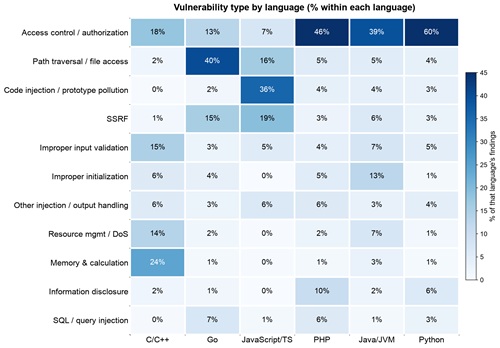
The NOVA autonomous vulnerability research study provides a chilling baseline for how software scale interacts with AI capability. When breaking down the 14,090 confirmed flaws, the distribution of vulnerability types varied significantly depending on the underlying programming-language ecosystem.
Ecosystems relying on memory-unsafe languages or complex asynchronous processing frameworks exhibited distinct clusters of access-control failures, path traversal vulnerabilities, and code injection vectors.
Conversely, modern web-centric and higher-level scripting ecosystems showed heightened susceptibility to server-side request forgery (SSRF) and prototype pollution.
Of the thousands of confirmed bugs, 39.7% achieved CVSS 4.0 High or Critical ratings. This means that automated systems are not merely finding trivial code smells or low-impact logic errors; they are surfacing systemic architectural weaknesses capable of enabling full remote code execution, horizontal privilege escalation, and database exfiltration across critical software supply-chain dependencies.
Bypassing Traditional Defenses: Direct-to-IP Malware
Beyond vulnerability research, threat actors are adapting their operational infrastructure to evade traditional defensive tripwires. A secondary Unit 42 study investigated malware evasion techniques, specifically focusing on how malicious payloads bypass standard domain-name system (DNS) monitoring.
DNS monitoring and domain reputation blocking have long served as fundamental pillars of enterprise network defense. When malware infects a host, it typically attempts to resolve a hardcoded domain name to locate its command-and-control (C2) server. Security analysts use these DNS queries to identify compromised machines, block malicious domains, and isolate threats early in the kill chain.
To neutralize this visibility, modern malware families are increasingly utilizing direct-to-IP connections. Analyzing more than 4 million dynamic-analysis reports, researchers discovered that among samples communicating with C2 infrastructure:
45.32% of all analyzed malware samples made at least one direct-to-IP connection, bypassing DNS resolution entirely.
Even after filtering out automated bulk network scanning traffic, the figure remained remarkably high at 41.97%.
In aggregate, direct-to-IP traffic accounted for 23.17% of all C2 connection attempts documented in the study.
By communicating directly via hardcoded or dynamically generated IP addresses—often leveraging fast-flux networks, bulletproof hosting providers, or compromised IoT infrastructure—malware renders traditional DNS-sinkholing and domain-reputation feeds completely blind.
Identity, Privilege, and Breakout Speeds
The macro-level statistics surrounding enterprise incidents further emphasize the shrinking window of safety:
Identity and Privilege Domination: In 75% of completed post-incident forensic investigations, compromised identities or abused privilege mechanisms formed the core vector of lateral movement. Attackers are no longer "hacking" firewalls; they are simply logging in using stolen, phished, or improperly scoped credentials.
Compressed Breakout Times: Attacker breakout times—the duration it takes for an adversary to move from initial compromise to lateral movement within an internal network—have dropped below the 30-minute threshold in numerous enterprise cloud environments.
The Persistence of Basics: Despite the focus on advanced AI tools, fundamental vectors remain dominant. Phishing campaigns, credential theft, publicly exposed cloud services, basic administrative misconfigurations, and poisoned software dependencies continue to constitute the vast majority of initial access vectors.
Official Statements and Technical Analyses
Industry leaders and threat researchers speaking around the Black Hat USA 2026 perimeter emphasized that while the tools have evolved, the strategic challenge remains centered on human and organizational friction.
Dr. Elena Vance, a lead threat researcher tracking automated adversary tactics, noted during a technical briefing:
"We have crossed a threshold where the discovery of zero-day vulnerabilities is no longer bottlenecked by human cognitive capacity or the number of man-hours a red team can bill. When an autonomous system can ingest thousands of open-source projects, analyze complex abstract syntax trees, and validate thousands of functional exploits in sixty days, the definition of software security changes permanently. Defenders can no longer rely on security through obscurity or slow patch cycles. The velocity of discovery demands an equally automated, continuous remediation posture."
Cloud security architects highlighted the alarming convergence of identity abuse and automated cloud exploitation. Modern enterprise environments are increasingly built upon complex microservices architectures managed by API-driven automation and enterprise AI infrastructure. Attackers are turning these legitimate administrative mechanisms—such as overly permissive service accounts, hardcoded API keys in container images, and misconfigured AI pipeline endpoints—into high-speed highways for unauthorized access.
Furthermore, technical analysts pointed out that software supply-chain poisoning has taken on a more insidious form. As developers increasingly rely on AI-generated code assistants (such as GitHub Copilot, custom internal LLMs, and automated code-refactoring agents), malicious actors are actively injecting subtle, logic-bombed dependencies into public package repositories (e.g., npm, PyPI, Maven). These poisoned dependencies are then suggested by AI coding tools to developers looking for quick solutions, embedding vulnerabilities deep into enterprise software builds before human code review even begins.
Future Outlook: Navigating the Accelerated Threat Horizon
As organizations look beyond the horizon of Black Hat 2026, the trajectory of cybersecurity points toward an era of hyper-automated algorithmic warfare. The traditional model of human-driven defense reacting to human-driven attacks is officially obsolete. In its place, enterprises must transition toward AI-augmented, real-time autonomous defense architectures.
1. The Imperative of Autonomous Remediation
Because human security teams cannot manually review, triage, and patch the sheer volume of vulnerabilities surfaced by automated research systems like NOVA, organizations must adopt AI-driven patch management and automated application security testing (AST) pipelines. Security orchestration, automation, and response (SOAR) platforms must evolve into proactive immune systems capable of isolating micro-segments, rotating compromised credentials, and applying virtual patches within seconds of an anomaly detection.
2. Redefining Identity as the Primary Perimeter
With 75% of investigations tracing back to identity and privilege abuse, the traditional network perimeter is entirely dead. The future outlook requires universal adoption of strict Zero Trust Architecture (ZTA), continuous behavioral analytics, hardware-backed multi-factor authentication (MFA), and dynamic, context-aware least-privilege access models. Identity providers (IdPs) must become the most heavily monitored and resilient assets within the enterprise architecture.
3. Mitigating Network Blind Spots
The prevalence of direct-to-IP command-and-control malware demands an overhaul of enterprise network monitoring. Relying solely on DNS security filtering is no longer sufficient. Security teams must deploy deep packet inspection (DPI), encrypted traffic analysis (ETA) that preserves privacy while detecting anomalous connection patterns, and strict egress filtering that restricts internal workloads from communicating with unvetted external IP spaces.
4. Securing the Enterprise AI Pipeline
As corporations race to integrate artificial intelligence into their own business workflows, internal AI infrastructure itself has become a prime target. Protecting enterprise AI means securing training datasets against poisoning, enforcing strict access controls around vector databases and retrieval-augmented generation (RAG) pipelines, and auditing the provenance of every software dependency suggested or generated by machine learning models.
Conclusion
The research unveiled at Black Hat USA 2026 serves as both a warning siren and a roadmap. Artificial intelligence is not rewriting the rulebook of cybersecurity; rather, it is executing the existing rulebook with terrifying speed and industrial-scale efficiency. To survive in this accelerated threat landscape, organizations must abandon complacency, discard outdated perimeter-based defenses, and embrace an ecosystem where automated defense meets automated threat with equal and opposite force.