
EXECUTIVE OVERVIEW
In an era where early childhood education faces increasing pressure to balance rigorous academic standards with engaging developmental play, educators are continually searching for innovative, no-prep tools. The foundational bedrock of early reading proficiency—phonological awareness—often requires repetitive, targeted practice that can sometimes struggle to capture the short attention spans of preschoolers and kindergartners.
Enter the "Color-by-Syllable" pedagogical framework, a seasonal literacy intervention designed by early childhood specialist Shaunna Evans. By merging the familiar, low-stress mechanics of color-by-code worksheets with phonological segmentation exercises, this approach transforms abstract phonics concepts into tangible, creative tasks. Recently expanded into a comprehensive yearlong curriculum spanning 33 distinct thematic pages, the program addresses a critical gap in Pre-K and kindergarten classrooms: how to build structural word-segmentation skills without sacrificing the joy of learning.

This report provides an in-depth analysis of the Color-by-Syllable initiative, exploring its underlying methodology, structural design, classroom implementation strategies, and the broader implications of play-based phonological awareness training in modern early education.
1. THE FOUNDATIONAL SCIENCE: PHONOLOGICAL AWARENESS IN EARLY YEARS
Phonological awareness—the ability to recognize, think about, and manipulate the spoken parts of sentences and words, including syllables, onsets, rimes, and phonemes—is widely recognized by literacy experts as one of the single best predictors of later reading success. Long before children decode printed letters on a page, they must master the auditory landscape of spoken language.
Syllable segmentation serves as an essential stepping stone within this continuum. When children learn to clap, tap, or count the beats within a word (such as recognizing that val-en-tine contains three distinct segments), they are training their brains to parse continuous speech into discrete units.

However, translating this cognitive milestone into daily classroom practice presents logistical hurdles for educators. Traditional drills can quickly lead to cognitive fatigue among young learners. To combat this, modern instructional design increasingly favors multisensory and gamified approaches. The Color-by-Syllable framework directly addresses this need by linking auditory-linguistic processing with visual-motor skills (coloring), creating a dual-coding pathway that enhances memory retention and student engagement.
2. STRUCTURAL BREAKDOWN OF THE COLOR-BY-SYLLABLE INTERVENTION
Designed specifically for preschool and kindergarten environments, the Color-by-Syllable model operates on a principle of radical simplicity combined with pedagogical depth. The activity requires minimal educator preparation, making it an ideal inclusion for literacy centers, independent workstations, early-finisher bins, or take-home practice packs.
Core Mechanics
- Vocabulary Introduction: Before independent execution, educators introduce thematic vocabulary words to ensure students understand the semantic meaning of the items being segmented.
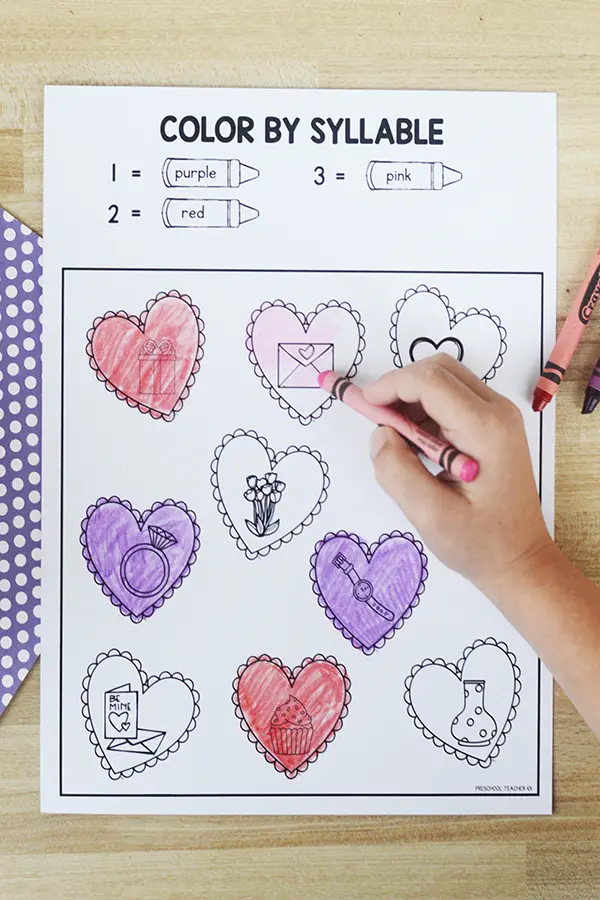
- Auditory & Visual Segmentation: Students say the target word aloud, isolate and count the individual syllables (ranging from one to five syllables depending on the difficulty tier), and match the count to a designated color code.
- Creative Execution: By coloring the corresponding sections of the worksheet, students reveal a hidden, holiday- or season-themed image, providing immediate visual reinforcement of their accurate linguistic analysis.
The Valentine’s Day Case Study
As a seasonal spotlight, the newly released Valentine’s Day Color by Syllable pack demonstrates how holiday-themed engagement can drive academic focus. Featuring specialized worksheets tailored to Pre-K and kindergarten developmental milestones, the Valentine’s edition allows teachers to seamlessly integrate seasonal excitement into literacy instruction. Rather than viewing the holiday as a distraction from core curricula, educators can leverage the thematic excitement to reinforce essential phonological skills.

3. SUPPORTING CONTEXT, METRICS, AND CURRICULUM INTEGRATION
The scaling of the Color-by-Syllable concept from a single-holiday worksheet into a comprehensive yearlong product reflects a broader shift toward systematic, thematic literacy resources in early education.
The 33-Page Yearlong Framework
To support educators across all four academic seasons, the expanded curriculum encompasses a 33-page comprehensive pack. This ensures that teachers do not have to reinvent the wheel for every calendar shift or holiday milestone. Key structural features of the full-year pack include:
- Scalable Difficulty: Worksheets progress from simple 1-syllable word identification up to complex 5-syllable segmentation tasks, accommodating mixed-ability classrooms and differentiated learning plans.
- Thematic Versatility: Covering major holidays, changing seasons, and everyday preschool themes, the resources maintain student interest through continuous novelty anchored in a predictable instructional routine.
- Accessibility and Format: Distributed via major educational platforms including Teachers Pay Teachers and specialized early learning networks, the materials are optimized for immediate digital downloading, printing, and deployment.
Classroom Implementation Matrix
| Implementation Context | Target Objective | Pedagogical Benefit |
|---|---|---|
| Literacy Centers | Small group guided practice | Allows teachers to observe individual student segmenting strategies and correct misconceptions in real-time. |
| Fast Finishers | Productive independent engagement | Prevents classroom downtime by offering meaningful, skill-reinforcing tasks for students who complete core work early. |
| Take-Home Practice | Home-school connection | Empowers parents to participate in their child’s pre-reading development through low-stress, game-like activities. |
4. OFFICIAL PERSPECTIVES AND EXPERT INSIGHTS
While instructional toolkits and printables are abundant in the modern digital educational marketplace, expert commentary emphasizes that the true value of resources like Color-by-Syllable lies in their alignment with evidence-based reading science.

Shaunna Evans, early childhood educator and creator behind the initiative, emphasizes the importance of scaffolding phonological tasks. According to educational commentary accompanying the release, the core philosophy relies on breaking down intimidating linguistic tasks into digestible, playful formats.
"Color-by-syllable activities provide a fantastic, no-prep avenue to break down words into individual components," notes curriculum documentation. "By allowing children to hear sounds and physically segment syllables while engaging in fine-motor coloring, we bridge the gap between auditory processing and artistic play."
Furthermore, early childhood literacy advocates continually stress that phonological awareness must precede explicit phonics instruction. Programs that incorporate visual coloring elements help mitigate the anxiety often associated with formal testing or rigid desk work, fostering a positive early association with literacy tasks.

5. FUTURE OUTLOOK: THE EVOLUTION OF PLAY-BASED LITERACY TOOLS
As early childhood education continues to navigate the post-pandemic landscape, the demand for high-quality, flexible, and low-prep resources is projected to accelerate. Teachers are under mounting pressure to close early learning gaps, yet they face severe time constraints and burnout.
The future of literacy interventions points toward hybrid models—resources that are digitally accessible, instantly printable, and grounded in rigorous cognitive science while maintaining a playful aesthetic. Frameworks like the Color-by-Syllable series illustrate how traditional worksheet formats can be revitalized through smart pedagogical design.
Key Trends to Watch:
- Increased Customization: Future iterations of phonological tools will likely feature customizable word lists, allowing educators to tailor syllable counting exercises directly to specific thematic units or science/social studies curricula.
- Multimodal Integration: Bridging printable worksheets with digital audio prompts (via QR codes linking to correct pronunciation and clapping guides) represents the next frontier for independent literacy centers.
- Equitable Access: The continued distribution of free seasonal samplers alongside comprehensive paid curricula ensures that underfunded classrooms and homeschooling parents alike can access foundational reading tools.
In conclusion, the expansion of the Color-by-Syllable methodology—from Valentine’s Day novelties to a robust yearlong educational framework—underscores a vital truth in early pedagogy: when learning to read feels like play, children are far more likely to embrace the journey.

