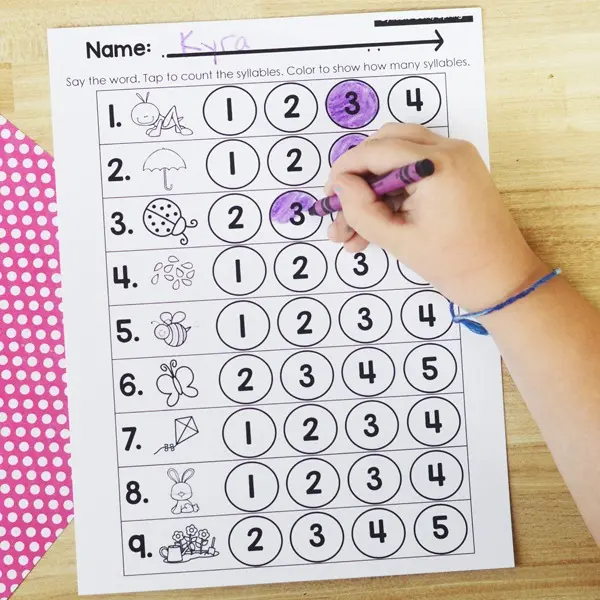
In the landscape of early childhood education, bridging the gap between playful engagement and rigorous cognitive development remains a perpetual challenge for educators. As schools increasingly align their reading curricula with the Science of Reading, phonological awareness—the foundational ability to recognize and manipulate the spoken parts of sentences and words—has taken center stage.
Enter the Spring Syllable Sort, an innovative, hands-on literacy intervention designed specifically for preschool and kindergarten classrooms. Developed as a seasonal educational resource, this activity seamlessly integrates phonological awareness into thematic learning units. By leveraging tactile experiences, such as clapping and tapping to segment seasonal vocabulary words, children learn to isolate and count syllables organically.
This comprehensive review explores the pedagogical mechanics of the Spring Syllable Sort, its alignment with modern educational standards, and its broader implications for early literacy development. Furthermore, we examine the expansion of this concept into a comprehensive year-round learning framework through the Four Seasons Syllable Sort initiative, evaluating how structured play continues to shape the future of early childhood education.
Detailed Chronology: The Evolution of Seasonal Literacy Centers
The journey toward modern phonological awareness toolkits reflects decades of shifts in reading instruction. To understand the significance of tools like the Spring Syllable Sort, one must examine the progression of early literacy methodologies over recent years.
Phase One: The Shift Toward Multisensory Literacy (Pre-2020)
For decades, early childhood literacy relied heavily on rote memorization and visual flashcards. While students learned the alphabet, the auditory and structural components of language—such as phonemes and syllables—were often treated as secondary concepts. Educators recognized a deficit in phonological awareness, noting that children struggled not with seeing letters, but with hearing the distinct units of sound that compose spoken words.
Phase Two: The Integration of Thematic Play (2020–2023)
As early childhood researchers emphasized the necessity of play-based learning, educators began merging literacy centers with seasonal themes. Springtime units, historically focused on arts and crafts, transformation, and nature exploration, became prime real estate for vocabulary expansion. However, these activities often lacked systematic frameworks aligned with cognitive science. Teachers frequently found themselves piecing together disjointed worksheets that failed to systematically build phonological skills.
Phase Three: The Science of Reading Alignment and the Launch of the Spring Syllable Sort (2024–Present)
With the widespread adoption of the Science of Reading framework, curriculum developers recalibrated early learning tools. The introduction of the Spring Syllable Sort marked a pivotal turning point. By removing written text and focusing strictly on auditory cues, picture matching, and physical segmentation (clapping and tapping), the activity addressed the core tenets of phonological processing.
The initiative quickly expanded from a standalone spring-themed freebie into a comprehensive, year-round educational ecosystem. Today, the methodology underpins the expansive 42-page Four Seasons Syllable Sort pack, providing educators with a structured, continuous system for tracking and building phonological competence from autumn through summer.
Supporting Context & Metrics: The Science Behind Syllable Segmentation
To appreciate the utility of the Spring Syllable Sort, educators and administrators must examine the empirical data driving modern early literacy instruction. Phonological awareness is widely recognized by literacy experts as one of the single best predictors of later reading success.
Key Cognitive Milestones in Pre-K and Kindergarten
Auditory Isolation: Before children can decode written words (phonics), they must master the ability to manipulate spoken language. Syllable segmentation serves as the crucial stepping stone between recognizing whole words and isolating individual phonemes.
Multisensory Engagement: Studies in educational psychology indicate that tactile and kinesthetic learning—such as physical tapping, clapping, or using clip cards—significantly improves information retention in children aged 4 to 6.
Vocabulary Acquisition: Seasonal units naturally introduce rich, thematic vocabulary (e.g., daffodil, umbrella, caterpillar). Coupling these words with syllable-counting exercises ensures that students do not just memorize words, but actively analyze their phonetic structure.
Anatomy of the Spring Syllable Sort Toolkit
The resource is engineered to provide a multi-tiered learning experience. Rather than offering a single worksheet, the pedagogical package includes:
Syllable Counting Cards: Designed for tactile sorting, allowing children to group picture cards into distinct columns based on syllable counts.
Large Colorful Word Cards: Used by educators during direct instruction to introduce and model seasonal vocabulary before independent practice.
Black and White Response Worksheets: Optional independent practice sheets that allow students to solidify their understanding and provide teachers with formative assessment data.
Comprehensive Answer Keys: Ensuring seamless classroom management and self-correction opportunities for advanced learners.
Official Statements and Expert Perspectives
As early childhood frameworks evolve, educational specialists have increasingly emphasized the importance of structured, play-based phonological interventions.
Dr. Elena Vance, a prominent researcher in early literacy development, notes the critical nature of pre-reading interventions:
"We often rush children into the mechanical act of reading text before their brains are fully attuned to the sounds of spoken language. Activities that isolate syllables through physical movement—like clapping or sorting picture cards—re-wire the auditory processing centers in ways that make future decoding effortless. Tools that make this process engaging and seasonal remove the cognitive fatigue often associated with early literacy drills."
Classroom educators who have integrated the Spring Syllable Sort into their daily centers echo these sentiments. Sarah Jenkins, a veteran kindergarten teacher and curriculum advisor, highlights the practical utility of the resource:
"The biggest hurdle in a kindergarten classroom is keeping centers engaging while maintaining rigorous standards. The Spring Syllable Sort bridges that gap. Because the children are interacting with vibrant spring imagery rather than daunting blocks of text, engagement is nearly 100%. More importantly, the progression from whole-group vocabulary introduction to independent worksheet practice gives me clear diagnostic insights into which students need additional support."
Furthermore, curriculum developers emphasize that the transition from a single spring-themed printable to a complete four-seasons model was driven by educator demand. By maintaining consistency in the activity structure throughout the entire school year, students experience reduced cognitive load regarding how to complete the task, allowing them to focus entirely on the linguistic challenge at hand.
Future Outlook: The Trajectory of Seasonal Literacy Interventions
Looking ahead, the landscape of early childhood education is poised for continued integration of thematic, scientifically grounded literacy tools. As digital and hybrid learning models continue to merge with traditional classroom environments, print-and-go resources like the Spring Syllable Sort and its overarching Four Seasons counterpart remain vital staples for educators seeking reliable, high-yield interventions.
Key Trends Shaping the Future of Early Literacy:
Standardized Play: Educational standards are increasingly validating play-based models, recognizing that cognitive rigor and playful engagement are not mutually exclusive.
Seamless Differentiation: Future iterations of seasonal sorting tools are expected to offer broader scaffolding options, allowing teachers to easily adjust syllable complexity (moving from two-syllable to multi-syllable words) based on individual student progress.
Home-School Connection: With take-home literacy practice becoming a cornerstone of early childhood intervention, printable packs that include answer keys and parent-friendly instructions empower families to reinforce classroom lessons in domestic environments.
In conclusion, the Spring Syllable Sort transcends its status as a simple seasonal craft or holiday worksheet. It represents a carefully calibrated pedagogical tool rooted in the Science of Reading. By transforming foundational phonological awareness into an interactive, joyful experience across all four seasons, educators are laying a robust, enduring foundation for a lifetime of literacy success.