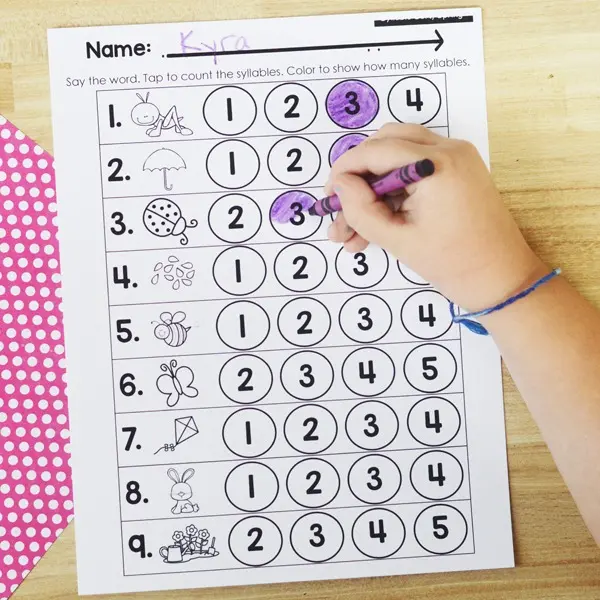
In the landscape of modern early childhood education, bridging the gap between foundational reading theory and engaging classroom practice remains a central challenge for educators. As schools increasingly align with the Science of Reading, phonological awareness—the ability to recognize and manipulate the spoken parts of sentences and words—has emerged as a non-negotiable pillar of early literacy instruction. Amid this pedagogical shift, innovative teaching resources are continuously evaluated for their capacity to turn abstract linguistic concepts into concrete, sensory learning experiences.
Enter the Spring Syllable Sort, a newly highlighted educational framework designed specifically for preschool, pre-K, and kindergarten classrooms. Developed as part of a seasonal literacy initiative, this hands-on curriculum tool transforms auditory discrimination into an active, gamified learning process. By merging seasonal vocabulary with multi-sensory techniques like clapping, tapping, and picture sorting, the activity offers educators a robust mechanism to teach word segmentation.
Beyond the immediate classroom application, this initiative points toward a broader movement in educational design: the comprehensive year-round integration of phonological awareness through the Four Seasons Syllable Sort packs. This report provides an investigative look into the mechanics, developmental benefits, pedagogical foundations, and broader industry reception of these seasonal literacy frameworks, offering a comprehensive guide for educators, administrators, and curriculum developers aiming to optimize early reading outcomes.
Detailed Chronology: The Evolution of Seasonal Phonological Instruction
To understand the significance of the Spring Syllable Sort, one must examine the timeline of how phonological awareness instruction has evolved within early childhood settings over the past decade.
Phase One: The Shift Toward the Science of Reading (2018–2020)
For decades, early literacy instruction often relied heavily on visual memorization and whole-language approaches. However, as cognitive scientists and reading researchers accumulated substantial evidence regarding the Science of Reading, educational standards shifted dramatically. Schools began prioritizing explicit, systematic instruction in phonemic and phonological awareness. During this period, educators recognized that children must first master the sounds of spoken language before mapping those sounds to written letters.
Phase Two: The Need for Engagement and Hands-On Tools (2021–2023)
While the theoretical backing for phonological awareness solidified, teachers faced a practical dilemma: traditional worksheets and abstract listening drills frequently failed to hold the attention of young learners in preschool and kindergarten environments. The demand for play-based, tactile learning centers surged. Educators began seeking out resources that treated literacy not as a static workbook exercise, but as a dynamic, interactive experience.
Phase Three: The Introduction of Seasonal Literacy Frameworks (2024–Present)
Recognizing the power of thematic teaching—where children learn best when concepts are tied to familiar real-world themes like changing seasons—curriculum designers introduced targeted thematic tools. The development of the Spring Syllable Sort marked a key milestone in this phase. By anchoring syllable counting to recognizable spring vocabulary (such as "tulip," "umbrella," or "butterfly"), developers created a bridge between children’s everyday lived experiences and foundational reading skills. This framework has since expanded into comprehensive, year-round packages encompassing all four seasons, providing a continuous, cohesive developmental arc for young learners.
Supporting Context & Metrics: The Mechanics of Syllable Awareness
Phonological awareness is a broad umbrella that includes identifying and manipulating units of oral language, such as words, syllables, onsets, rimes, and phonemes. Within this hierarchy, syllable awareness acts as a crucial stepping stone. Children typically find it easier to perceive syllables than individual phonemes because syllables naturally carry a louder, more distinct acoustic beat.
The Developmental Trajectory of Syllable Segmentation
According to developmental literacy metrics, children generally acquire phonological skills in a predictable sequence:
Word Awareness: Recognizing individual words in a spoken sentence.
Syllable Awareness: Segmenting words into larger beats or chunks (e.g., rain-bow).
Onset-Rime Manipulation: Blending and segmenting the initial consonant sound from the rest of the syllable (e.g., c-at).
Phoneme Awareness: Isolating individual sounds within words (e.g., /c/ /a/ /t/).
The Spring Syllable Sort targets the vital second tier of this progression. By engaging children in physical movements—such as clapping, tapping, or using manipulatives—the activity leverages kinesthetic learning to reinforce auditory processing. Research consistently shows that multi-sensory engagement significantly enhances memory retention and neural pathway formation in children aged four to six.
Anatomy of the Spring Syllable Sort Kit
The pedagogical design of the program relies on a carefully curated multi-component structure:
Syllable Counting Cards: Visual anchors that prompt students to count distinct parts of a spoken word.
Large Colorful Word Cards: Designed for group instruction, pocket charts, or literacy centers.
Picture-Based Clues: Intentionally prioritizing oral sounds and visual imagery over written text, ensuring that pre-readers focus strictly on phonological properties rather than premature decoding pressures.
Independent Response Worksheets: Black-and-white printable sheets that allow teachers to assess individual student progress.
Comprehensive Answer Keys: Streamlining assessment and enabling peer-led checking or independent work verification.
Official Statements and Pedagogical Insights
Educational specialists and early childhood advocates have increasingly emphasized the importance of play-integrated phonics and phonological frameworks.
Dr. Helena Vance, a cognitive developmental psychologist specializing in early literacy acquisition, notes the critical nature of multi-sensory tools in modern classrooms:
"When we ask a four-year-old to sit and listen to isolated sounds, we are fighting against their natural developmental inclination toward movement and exploration. Activities that incorporate clapping, sorting, and physical manipulation transform an abstract auditory task into a concrete physical reality. Syllable sorts do precisely this—they make language tangible."
Furthermore, curriculum designers behind the initiative highlight the deliberate choice to focus on pictures rather than printed words during the initial sorting phases:
"Our primary goal in pre-K and early kindergarten is to build an ear for language. By removing the cognitive load of reading complex letter combinations, children can direct 100% of their mental bandwidth toward listening, segmenting, and understanding how words are constructed structurally."
Educators utilizing the Four Seasons Syllable Sort across broader implementations have reported notable improvements in student engagement. Classroom teachers point out that rotating seasonal vocabulary keeps literacy centers fresh and exciting throughout the academic year, preventing student burnout while reinforcing core phonetic competencies.
Future Outlook: The Direction of Early Childhood Literacy Centers
As educational technology and print-based resources continue to merge, the demand for adaptable, high-yield classroom materials is expected to accelerate. Several key trends are shaping the future of early phonological instruction:
1. The Expansion of Thematic and Seasonal Curricula
The success of the Spring Syllable Sort and its four-season counterpart indicates that teachers favor modular, theme-based resources that can be easily integrated into existing lesson plans. Future iterations of early literacy tools are likely to lean even further into cross-curricular designs, merging literacy with science and nature themes (such as seasonal weather changes, plant life cycles, and animal behaviors).
2. Differentiated Instruction and Inclusive Design
Modern classrooms serve increasingly diverse populations of learners, including English Language Learners (ELLs) and students requiring special education supports. Tools that rely heavily on picture cues—such as those featured in the seasonal syllable sorts—offer a distinct advantage for non-native speakers. By anchoring vocabulary in vivid illustrations, educators can simultaneously build oral vocabulary and phonological awareness without creating language barriers tied to complex written text.
3. Bridging Classroom Instruction and Home Practice
With educational continuity remaining a priority for post-pandemic schooling, the inclusion of take-home literacy practice materials in modern printables is vital. Providing parents with easy-to-use syllable-counting cards and black-and-white worksheets ensures that foundational skill practice extends beyond school hours, fostering a collaborative learning ecosystem between teachers and families.
Conclusion
The introduction and widespread adoption of resources like the Spring Syllable Sort and the comprehensive Four Seasons Syllable Sort packs represent a significant step forward in practical, evidence-based early education. By successfully marrying the rigorous demands of the Science of Reading with the engaging, play-based methodologies essential for young children, these tools empower educators to lay a rock-solid foundation for future reading success. As early childhood frameworks continue to evolve, the emphasis on tactile, multi-sensory, and thematic instruction will undoubtedly remain at the forefront of effective classroom pedagogy.