
Executive Overview
For generations, chemistry education has battled a persistent image problem. Mentioning terms like "acids," "bases," and "pH levels" inside a traditional classroom often elicits a chorus of groans and collective sighs from students. Too frequently, the foundational concepts of molecular science are confined to textbook definitions, rigid memorization, and abstract formulas that fail to capture the imagination of young learners. However, a quiet revolution is underway in educational methodology. Educators and STEM advocates are increasingly shifting toward hands-on, experiential learning models that turn kitchen counters into laboratories and everyday household products into compelling scientific instruments.
At the heart of this pedagogical shift is the demystification of acids and bases. Far from being exotic or hazardous chemicals locked away in high school stockrooms, acids and bases are fundamental components of daily life. From the tangy bite of morning citrus juice to the slippery, soapy lather used during handwashing, these chemical solutions surround us. By leveraging familiar household items, parents and educators can bypass the traditional intimidation factor of chemistry, replacing it with curiosity, experimentation, and critical thinking.
This comprehensive report explores the underlying chemistry of acids and bases, examines the mechanics of the pH scale, and details five dynamic, hands-on projects designed to transform abstract chemical theories into engaging, memorable learning experiences for children.
Detailed Chronology & Pedagogical Evolution
To understand why modern STEM education places such heavy emphasis on tactile learning, it is helpful to trace the evolution of how chemistry has been taught to young minds over the past century.
The Era of Rote Memorization (Mid-20th Century)
For decades, science education followed a top-down model. Students were introduced to complex chemical nomenclature before they ever touched laboratory equipment. Acids were defined abstractly as proton donors, and bases as proton acceptors, long before the student had any contextual framework for what a proton or a molecule actually represented. Experiments, when they occurred, were rigidly scripted "cookbook" exercises where students simply followed step-by-step instructions to arrive at a predetermined outcome, leaving little room for genuine inquiry or discovery.
The Rise of Constructivism (Late 20th Century)
As educational psychology evolved—largely driven by the theories of Jean Piaget and Lev Vygotsky—the educational community recognized that children construct knowledge best through active engagement with their environment. Constructivism posited that learners form their own representations of the world by interacting with objects and people. In science education, this meant moving away from rote learning and toward active investigation. Concepts like acidity and alkalinity could no longer be understood purely through lectures; they required sensory engagement: tasting sour foods, feeling slippery soaps, and observing color changes.
The Modern STEM Framework (Present Day)
Today, STEM (Science, Technology, Engineering, and Mathematics) education integrates these constructivist principles into structured, interdisciplinary frameworks. Modern educators utilize inquiry-based learning, encouraging students to form hypotheses, conduct experiments, record data, and draw conclusions independently. Teaching acids and bases has thus transformed from a dry theoretical lecture into an investigative adventure. By utilizing everyday materials, modern pedagogy bridges the gap between academic theory and practical reality, fostering a lifelong appreciation for the scientific method.
Supporting Context & Metrics: Decoding the Chemistry of Acids and Bases
To effectively guide children through experiments, parents and educators must first master the fundamental science underpinning these solutions. What makes an acid an acid, and a base a base?
The Atomic Architecture: Ions
At the microscopic level, all chemical substances are composed of atoms and molecules. When certain substances dissolve in water, they break apart into charged particles called ions. The behavior of these ions dictates whether a solution will exhibit acidic or basic properties.
- Acids: Characterized by a high concentration of hydrogen ions ($H^+$). When dissolved in water, acids release these hydrogen ions into the solution. This abundance of hydrogen ions is responsible for the characteristic sharp, sour taste found in edible acids like lemons, limes, and tomatoes.
- Bases (Alkaline Solutions): Characterized by a high concentration of hydroxide ions ($OH^-$). When dissolved in water, bases release hydroxide ions. In everyday life, basic solutions often feel slimy or slippery to the touch (such as soap or baking soda dissolved in water) and tend to have a bitter taste if edible.
The Duality of Nature: Safety vs. Hazard
A critical component of teaching children about chemistry is instilling a healthy respect for safety. While many acids and bases are entirely safe to consume or handle—such as orange juice and baking soda—others possess corrosive properties that demand caution.
- Hazardous Acids: Automotive battery acid (sulfuric acid) is intensely corrosive and can disintegrate organic fabrics and human skin upon contact.
- Hazardous Bases: Ammonia, a powerful cleaning base, emits pungent vapors that can irritate respiratory pathways, posing particular risks for individuals with asthma or other respiratory sensitivities.
Teaching children to distinguish between safe, household-grade solutions and industrial chemicals is a vital lesson in laboratory safety and situational awareness.
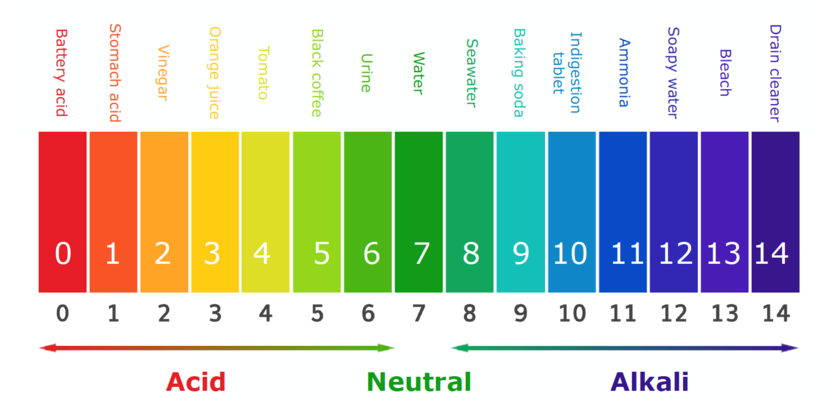
+-----------------------------------------------------------------+
|                        THE pH SPECTRUM                          |
|                                                                 |
|  [ 0 ] <------------------[ 7 ]-------------------> [ 14 ]      |
|  ACIDIC                   NEUTRAL                    BASIC      |
|  (Lemon Juice, Vinegar)   (Pure Water)               (Soap, Soda) |
+-----------------------------------------------------------------+
Navigating the pH Scale
To graphically and mathematically compare the relative strength of acidity and alkalinity, scientists utilize the pH scale (potential of hydrogen). Ranging from 0 to 14:
- Values from 0 up to 7 represent acids, with lower numbers indicating stronger, more concentrated acidic solutions.
- Exact 7 represents a neutral solution, perfectly balanced between acidic and basic properties (pure water serves as the standard benchmark here).
- Values above 7 up to 14 represent bases (alkaline solutions), with higher numbers indicating stronger basic properties.
Because we cannot safely taste every chemical substance to determine its placement on the pH scale, scientists rely on indicator solutions. These are organic materials—often derived from plants—that undergo distinct chemical transformations (specifically, molecular structural changes) when exposed to varying concentrations of hydrogen or hydroxide ions, visibly shifting color to reveal the solution’s pH status.
Official Guidelines & STEM Educational Standards
Educational institutions and science advocacy groups emphasize that early exposure to foundational chemistry significantly enhances long-term academic performance in STEM fields. According to curriculum guidelines established by leading educational organizations:
- Inquiry-Based Learning: Students retain up to 75% more scientific information when learning is anchored by hands-on experimentation rather than passive listening.
- Cross-Disciplinary Integration: Chemistry experiments naturally integrate mathematics (measuring volumes, recording pH values), reading comprehension (following procedural instructions), and critical thinking (forming and testing hypotheses).
- Safety Literacy: Introducing chemical safety protocols at an early age builds responsible habits that translate safely into middle school, high school, and collegiate laboratory environments.
As part of this educational push, numerous open-access resources—including downloadable STEM activity books, scientific method worksheets, and structured experiment guides—are widely distributed by educational platforms to empower parents and teachers to bring dynamic laboratory experiences into non-traditional learning spaces.
5 Hands-On Projects to Teach Acids and Bases
Transforming theoretical concepts into tangible reality requires active participation. Below are five expertly curated, hands-on projects designed to make learning about acids and bases interactive, educational, and fun.
1. Red Cabbage as a Natural pH Indicator
Litmus paper is a staple of chemical laboratories, but you can manufacture your own organic indicator at home using an ordinary head of red cabbage. Red cabbage contains a water-soluble pigment molecule called anthocyanin, which changes color depending on the acidity of its environment.
- Procedure: Slice a red cabbage and simmer it in a pot of water on the stove until the liquid turns a deep, rich purple-blue. Allow the mixture to cool, then strain out the plant matter (save the cooked cabbage for dinner!).
- Testing with Paper: Dip plain white index cards into the cooled cabbage juice, let them dry completely, and cut them into testing strips. Use these strips to test household liquids like pickle juice, milk, and tap water. Have children predict beforehand whether the strip will turn red (indicating an acid) or blue/green (indicating a base).
- Testing in Glass: Pour the liquid cabbage juice into several clear glasses. Introduce various household liquids—such as cola or a baking soda solution—and watch as the liquid magically shifts colors, providing a visual spectrum of pH levels.
2. The Edible Chemical Reaction: Fizzing Sherbet
Chemical reactions are often associated with bubbling test tubes and noxious fumes in professional labs. However, chemistry can also be delicious. When an acid and a base combine, they neutralize one another, often releasing carbon dioxide gas in the process.
- Procedure: In a clean, dry bowl or a sealable plastic bag, combine edible acidic ingredients (such as powdered citric acid or cream of tartar) with edible basic ingredients (such as baking soda), along with powdered sugar and flavored drink mix to taste.
- The Experience: Seal the bag and shake thoroughly to blend the ingredients. When a small amount is placed on the tongue, saliva dissolves the powders, initiating an immediate acid-base neutralization reaction. Children will feel a delightful "fizzing" sensation on their tongues as carbon dioxide micro-bubbles form.
- Discussion: Engage students by asking them to deduce which ingredients provided the sour acid component and which provided the basic component.
3. The Great Penny Clean-Up Challenge
Copper-bearing items, such as circulating pennies, naturally tarnish over time as the copper reacts with oxygen in the air, forming copper oxide. Acids and bases possess distinct chemical properties that interact with metals in unique ways.
- Procedure: Gather several tarnished, dirty-looking pennies. Set up four clear glasses containing different aqueous mixtures: plain water, a strong acid (lemon juice or vinegar), a sugary acid (cola), and a basic solution (baking soda or dish soap dissolved in water).
- Experimentation: Have students write down their hypotheses regarding which solution will clean and shine the oxidized pennies most effectively. Submerge the coins and let them sit for 15 to 30 minutes.
- Analysis: Observe the varying degrees of tarnish removal. Discuss why acidic solutions excel at breaking down metal oxides compared to neutral or basic solutions.
4. Making an Eggshell Disappear (The "Rubber Egg")
This classic experiment visually demonstrates the corrosive power of acids on mineral structures. Chicken eggshells are composed primarily of calcium carbonate, a hard compound structurally similar to limestone and seashells.
- Procedure: Carefully lower a raw chicken egg into a glass or jar filled with white vinegar (an acetic acid solution).
- Observation: Almost immediately, tiny bubbles of carbon dioxide gas will form on the surface of the shell—the visible sign of an acid-base/carbonate reaction taking place. Leave the egg submerged for approximately 24 to 48 hours.
- The Result: The acid in the vinegar will completely dissolve the hard calcium carbonate shell, leaving behind the underlying semi-permeable inner membrane. The result is a bouncy, translucent "rubber egg." (Note: Remind children that because of potential bacterial presence on raw eggs, this experiment is strictly for observation, not consumption.)
5. Neutralizing Acids and Bases
What happens when you bring an acid and a base together? This experiment explores the concept of neutralization, demonstrating how opposing chemical forces cancel each other out.
- Procedure: Pour a measured amount of vinegar into a clear glass. Test the vinegar with your homemade red cabbage indicator paper to confirm its strong acidity.
- The Reaction: Slowly spoon baking soda (a base) into the vinegar. Observe the vigorous bubbling and foaming that erupts as carbon dioxide gas is rapidly released.
- Post-Reaction Testing: Once the bubbling subsides, test the resulting solution again with the cabbage indicator paper. Students will discover that the pH level has shifted dramatically closer to the neutral range (7), proving that the acid and base have neutralized one another.
Future Outlook: The Next Generation of STEM Learners
As educational paradigms continue to evolve, the integration of practical, inquiry-based science into everyday life will only grow in importance. The future of STEM education relies heavily on breaking down the barriers between formal classroom instruction and informal home-based learning.
By utilizing accessible, everyday kitchen chemistry to teach complex scientific principles like pH levels, ionic bonding, and neutralization reactions, educators and parents are equipping children with essential critical-thinking tools. More importantly, they are fostering an intrinsic love for discovery. When a child watches cabbage juice shift from purple to neon pink, or turns a dull penny bright and shiny using lemon juice, they are not merely memorizing facts for an upcoming exam—they are experiencing the profound wonder of scientific inquiry. That spark of curiosity is the true catalyst for the next generation of scientists, engineers, innovators, and informed global citizens.

