

Executive Overview
The landscape of artificial intelligence is undergoing a foundational paradigm shift. For years, the industry has chased brute-force scalability—relying on massive, monolithic "frontier models" to handle everything from creative prose generation to complex logical reasoning, API orchestration, and data validation. While these general-purpose powerhouses have achieved remarkable milestones, they present significant operational bottlenecks: exorbitant inference costs, high latency, and an inefficient allocation of computing resources.
Entering this fray with a radically pragmatic philosophy is technology titan Nvidia. With the August 11 release of Nemotron 3.5 Lightning, Nvidia is not attempting to build yet another all-purpose answer engine designed to dominate conversational benchmarks. Instead, the company has engineered a high-velocity, specialized workhorse explicitly tailored to power the engine rooms of long-running, autonomous AI agent systems.
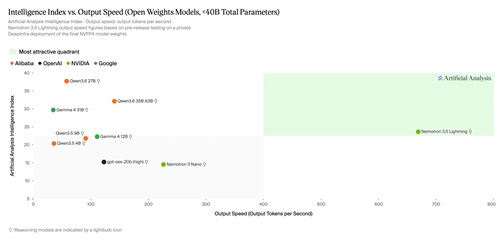
Nemotron 3.5 Lightning is a 30 billion-parameter Mixture-of-Experts (MoE) model that activates a remarkably lean 3 billion parameters per token. Boasting a massive 1-million-token context window and output speeds up to four times faster than comparable models of its size, Lightning represents a deliberate pivot away from raw, unfocused intelligence in favor of optimized speed, efficiency, and task-specific execution.
Crucially, Nvidia is not releasing Nemotron 3.5 Lightning in a vacuum. Alongside the model, the company has introduced NeMo Switchyard, an open-source routing library designed to dynamically direct workloads across a heterogeneous mix of proprietary, open-source, and custom models at runtime. Together, these releases signal the maturation of the AI industry from single-model dependency to an ensemble "system of models" architecture—a structural transformation that promises to redefine how enterprise applications deploy, scale, and monetize artificial intelligence.

Detailed Chronology: The Evolution Toward Specialized Agent Workflows
To fully understand the significance of the Nemotron 3.5 Lightning release, one must trace the rapid evolution of generative AI application design over the past several years.
Phase I: The Monolithic Era
When large language models (LLMs) first captured the global imagination, application architecture was deceptively simple. Developers built user interfaces that sent a single prompt directly to a massive frontier model, receiving a single response in return. In this paradigm, model selection was a one-time platform choice. Organizations evaluated models primarily on raw capability, generalization benchmarks, and zero-shot performance.
However, as businesses attempted to transition generative AI from chat interfaces into production-grade business workflows, the limitations of this monolithic approach became glaringly apparent. Real-world tasks rarely happen in a single turn. They require planning, multi-step execution, error handling, tool utilization, validation, and real-time data ingestion.
Phase II: The Rise of Autonomous Agents
To bridge this capability gap, the industry pivoted toward autonomous AI agents. These systems are capable of breaking down complex, high-level objectives into sequential execution plans. As an agent works through a plan, it might execute dozens—or even hundreds—of background operations: calling APIs, querying databases, parsing JSON payloads, formatting outputs, and validating constraints.
Yet, routing every single one of these micro-tasks through a massive, high-latency reasoning model proved economically and operationally unsustainable. Every routine tool call or formatting check incurred heavy latency penalties and racked up unsustainable inference costs.
Phase III: The Nvidia Blueprint and the Introduction of Lightning
Recognizing this bottleneck, Nvidia conceptualized a division of labor within AI workflows. Under this new architectural vision, a large, highly capable reasoning model acts as the "executive planner"—mapping out workflows, evaluating strategic alternatives, and handling difficult edge cases. Meanwhile, a fleet of ultra-fast, specialized models handles the heavy lifting of repeated, low-level execution.
Nemotron 3.5 Lightning was purpose-built to occupy this second tier. Released on August 11, the model is engineered to absorb the crushing volume of routine operations generated by autonomous agents. By trading off the exhaustive, generalized knowledge of a trillion-parameter frontier model for hyper-optimized execution speed, Lightning provides enterprises with a viable mechanism to scale agentic systems without inflating infrastructure budgets.
Simultaneously, the concurrent release of the NeMo Switchyard library addresses the routing challenge inherent in multi-model environments. By enabling runtime evaluation and dynamic request dispatching, Switchyard automates the handoff between strategic reasoning engines and execution workhorses like Lightning.

Supporting Context & Metrics: Architecture and Efficiency
The performance characteristics of Nemotron 3.5 Lightning are direct derivatives of its underlying technical architecture. Rather than treating efficiency as an afterthought, Nvidia built speed and cost-effectiveness into the foundational layers of the model.
Architectural Breakdown: Mixture-of-Experts (MoE)
Nemotron 3.5 Lightning is structured as a 30 billion-parameter Mixture-of-Experts model. In an MoE architecture, the network is divided into multiple "expert" sub-networks, and a gating router dynamically selects a subset of these experts to process each given token.
For Lightning, Nvidia has tuned this mechanism so that only 3 billion parameters are activated per token. This design choice provides the model with the aggregate capacity and representational richness of a much larger network while retaining the computational footprint and execution velocity of a compact model. Consequently, Lightning achieves up to four times the output speed of similarly sized dense models.
Context Window and Throughput
In the realm of long-running AI agents, context length is paramount. Agents handling intricate coding projects, multi-document analysis, or extensive audit trails must retain massive amounts of state across hundreds of operational steps. Nemotron 3.5 Lightning addresses this requirement by supporting an expansive 1-million-token context window. This allows agents to maintain deep operational memory without suffering from catastrophic forgetting or requiring constant, expensive summarization passes.

Advanced Optimization Techniques
Nvidia’s engineering team applied a suite of advanced optimization primitives to maximize inference efficiency:
- Multi-Token Prediction: Allowing the model to forecast multiple steps ahead, dramatically reducing sequential generation latency.
- Speculative Decoding: Leveraging smaller, ultra-fast draft models to accelerate the generation verification process of the primary model.
- NVFP4 Quantized Checkpoints: Utilizing advanced low-bit numerical formats (FP4) to reduce memory bandwidth requirements, allowing high-density deployments on enterprise hardware without sacrificing numerical stability.
Licensing and Open Access
In a strategic move to foster developer adoption and enterprise trust, Nvidia is offering Nemotron 3.5 Lightning under its OpenMDW-1.1 license. This permissive framework grants developers access not only to the model’s open weights but also to its core training data and procedural recipes, empowering internal engineering teams to audit, fine-tune, and self-host the model in secure environments.
Official Statements and Industry Implications
The release of Nemotron 3.5 Lightning and NeMo Switchyard challenges deeply ingrained assumptions within the enterprise software ecosystem. For years, the commercial AI narrative was defined by a binary choice: build atop proprietary APIs or self-host a singular open-source foundational model.
Nvidia’s messaging reframes this debate entirely. According to the company’s enterprise announcements, modern artificial intelligence applications increasingly operate as model ensembles. In this environment, raw capability is no longer the sole metric of success; rather, a complex matrix comprising latency, inference cost, deployment location, and task specialization dictates architectural decisions.

"A model that is not the strongest choice for difficult reasoning may still make sense for a large volume of narrower tasks if it can complete them more quickly and with sufficient accuracy."
This pragmatic philosophy shifts the economic calculus of AI deployment. Enterprises no longer need to pay a heavy "frontier model tax" for routine operations like data formatting, text extraction, or standard API payload generation. By pairing a specialized executor like Lightning with a robust routing layer, organizations can achieve optimal cost-performance ratios tailored precisely to their operational workloads.
Furthermore, the introduction of NeMo Switchyard removes a major friction point in multi-model adoption. Historically, routing requests across disparate models required extensive custom coding, rigid middleware, and disruptive application rewrites whenever a model was updated or swapped out. Switchyard abstracts this complexity, allowing organizations to dynamically route work across a hybrid ecosystem of open-source models, proprietary frontier APIs, and specialized Nvidia checkpoints without modifying underlying application code.
Future Outlook: The Runtime Decision Paradigm
As the enterprise AI market matures beyond proof-of-concept chatbots into deeply embedded autonomous agent networks, the release of Nemotron 3.5 Lightning offers a clear glimpse into the future of software architecture.

1. Granular Workflow Evaluation
Development teams will increasingly evaluate the performance of entire workflows rather than treating model selection as a static, global decision. Profiling tools will measure cost-per-task, latency per step, and accuracy degradation across multi-model chains, allowing engineers to continuously optimize their agent pipelines.
2. Runtime Model Routing as Standard Practice
Static API endpoints routing every request to the exact same model will soon look antiquated. The future belongs to dynamic, context-aware routing engines like NeMo Switchyard that evaluate incoming requests in real time—weighing quality requirements, latency thresholds, and financial budgets at the millisecond level before dispatching work to the most appropriate model.
3. The Rise of Domain-Specific Fast Workhorses
While frontier models will continue to push the boundaries of abstract reasoning, creative synthesis, and complex planning, the vast majority of enterprise AI transactions will be absorbed by hyper-specialized, highly efficient models. By providing the open-weight foundations, training recipes, and routing infrastructure necessary to build these multi-model systems, Nvidia is positioning itself not just as a hardware supplier of GPUs, but as the foundational architect of the enterprise AI runtime stack.
Ultimately, Nemotron 3.5 Lightning signals the end of the "one model to rule them all" era. In its place rises a sophisticated, highly choreographed ecosystem where speed, specialization, and intelligent orchestration dictate the next generation of artificial intelligence innovation.

