
Executive Overview
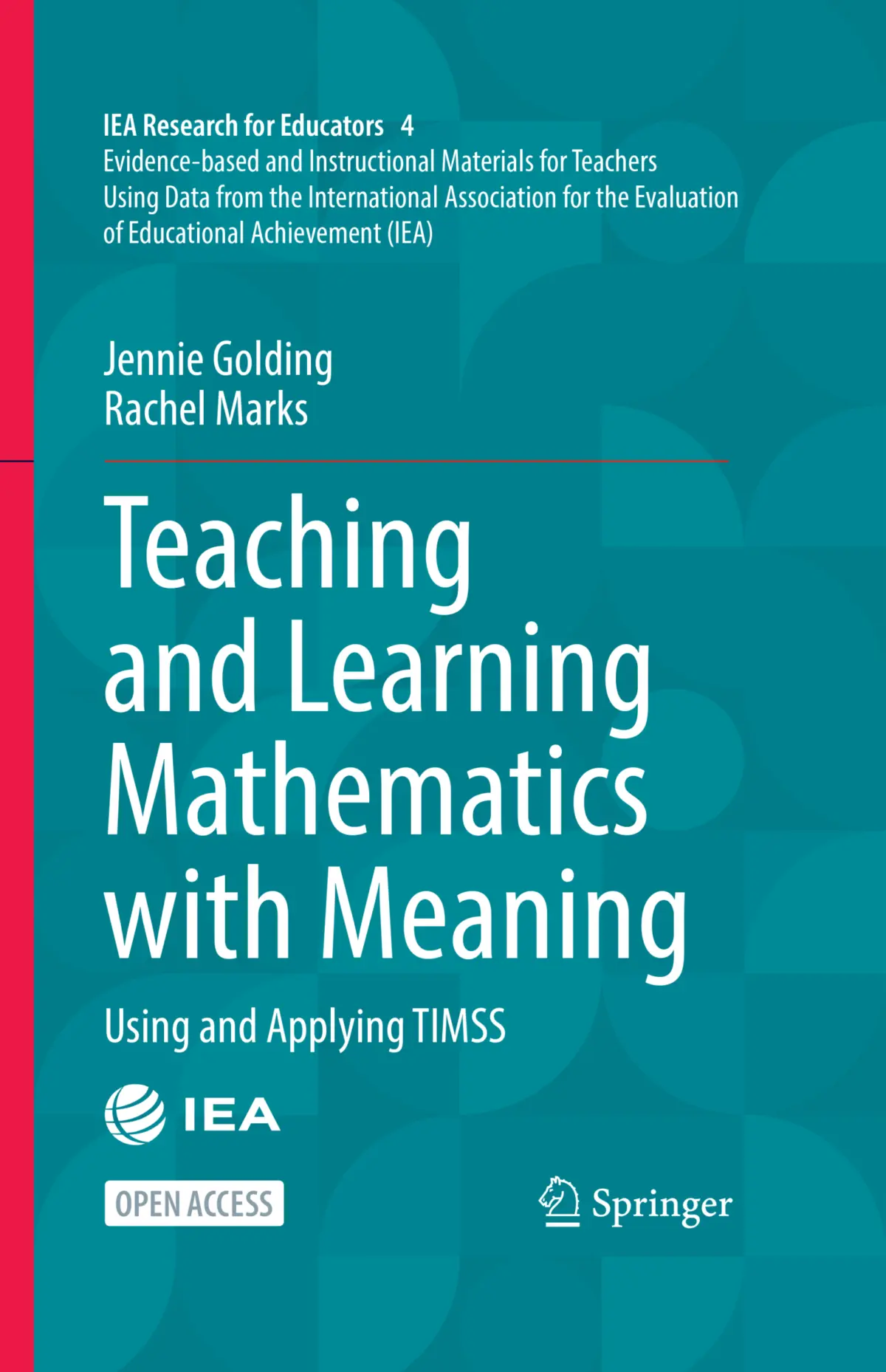
In an era defined by rapid technological advancement and the increasing dominance of artificial intelligence, the fundamental pillars of mathematics education are undergoing a rigorous re-evaluation. The recent announcement of Volume 4 in the IEA Research for Educators series, titled Teaching and Learning Mathematics with Meaning: Using and Applying TIMSS, marks a pivotal moment in this global educational evolution. Authored by esteemed researchers Jennie Golding and Rachel Marks and published by Springer (2026), this volume serves as a bridge between the high-level data of the Trends in International Mathematics and Science Study (TIMSS) and the practical, day-to-day realities of the classroom.
For decades, TIMSS has provided a "temperature check" for global education systems, ranking nations based on student proficiency. However, a persistent criticism of such large-scale assessments has been the "data-practice gap"—the disconnect between international metrics and the pedagogical strategies used by teachers in diverse sociocultural contexts. Volume 4 addresses this gap head-on, transforming abstract statistical evidence into actionable, open-access resources designed to foster deep "meaning-making."
By shifting the focus from rote memorization and procedural fluency to mathematical reasoning and problem-solving, Golding and Marks provide a blueprint for a more equitable and effective approach to STEM education. This article explores the implications of this publication, the methodology behind its development, and the potential for these resources to reshape the future of mathematical literacy on a global scale.
Detailed Chronology: From Data Collection to Classroom Transformation
The journey toward Teaching and Learning Mathematics with Meaning is rooted in the long-standing history of the International Association for the Evaluation of Educational Achievement (IEA). To understand the significance of this new volume, one must trace the evolution of how international assessment data has been utilized over the last thirty years.
The Era of "Rankings" (1995–2010)
When TIMSS was first launched in 1995, its primary utility was seen through a geopolitical lens. Governments used the data to justify educational reforms or to boast of national superiority in STEM. During this period, the data was largely the province of policymakers and academics. Teachers, the primary agents of educational change, were often left out of the conversation, receiving only the "verdict" of their nation’s performance without the tools to address the underlying pedagogical weaknesses identified by the study.
The Shift Toward Diagnostic Utility (2011–2019)
As the IEA matured, there was a concerted effort to move beyond simple rankings. The focus shifted toward "secondary analysis," where researchers began to look at the contextual questionnaires—data regarding teacher preparation, school resources, and student attitudes. It became clear that high scores in some regions were achieved through "shadow education" (private tutoring) rather than classroom innovation. This realization sparked the need for a series that could translate these nuanced findings into teacher-centric language.
The Inception of the "Research for Educators" Series (2020–Present)
Recognizing that the 500-page technical reports produced after each TIMSS cycle were inaccessible to busy practitioners, the IEA launched the Research for Educators series. Volumes 1 through 3 laid the groundwork by exploring science education and general assessment literacy.
The development of Volume 4 (2024–2026) represents the most ambitious installment to date. Golding and Marks were tasked with synthesizing decades of TIMSS evidence to answer a singular, difficult question: How can we move students from "knowing" math to "understanding" math? The resulting work, scheduled for full release in 2026, is the culmination of years of classroom observations, data synthesis, and pedagogical refinement.
Supporting Context & Metrics: The Crisis of Mathematical Reasoning
The urgency of this publication is underscored by a concerning trend in global education metrics. While many countries have seen a rise in "procedural" scores—the ability of students to perform basic calculations—there has been a stagnant or declining trend in "reasoning" and "problem-solving" domains.
The "Meaning" Deficit
According to the most recent TIMSS data cycles, a significant percentage of students in middle-income and even high-income countries can solve a multi-step equation if it follows a familiar template. However, when the same mathematical principle is applied to an unfamiliar, real-world context, performance drops by as much as 40%. This "meaning deficit" suggests that students are learning the what of mathematics without the why.
Key Metrics Influencing Volume 4
- The Reasoning Gap: In the 2019 TIMSS cycle, the gap between the "Knowing" domain and the "Reasoning" domain was most pronounced in secondary education, suggesting that as mathematics becomes more abstract, students lose their grip on conceptual meaning.
- Teacher Confidence: IEA data indicates that nearly 30% of mathematics teachers in some regions feel "less than confident" in teaching students how to apply mathematics to non-routine problems.
- Equity of Access: The data reveals that students from lower socio-economic backgrounds are disproportionately taught via "rote learning," while their wealthier peers are more likely to engage in "inquiry-based" meaning-making.
Volume 4 utilizes these metrics to justify its focus on open-access resources. By providing these tools for free, Golding and Marks aim to democratize high-quality pedagogy, ensuring that "teaching for meaning" is not a luxury reserved for elite institutions.
Official Statements: Insights from the Authors and IEA Leadership
While the full text of the volume is highly technical, the philosophy behind it is rooted in a passion for teacher empowerment.
Jennie Golding, a lead author and a prominent figure in mathematics education at University College London (UCL), has frequently emphasized the importance of teacher agency. In discussions regarding the book’s framework, Golding notes:
"Mathematics should not be a series of hurdles students jump over to pass an exam. It is a language for understanding the universe. Our goal with this volume was to take the massive evidentiary weight of TIMSS and distill it into something a teacher can use on a Tuesday morning to help a child see the beauty and logic in a geometric proof."
Rachel Marks, co-author and expert in primary and secondary mathematics pedagogy, highlights the practical nature of the resources:
"We aren’t just giving teachers more theory. We are providing them with classroom-ready resources that have been tested against the benchmarks of what the world’s most successful students are doing. We are focusing on ‘mathematical talk’—encouraging students to articulate their reasoning, which the TIMSS data shows is a key predictor of long-term success."
The IEA Secretariat issued a statement regarding the publication’s role in the broader Research for Educators initiative:
"The IEA is committed to ensuring that our research does not sit on a shelf. Volume 4 of the Research for Educators series is a testament to our mission of improving education worldwide. By partnering with Springer to provide these resources as open access, we are breaking down the barriers between international research and the classroom door."
Future Outlook: Mathematics Education in 2026 and Beyond
As we look toward the 2026 release of Teaching and Learning Mathematics with Meaning, the landscape of education is poised for a significant shift. The impact of this volume is expected to be felt in three primary areas:
1. The Integration of Digital and Conceptual Tools
The 2026 cycle of TIMSS will be the most digitally integrated yet. Volume 4 prepares educators for this transition by offering resources that leverage digital environments for "meaning-making." Instead of using computers for simple drills, the book guides teachers in using technology to visualize complex data and model mathematical phenomena.
2. A New Standard for Teacher Training
It is anticipated that Volume 4 will become a staple in Initial Teacher Education (ITE) programs. By providing a clear link between international evidence and classroom practice, the book offers a "gold standard" for what effective mathematics teaching looks like in the 21st century. We can expect to see university curricula around the world adopting the Golding-Marks framework to train the next generation of educators.
3. Closing the Achievement Gap
The most profound hope for this publication lies in its potential to address educational inequality. As these resources are open-access, they provide high-quality instructional materials to under-resourced schools that may not have the budget for expensive consultancy or proprietary curriculum sets. If widely adopted, the "meaning-making" approach could significantly narrow the achievement gap between different socio-economic strata by moving away from "low-floor" rote learning toward "high-ceiling" conceptual thinking.
Conclusion
Teaching and Learning Mathematics with Meaning: Using and Applying TIMSS is more than just a textbook; it is a strategic intervention in a global educational crisis. By empowering teachers with the evidence-based tools they need to foster true understanding, Golding and Marks are not just helping students pass the next TIMSS test—they are preparing them for a future where mathematical reasoning is the most valuable currency they possess. As the 2026 publication date approaches, the global education community waits with high expectations for a resource that promises to turn data into wisdom.

