

Executive Overview
The landscape of cloud computing security has officially shifted away from foundational infrastructure concerns toward the complexities of human access, interconnected ecosystems, and emergent technologies. According to the Cloud Security Alliance’s (CSA) Top Threats to Cloud Computing Survey Report 2026, Identity and Access Management (IAM) has decisively claimed the number-one spot as the leading threat vector in modern enterprise cloud environments.
This latest installment of the CSA’s benchmark research series represents a major ideological and operational pivot. For years, cloud misconfigurations—human errors in setting up storage buckets, permissions, or network topology—reigned supreme as the single greatest risk to organizational data. However, the 2026 report reveals that attackers are increasingly bypassing technical misconfigurations to exploit credentials, manipulate permissions, and weaponize the very software supply chains and artificial intelligence (AI) models organizations are rushing to adopt.
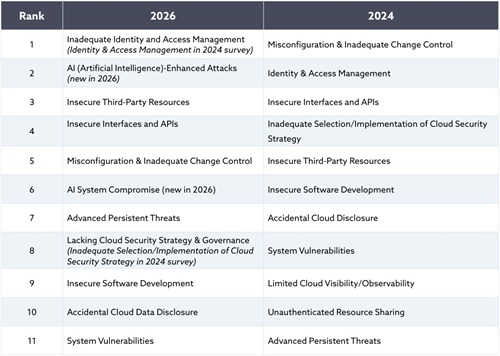
The report, drawing insights from 507 cybersecurity professionals who evaluated 23 distinct cloud security issues, encapsulates a newly minted Top 11 list. Notably, this year’s survey marks the historic debut of two artificial intelligence-related threats. Meanwhile, legacy risks such as denial-of-service (DoS) attacks, shared technology vulnerabilities, unauthenticated resource sharing, and limited cloud visibility have been pushed entirely out of the top tier.
For Chief Information Security Officers (CISOs), risk managers, compliance officers, and executive leadership, the 2026 findings are more than just a theoretical ranking—they are an urgent directive. As organizations scale their multi-cloud strategies, integrate generative AI tools, and rely heavily on third-party APIs, the metrics provided by the CSA offer a vital blueprint for prioritizing security budgets, governance investments, and risk mitigation frameworks.
Detailed Chronology and Paradigm Shift: 2024 vs. 2026
To fully understand the gravity of the 2026 findings, security leaders must examine the trajectory of cloud threats over recent survey cycles. The digital ecosystem has evolved at a breakneck pace, and threat actors have adapted their tactics in lockstep.
The Rise of Identity and the Fall of Misconfiguration
In the previous benchmark report, misconfiguration and inadequate change control sat comfortably at the peak of the hierarchy. Cloud environments were expanding faster than administrators could secure them, leading to countless instances of public-facing data buckets, overly permissive IAM roles, and neglected asset inventories.
Fast-forward to the 2026 report, and Identity and Access Management has surged from the number two position to capture the crown jewel of cloud risks. This transition does not mean misconfigurations have disappeared; rather, it underscores a sophisticated shift in adversary behavior. Attackers realize that they do not need to hunt for a misconfigured server if they can simply compromise a legitimate user credential, abuse a compromised service account, or execute a session-hijacking attack. By leveraging valid credentials, bad actors blend in with normal administrative traffic, rendering traditional perimeter defenses largely ineffective.
Concurrently, misconfigurations have dropped to number five on the list. While still a critical hazard, organizations have collectively improved their automated posture management tools (such as CSPM solutions), reducing the frequency of blatant configuration errors.
The Escalation of Third-Party and Supply Chain Risks
Another defining trend in the 2026 chronology is the rapid ascension of third-party dependencies. Insecure third-party resources climbed from number five up to number three. As organizations migrate deeper into SaaS ecosystems, rely on open-source libraries, and integrate external microservices, the enterprise perimeter has dissolved. A single vulnerability in a third-party API or an upstream software library can compromise an entire cloud tenant, a reality demonstrated by numerous high-profile supply chain breaches over recent years.
Furthermore, Advanced Persistent Threats (APTs) have clawed their way up from number 11 to number seven. Nation-state actors and sophisticated cybercriminal syndicates are no longer just probing cloud perimeters; they are establishing long-term, stealthy footholds within cloud native environments, exploiting weak identities and complex interdependencies to evade detection.
The Entry of Artificial Intelligence
Perhaps the most striking evolution in the 2026 report is the formal introduction of AI-related risks into the Top 11. As enterprises race to deploy Large Language Models (LLMs), machine learning pipelines, and autonomous agentic workflows, they are introducing an entirely unprecedented attack surface. These entries do not merely reflect speculative risks; they capture real-world vulnerabilities—such as prompt injection, training data poisoning, model inversion, and insecure AI API integrations—that organizations are struggling to govern.
Supporting Context and Metrics: Inside the Data
The methodology underpinning the CSA’s 2026 findings provides a rigorous foundation for enterprise risk assessment. The CSA Top Threats Working Group polled 507 qualified cybersecurity professionals worldwide, asking them to evaluate and score 23 distinct cloud security risks.
Statistical Tightness of the Rankings
One of the most revealing aspects of the 2026 survey data is the close clustering of scores. The threat scores are remarkably tightly grouped, ranging from 7.95 out of 10 for the top-ranked issue down to 7.45 out of 10 for the number 11 spot.
This narrow margin communicates a vital message: there is no longer a single, runaway "monster" threat that dwarfs all others. Instead, modern cloud security is characterized by a dense, interconnected matrix of high-severity risks. An organization that fixes its identity management while ignoring third-party APIs or AI vulnerabilities remains acutely vulnerable. Every single entry in the Top 11 demands active mitigation.
The Displacement of Infrastructure-Level Concerns
A profound takeaway from the 2026 report is what failed to make the cut. Traditional infrastructure-level hazards—such as denial-of-service (DoS) attacks, shared technology vulnerabilities, cloud service provider (CSP) data loss, unauthenticated resource sharing, and limited cloud visibility or observability—have all dropped below the Top 11 threshold.

This displacement highlights a maturing cloud market. Organizations largely trust the underlying infrastructure security provided by major hyper-scalers (such as Amazon Web Services, Microsoft Azure, and Google Cloud Platform). Hyperscalers have poured billions into hardening physical data centers, mitigating DDoS vectors, and securing shared hardware. Consequently, the battleground has shifted entirely to the customer side of the Shared Responsibility Model—specifically into the realms of software logic, data governance, API connectivity, human identity, and AI implementation.
Official Statements and Industry Insights
In releasing the 2026 report, leaders within the Cloud Security Alliance emphasized the urgent need for structural transformation in how enterprises approach defense-in-depth.
Industry experts collaborating on the CSA Top Threats Working Group noted that the erosion of traditional perimeters has fundamentally changed the nature of defense. In an environment where infrastructure is ephemeral and code-driven, security can no longer rely on static network boundaries or legacy firewalls.
"The 2026 survey results demonstrate a definitive maturation in how organizations must view the cloud threat landscape," noted security analysts contributing to the report. "We are no longer merely fighting against sloppy administrative configurations or basic infrastructure gaps. We are dealing with sophisticated identity manipulation, deeply interwoven third-party supply chains, and cognitive vectors introduced by artificial intelligence. Security programs that fail to evolve past traditional perimeter thinking will find themselves fundamentally misaligned with modern enterprise risk."
Furthermore, the CSA has structured the individual threat analyses within the report to be fiercely actionable. Each threat profile does not merely define the technical vulnerability; it outlines:

- Business and Technical Impacts: Quantifying how a compromise affects bottom lines, regulatory compliance, and system integrity.
- Key Takeaways: Providing digestible, high-level summaries for executive leadership.
- Real-World Examples: Grounding abstract threats in actual, observable attack patterns.
- Corresponding CSA Security Controls: Pointing directly to established frameworks and control matrices that security architects can implement immediately.
Comprehensive Breakdown: The New Threat Hierarchy
While the complete 2026 report outlines the granular details of all 23 evaluated issues, the newly crowned Top 11 demands immediate scrutiny from security practitioners.
1. Identity and Access Management (IAM) Failures
Taking the number-one spot, IAM vulnerabilities encompass everything from weak password policies and lack of multi-factor authentication (MFA) to over-privileged service accounts and stale credentials. In cloud-native architectures, identity is the new perimeter. When an attacker compromises an administrative credential, they effectively inherit the keys to the kingdom, bypassing firewalls and encryption effortlessly.
2. Artificial Intelligence (AI) and Machine Learning Integration Risks
Entering the rankings for the first time, AI-related threats reflect the massive surge in enterprise machine learning adoption. Security teams are grappling with vulnerabilities unique to cognitive systems, including prompt injection, data poisoning, insecure model serialization, and unauthorized extraction of proprietary training data via LLM interfaces.
3. Insecure Third-Party Resources and Supply Chain Vulnerabilities
Rising to number three, this threat highlights the dangers of external dependencies. Modern applications are built using thousands of open-source packages, third-party SaaS tools, and managed APIs. If an upstream vendor suffers a breach or introduces malicious code, downstream cloud tenants inherit the risk instantly.
4. Application Programming Interface (API) Insecurity
APIs are the connective tissue of modern cloud applications, facilitating data exchange between microservices, mobile apps, and third-party partners. Inadequate authentication, broken object-level authorization (BOLA), and insufficient rate limiting make APIs prime targets for data exfiltration.

5. Misconfiguration and Inadequate Change Control
Former championing threat misconfiguration has dropped to number five. While automated posture management tools have helped, human error during complex cloud deployments, forgotten test environments, and improper permission grants remain a persistent vector for compromise.
6. Lack of Cloud Security Architecture and Strategy
Organizations rushing into multi-cloud environments without a cohesive, unified security strategy often find themselves deploying fragmented, incompatible defense tools. This architectural deficit leaves blind spots that sophisticated attackers readily exploit.
7. Advanced Persistent Threats (APTs)
Climbing to number seven, APT groups are increasingly targeting cloud environments to establish long-term espionage or disruptive campaigns. These actors use living-off-the-cloud techniques, abusing legitimate administrative tools to blend in with normal traffic.
8. Insufficient Logging, Monitoring, and Auditing
Detecting a breach in progress requires robust observability. When logs are misconfigured, incomplete, or insufficiently analyzed, dwell times skyrocket, allowing attackers to move laterally across cloud tenants undetected.
9. Cryptographic Failures and Data Protection Gaps
Data breaches often occur because sensitive information is stored or transmitted without adequate encryption, or because cryptographic keys are managed poorly (e.g., hardcoded keys in source code repositories or stored in public buckets).

10. Insecure Software Development Life Cycle (SDLC)
Failing to embed security into the development pipeline—known as "shifting left"—results in applications being deployed with inherent vulnerabilities. Securing cloud infrastructure is pointless if the code running on top of it is fundamentally flawed.
11. Ransomware and Extortion in Cloud Environments
Rounding out the Top 11, ransomware has evolved beyond simple local machine encryption. Modern ransomware gangs specifically target cloud backups, storage repositories, and virtualization layers to paralyze enterprise operations and demand multi-million-dollar extortions.
Future Outlook: Navigating the 2026 Landscape and Beyond
As organizations look toward the remainder of the decade, the implications of the CSA’s 2026 Top Threats report are profound. The traditional paradigm of locking down the data center has been permanently replaced by a fluid, dynamic, and highly complex operating model.
Strategic Recommendations for Enterprise Leaders
- Adopt a Zero-Trust Identity Framework: Because IAM is now the primary attack vector, organizations must move beyond basic MFA. Implementing continuous identity validation, micro-segmentation, dynamic privilege access management (PAM), and robust session monitoring is non-negotiable.
- Establish AI Governance Early: As AI makes its debut in the threat rankings, organizations cannot treat machine learning projects as sandbox experiments. Comprehensive AI asset inventories, input sanitization firewalls, and rigorous model validation must be integrated into enterprise risk management frameworks.
- Enforce Software Supply Chain Transparency: Security teams must demand Software Bills of Materials (SBOMs) from all third-party vendors and open-source suppliers. Automated dependency scanning must become a continuous, real-time gatekeeper in the CI/CD pipeline.
- Align Budgets with Real-World Risks: CISOs must audit their security spending to ensure investments match the CSA’s updated risk priorities. Funding should flow heavily toward identity governance, API security posture management (ASPM), and AI safety tools rather than over-investing in legacy infrastructure defenses.
Conclusion
The Cloud Security Alliance’s Top Threats to Cloud Computing Survey Report 2026 serves as a vital reality check for the global technology sector. By illuminating the supremacy of identity, the arrival of AI vulnerabilities, and the escalating peril of third-party supply chains, the report strips away complacency.
The message to executive management and information security personnel is clear: securing the cloud in 2026 and beyond requires moving past legacy infrastructure assumptions and mastering the human, code-driven, and cognitive frontiers of enterprise technology. Organizations that heed these insights will build resilient, adaptable cloud ecosystems; those that ignore them do so at their own peril.

