
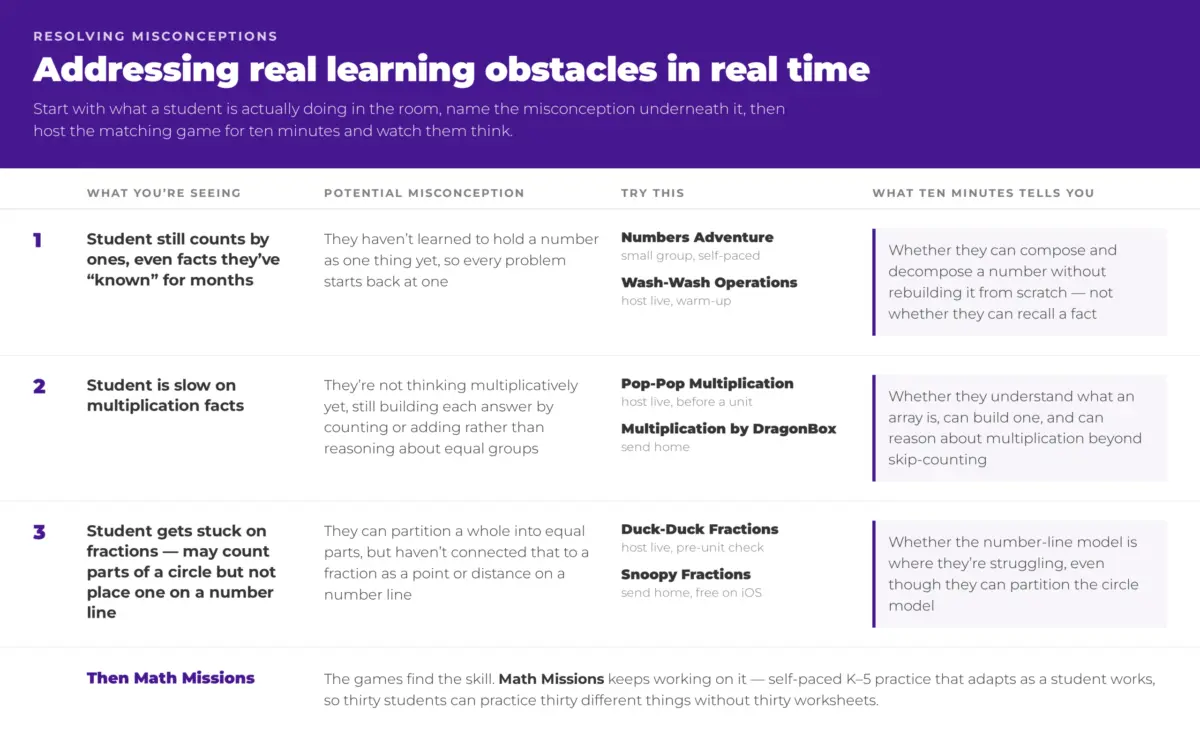
Executive Overview
Every educator is intimately familiar with the invisible fracturing of a standard mathematics classroom. Within minutes of launching a new unit, a class quietly splits into distinct operational tiers. At one end of the room sit students who have fully mastered prerequisite concepts, eagerly pressing forward toward advanced grade-level content. At the other end are learners struggling with foundational deficits buried two or three grade levels deep—gaps that render today’s new concepts structurally impossible to grasp.
The historical challenge of differentiated instruction has never been a lack of educator effort or pedagogical vision. Rather, it is the logistical impossibility of delivering responsive teaching within a live, whole-group lesson while simultaneously catering to twenty-five unique learning trajectories. Designing, organizing, and executing twenty-five customized lesson sequences simultaneously is a burden that routinely pushes teachers toward exhaustion.
Enter Kahoot! Math Games and Math Missions—a comprehensive suite of digital, interactive tools designed specifically to dismantle this pedagogical bottleneck. By combining targeted gameplay for known conceptual misconceptions with adaptive, self-paced K-5 practice paths, the platform offers a streamlined bridge between whole-group engagement and individualized remediation. Rather than relying on traditional, one-size-fits-all worksheets or high-stakes timed drills, educators can leverage game-based diagnostics to pinpoint exact student friction points, remediate missing foundations without social stigma, and foster genuine mathematical intuition.
Detailed Chronology and Evolution of the Math Learning Crisis
To understand the urgency behind digital remediation tools like Kahoot! Math Games, one must examine the compounding nature of mathematical learning losses over the past decade.
Phase 1: The Accumulation of Unfinished Foundations (Grades K–3)
Mathematical literacy is cumulative; it is a structural staircase where every subsequent step relies entirely on the integrity of the previous one. Historically, foundational cracks begin early. In kindergarten and first grade, students who fail to transition from physical counting to an internalized sense of quantity experience a compounding disadvantage.
When a fourth-grade student is still forced to rely on finger-counting to solve basic arithmetic, their working memory is saturated by the mechanics of counting. Consequently, they have zero cognitive bandwidth left to process advanced multi-digit multiplication, long division, or proportional reasoning. The deficit is not necessarily a lack of effort; it is an architectural collapse further down the line.
Phase 2: The Memorization Trap (Upper Elementary)
As students transition into upper elementary grades, the curriculum introduces abstract structures such as multiplication arrays, division algorithms, and fractional parts. Traditionally, classrooms attempted to solve lagging computational fluency through rote memorization and timed worksheets.
However, educational research consistently demonstrates that rote drilling fails to differentiate between a student who lacks memory retrieval skills and a student who fundamentally does not understand the structural concept of multiplication (such as equal groups or array configurations). Treating these two distinct cognitive profiles with the same intervention inevitably leaves struggling learners behind.
Phase 3: The Abstraction Barrier (Middle School Transition)
The final pre-algebraic hurdle often manifests in how students conceptualize fractions and rational numbers. Most children can successfully physically partition a geometric shape (like a circle or a rectangle) into equal slices long before they can accurately place that same fractional value as an abstract coordinate point on a number line. When this conceptual bridge fails to build, algebra becomes an impenetrable wall of arbitrary rules rather than a logical extension of arithmetic.
Phase 4: The Digital Intervention Era
Recognizing these recurring structural failures, educational technologists and classroom practitioners collaborated to develop targeted digital interventions. Over recent years, platforms have evolved from static multiple-choice quiz generators into dynamic diagnostic environments. The modern iteration—exemplified by Kahoot! Math Games and adaptive Math Missions—represents a shift toward interactive, game-based routing systems that diagnose misconceptions in real time, routing students to targeted practice environments seamlessly integrated into the daily school schedule.
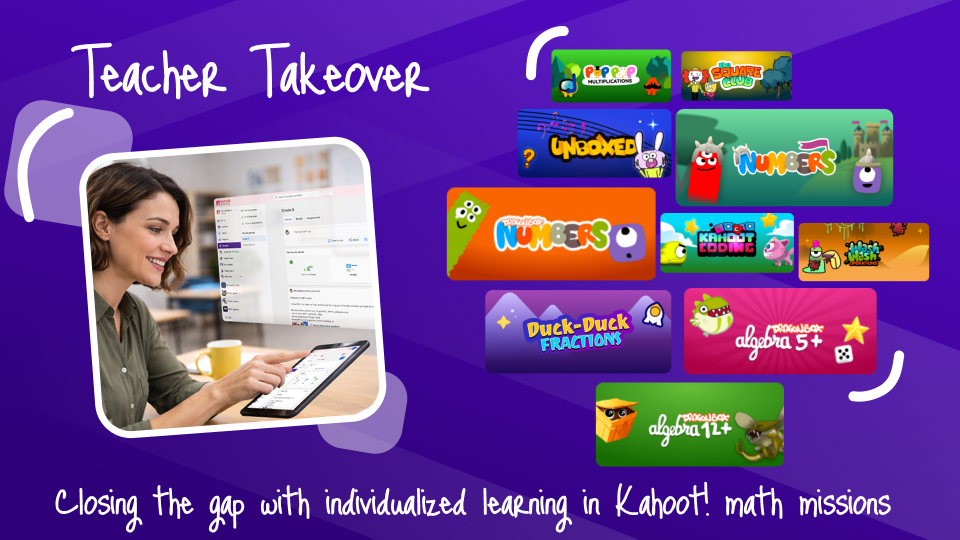
Supporting Context & Core Mechanics: Deconstructing Three Major Math Misconceptions
Kahoot! Math Games addresses three of the most pervasive conceptual hurdles in elementary and middle school mathematics, replacing archaic drills with targeted, intuitive gameplay.
+---------------------------------------------------------------------------------+
|                        THE THREE CORE MATH MISCONCEPTIONS                        |
+--------------------------+---------------------------+--------------------------+
| 1. NUMBER SENSE          | 2. MULTIPLICATION         | 3. FRACTIONS             |
| A number is treated as a | Multiplying is viewed as  | Splitting a shape is     |
| count rather than an     | rote memorization rather  | disconnected from        |
| internal quantity.       | than structured groups.   | number line placement.   |
+--------------------------+---------------------------+--------------------------+
| TARGETED GAME:           | TARGETED GAME:            | TARGETED GAME:           |
| Numbers Adventure &      | Pop-Pop Multiplications & | Duck-Duck Fractions &    |
| Wash-Wash Operations     | Multiplication by Dragon  | Snoopy Fractions         |
+--------------------------+---------------------------+--------------------------+
Misconception 1: A Number Is a Count, Not a Quantity
- The Problem: When a student cannot hold an internal sense of quantity in their working memory, every subsequent mathematical operation demands excessive time, effort, and cognitive load. Fourth graders still tethered to finger-counting inevitably stumble when introduced to multi-digit multiplication and rational numbers.
- The Solution via Kahoot!: Educators can deploy Numbers Adventure, a narrative-driven progression of short, solo sessions focusing explicitly on counting and comparing quantities. Because the game utilizes discrete worlds and levels, students requiring foundational support can engage with early-world mechanics safely, without drawing public attention from peers. For whole-class engagement, teachers utilize Wash-Wash Operations as a live, five-minute, pin-based warm-up covering all four basic operations.
- Why It Works: Both games force students to actively manipulate and visualize quantity rather than relying on automated fact recall. Because Numbers Adventure operates as a solo player experience, foundational rebuilding occurs in a low-anxiety, private environment.
Misconception 2: Multiplying Without Thinking in Groups
- The Problem: When learners fail to visualize multiplication as structural sets of equal groups, every mathematical fact transforms into an isolated piece of trivia to be memorized. Slow recall rates during early multiplication units inevitably cascade into persistent obstacles during fractions, factoring, and algebraic factorization units.
- The Solution via Kahoot!: Teachers host Pop-Pop Multiplications live for ten minutes preceding a formal division or factor unit. Students physically drag characters into active play zones to construct visual arrays, transforming multiplication from abstract tables into tangible structural geometry. For independent home or center reinforcement, educators assign Kahoot! Multiplication by DragonBox.
- The Array Distinction: The array model cleanly isolates the student who simply needs memory support from the student who lacks foundational comprehension of proportional grouping, bypassing the blind spots inherent in traditional timed worksheets.
Misconception 3: Splitting a Shape Is Not the Same as Placing a Point
- The Problem: While the vast majority of students can accurately partition geometric circles or squares into equal fractional parts, they routinely freeze when asked to represent that exact fractional value as a single point along an infinite number line. This disconnect is the primary gateway for middle-school fraction anxiety.
- The Solution via Kahoot!: Educators run Duck-Duck Fractions live as an interactive pre-unit diagnostic check. Teachers select a playlist and a time limit (up to ten minutes), allowing students to join via a standard game PIN. During gameplay, instructors monitor individual hesitations: which students breeze through circle partitioning but stall on number line placement? These distinct friction points identify precise conceptual gaps. For extended remediation, Snoopy Fractions is assigned for autonomous practice.
- Pedagogical Impact: These games cultivate the exact representational flexibility mandated by core mathematical standards, allowing educators to diagnose class-wide understanding before committing to a rigid lesson plan rather than discovering gaps post-exam.
Official Statements and Educator Insights
The integration of game-based diagnostics and adaptive learning paths has drawn high praise from frontline educators navigating increasingly complex classrooms.
Ika M., a certified Kahoot! Ambassador based in Indonesia, emphasizes the practical utility of adaptive tools like Math Missions during daily lesson execution. Utilizing Math Missions as a structured post-lesson review tool has revolutionized her instructional workflow:
"It can be useful for identifying which concepts students have understood and which areas may need further explanation or practice," notes Ika M.
She further highlights how adaptive digital environments reshape student attitudes toward routine skill maintenance:
"It makes mathematics practice feel more like an active learning experience rather than a traditional worksheet or quiz, and it can be integrated into a lesson without requiring a lot of additional preparation."
According to pedagogical experts, this friction-free integration is the singular metric that determines whether an educational innovation successfully survives a demanding, full-time teaching week. By eliminating the administrative burden of generating fifteen distinct, leveled worksheets for a single classroom, platforms like Kahoot! return critical planning hours to educators while simultaneously increasing student autonomy during independent learning blocks.
Future Outlook: The Evolution of Responsive Math Instruction
As educational systems worldwide grapple with persistent learning variability and the demands of inclusive classrooms, the future of mathematics instruction will undeniably rely on intelligent, adaptive ecosystems. The rigid, lock-step curriculum model—where an entire class moves at an identical pace regardless of mastery—is rapidly giving way to fluid, data-informed pathways.
Moving forward, platforms expanding into comprehensive offerings like Kahoot! EDU and Kahoot!+ plans are setting new benchmarks for classroom analytics. By integrating robust standards-tagging, granular performance reporting, and self-paced student trajectories into everyday classroom routines, educators are empowered to make real-time instructional pivots.
Ultimately, the goal of modern edtech is not to replace the teacher, but to amplify their responsive capabilities. By letting adaptive engines like Math Missions handle the day-to-day triage of foundational reinforcement, educators are freed to focus on what humans do best: inspiring curiosity, facilitating deep mathematical discourse, and guiding every student toward authentic conceptual mastery.

