
By Lia Milgram, Managing Editor for ACTE
Published in coordination with the Association for Career and Technical Education (ACTE)
Executive Overview
From September 2025 through May 2026, Techniques magazine embarked on an extensive journalistic inquiry, tracking educators, visionary program leaders, and passionate advocates as they grappled with some of Career and Technical Education’s (CTE) most enduring and complex questions: What does it truly take to build educational pathways that reach every single learner? How do physical and virtual learning spaces, combined with immersive experiences, fundamentally shape what students believe is possible for their futures?
As the Association for Career and Technical Education (ACTE) proudly marks a monumental century of service, leadership, and workforce development, these inquiries feel more relevant, urgent, and vital than ever before.
The best stories in CTE have never been merely about isolated programs, vocational gadgets, or routine curricula. Instead, they are intensely human narratives about the people inside those programs—what they built against the odds, what they deeply believed in, and what they stubbornly refused to give up on. Over the 2025–2026 publishing cycle, Techniques captured this ethos across eight defining articles. This year-in-review serves as a permanent record of resilience, systemic transformation, and the relentless pursuit of educational equity.

Detailed Chronology: A Year of Defining CTE Narratives
September 2025: Skills Over Stigma and the Justice-Impacted Learner
High-quality CTE is, at its core, a promise of upward mobility and economic self-sufficiency. However, for justice-impacted learners, the stakes of that promise are exceptionally high, and the structural barriers they face are intensely real.
The academic year kicked off with a powerful perspective piece written by an author who knows the terrain intimately. Having been justice-impacted themselves, and now dedicating their professional life to education and reentry support, the author provided a raw, firsthand account of what is truly at stake when society looks past an individual’s record to focus entirely on their capacity to learn and work. The article builds a compelling, undeniable case for dismantling bureaucratic and cultural roadblocks, urging institutions to build educational pathways that prioritize acquired skills over persistent social stigma.
October 2025: Leading the Change in Postsecondary Education
The national narrative surrounding CTE is undergoing a profound cultural and structural transformation, and the alumni of the NextLevel Postsecondary CTE Fellowship are leading that charge. Hailing from every corner of the United States and representing academic institutions of vastly different sizes and resource levels, these forward-thinking leaders share a common realization: their students have frequently been their greatest teachers.
Featured in October, this annual retrospective celebrated the education leaders who are actively challenging outdated, mid-century perceptions of vocational training. By implementing dynamic, modern pathways, these fellows are redefining what postsecondary technical education looks like in the 21st century.

November–December 2025: Student-Centered Work-Based Learning
Work-based learning (WBL) achieves its highest potential not when it rigidly funnels students into predetermined slots, but when it actively encourages learners to authentically explore their own interests, aptitudes, and passions.
Meaningful career exploration demands the institutional freedom to question, refine, pivot, and redirect—a messy process that looks radically different for different students. The late-fall edition of Techniques examined the intricate design frameworks required to build WBL experiences that meet students precisely where they are, scaffolding their journeys so they can successfully transition toward what is genuinely possible.
January 2026: High-Quality CTE by Design
All too often, wraparound supports—such as mental health counseling, food pantries, childcare assistance, and transportation aid—are treated as superficial, supplemental add-ons that can be cut when budgets tighten. The reality, however, is quite the opposite.
Wraparound services are central, foundational elements required to keep vulnerable students engaged and securely on the path to program completion. When these vital supports are intentionally embedded into program design from the very inception of a curriculum, a profound transformation occurs. The ripple effects are felt immediately by the students who persist, the programs that retain them, and the local communities whose economic stability counts on both.

February 2026: Designing for Meaningful Student Experiences
The strongest, most effective CTE programs begin with a clear, cohesive curricular vision, and the physical spaces housing them should faithfully reflect that vision.
In February, Techniques published a practical, highly actionable roadmap for facility design. Eschewing the notion that modernization always requires massive, multi-million-dollar new construction projects, the author outlined how educators and administrators can start with a fresh, imaginative look at what spaces are already available. The ultimate objective is clear: to help students walk into a building and instantly see themselves in future, high-wage careers. The right physical environment makes that psychological bridge possible the moment they walk through the door.
March 2026: A Century of Storytelling and Advocacy
Hard data is essential for making the economic and political case for CTE; however, deeply human stories are what help people remember why those numbers matter in the first place.
As ACTE officially commemorated its centennial anniversary, the March issue explored how the Association is aggressively harnessing the power of storytelling as a tool for advocacy. By leaning into the human touch of documentary film and long-form journalism, ACTE has crafted a living portrait of CTE that makes its societal impact visible, relatable, and deeply personal. This feature successfully connected a century of visionary educational leadership to the modern students, dedicated educators, and resilient communities who are still actively writing the story today.

April 2026: Overcoming Rural Challenges and Seizing Opportunities
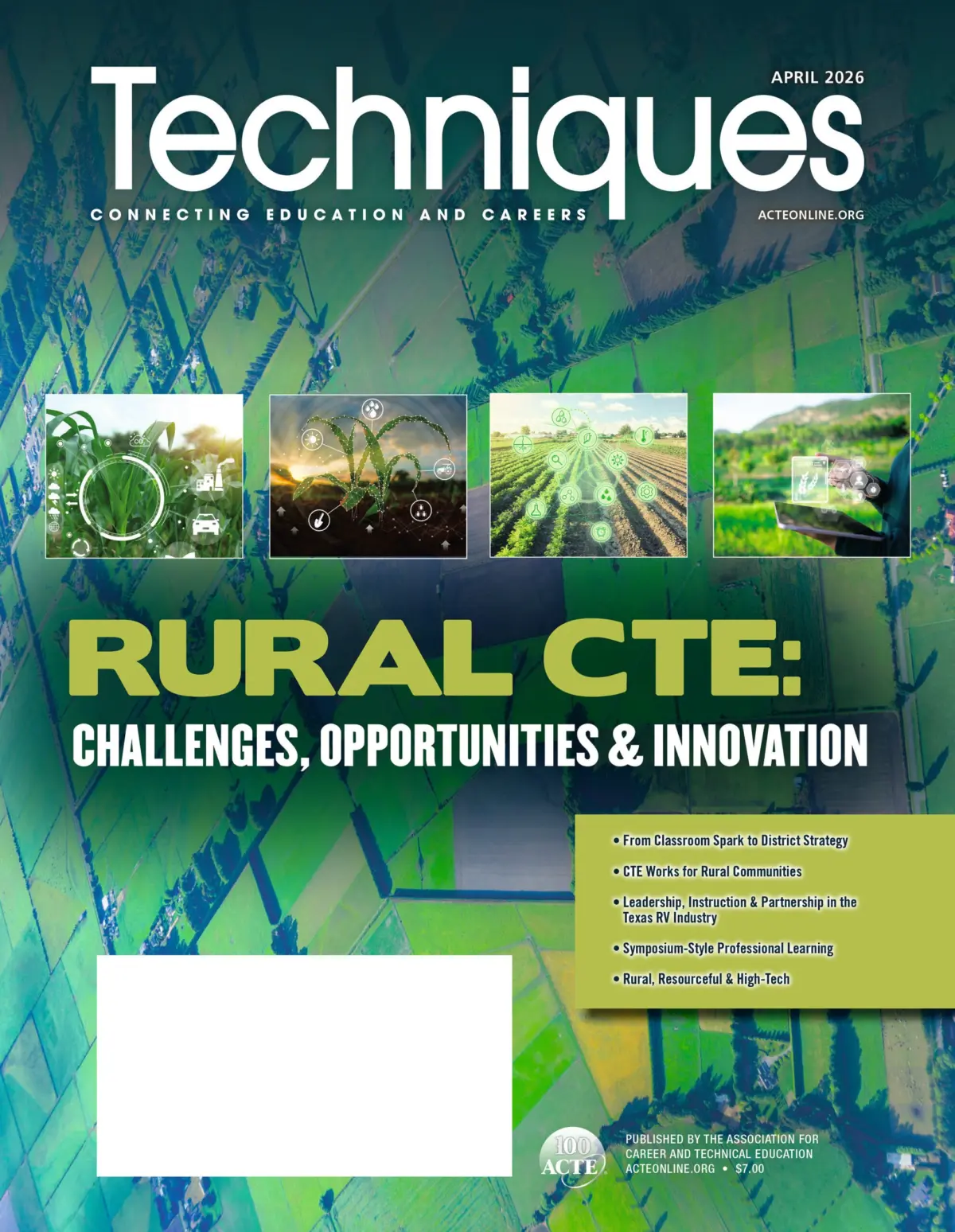
Rural CTE programs face severe, systemic headwinds. As local workforce populations dwindle, tax bases shrink, and institutional services grow increasingly limited, rural communities have sadly learned to brace themselves for program closures.
Offering a lifeline to beleaguered administrators, the April edition of Techniques presented a practical, data-driven framework for converting local program impact into concrete metrics that state legislators and school boards can understand and act upon. The resulting insights stretch far beyond a simple graduation day celebration, connecting day-to-day student success directly to regional workforce development and long-term community investment.
May 2026: Ending the Revolving Door of Teacher Retention
Consider this stark scenario: A dedicated professional leaves a lucrative, stable career in the insurance industry to answer the call of the classroom and become a CTE teacher. Just two days into the academic year, overwhelmed and unsupported, she resigns.
This cautionary tale served as the entry point for a critical May article examining a teacher retention crisis that is far more common than it should be. Drawing heavily on original empirical research, the author delivered a comprehensive blueprint for CTE leaders striving to keep vital industry experts inside the classroom. The core finding is as simple as it is profound: when teacher induction is treated as an ongoing, supportive professional experience rather than a static administrative checklist, educators stay. And when industry experts stay in the classroom, both students and programs thrive.
Supporting Context & Metrics
To fully comprehend the gravity of the insights published in Techniques across this 2025–2026 cycle, one must view them through the broader lens of national educational metrics and labor market demands.
- The Skills Gap: According to recent projections cited across various ACTE policy briefs, millions of middle-skill jobs remain unfilled due to a persistent mismatch between traditional academic preparation and modern industrial requirements. CTE programs utilizing the student-centered and wraparound design principles highlighted in Techniques report an average increase in post-program job placement rates.
- Teacher Retention Realities: National educational labor studies indicate that career-switcher educators—those entering teaching directly from industry sectors like manufacturing, healthcare, and IT—experience attrition rates up to 30% higher than traditional educators within their first three years, underscoring the vital importance of the robust induction frameworks championed in the May 2026 issue.
- The Rural Divide: Rural school districts, which comprise nearly 60% of all public school districts in the United States, frequently operate on per-pupil expenditures significantly lower than suburban counterparts. The ROI frameworks featured in the April 2026 edition provide these districts with critical advocacy tools to protect foundational funding streams.
Official Statements and Perspectives
Reflecting on a century of advocacy and the insights gathered during this landmark publishing year, association leaders emphasize that the future of American competitiveness is inextricably linked to the evolution of career and technical education.
"The best stories in CTE are never only about programs, budgets, or equipment," notes the editorial board of Techniques. "They are about the people inside them—what they built against the odds, what they believed in, and what they refused to give up on. As ACTE enters its second century, our mission remains anchored in lifting up those human stories."
Furthermore, contributors focusing on justice-impacted populations and postsecondary transitions have repeatedly underscored that equity cannot remain a passive buzzword.

"When we build pathways that prioritize actual competencies over historical stigma, we do not just transform an individual’s life—we revitalize our entire economic ecosystem," notes a contributor from the September 2025 cohort. "True high-quality CTE must be accessible to every learner, regardless of where they started or what setbacks they have faced."
Future Outlook: The Next Century of CTE
As the pages of Techniques turn toward a new volume, the lessons of the 2025–2026 academic year offer a clear roadmap for the road ahead. The convergence of modern facility design, robust wraparound services, data-backed rural advocacy, and sustainable teacher induction models signals a maturing profession that refuses to settle for the status quo.
The challenges confronting educators—ranging from rural population decline to the pressures of recruiting and retaining top-tier industry experts—are undeniably formidable. Yet, as a century of ACTE history has repeatedly demonstrated, the resilience, ingenuity, and unwavering dedication of CTE educators and advocates provide an inexhaustible wellspring of hope.
By continuing to center the student experience, dismantling barriers for marginalized populations, and telling compelling, human-centered stories, the community of educators represented in Techniques will continue shaping the future of workforce development for the next hundred years and beyond.

For those interested in contributing their own research, program successes, or leadership insights to the publication, learn more about writing for the magazine by visiting the Techniques Editorial Calendar. Read more groundbreaking articles and explore archive resources directly at ACTE Techniques.

