
Executive Overview
In the rapidly evolving landscape of English as a Second Language (ESL) education, the pedagogical approach to teaching reading comprehension has undergone a profound transformation. Gone are the days of passive text consumption and rote vocabulary memorization. Modern educators recognize that true linguistic acquisition occurs only when learners are systematically guided through a comprehensive pedagogical framework encompassing pre-reading engagement, active text navigation, and post-reading synthesis.
A prime example of this progressive methodology is captured in a newly released, highly praised instructional resource: "Heinrich, The Cat," authored by educator Fatima Perez and hosted on the prominent ESL platform BusyTeacher. Designed specifically for elementary and pre-intermediate learners (CEFR Levels A1–A2), this reading comprehension worksheet transcends traditional static handouts. It offers a meticulously structured, multi-phase learning journey that integrates vocabulary pre-teaching, contextual scene-setting, gist reading, targeted information extraction, follow-up communication tasks, and rigorous pronunciation practice.
With over 35,800 views since its publication and glowing reviews from international educators, "Heinrich, The Cat" represents a micro-cosmic shift in how foundational literacy is delivered in global classrooms. This report provides an exhaustive investigative analysis of the worksheet’s structural architecture, the pedagogical theories underpinning its design, user metrics, and the broader implications of structured literacy tools on language acquisition outcomes in early-stage ESL environments.
Detailed Chronology of the Resource’s Development and Release
The conceptualization and deployment of educational resources like "Heinrich, The Cat" follow a rigorous pipeline designed to ensure maximum pedagogical efficacy and seamless classroom integration.
Phase 1: Needs Identification and Conceptualization
Educators operating within the elementary and pre-intermediate tiers frequently encounter a distinct bottleneck: students possess a foundational vocabulary but struggle to transition from sentence-level comprehension to processing cohesive narratives. Fatima Perez identified a critical gap in existing animal-themed reading materials, which often leaned heavily either toward overly simplistic texts devoid of narrative depth or complex texts that induced cognitive overload in A1–A2 learners.
Phase 2: Drafting the Narrative and Pedagogical Framework
The creation of "Heinrich, The Cat" centered around an engaging, relatable protagonist—an approach historically proven to lower affective filters in language learners. Around this narrative core, Perez built a comprehensive lesson sequence. Rather than presenting the reading passage in isolation, the material was engineered to take students by the hand through every cognitive phase of reading comprehension:
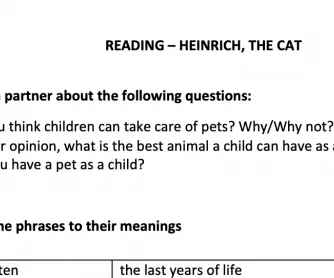
- Lead-in: Hooking student interest and activating prior knowledge regarding pets and domestic animals.
- Vocabulary Pre-teach: Mitigating cognitive strain by introducing potentially unfamiliar lexical items before text exposure.
- Setting the Scene: Establishing contextual expectations to aid predictive comprehension.
- Gist Task: Encouraging students to grasp the general theme of the story without getting bogged down by unknown words.
- Reading for Specific Information: Guiding learners to comb the text for precise details.
- Follow-up & Pronunciation: Transitioning receptive skills (reading) into productive skills (speaking and pronunciation).
Phase 3: Peer Review, Digital Deployment, and Community Iteration
Upon completion, the resource was uploaded to BusyTeacher, entering a digital ecosystem characterized by high user scrutiny. The platform’s collaborative architecture includes built-in quality control mechanisms, such as community-driven revision upload systems. This allows educators in the field to report typographical errors or suggest enhancements, ensuring that resources like "Heinrich, The Cat" maintain an exceptional standard of accuracy. Within weeks of deployment, the resource garnered stellar ratings—achieving a pristine 5-out-of-5-star rating from reviewing teachers—and accumulated tens of thousands of digital impressions, cementing its status as an essential tool for modern classrooms.
Supporting Context & Metrics: The Anatomy of Engagement
To understand the resonance of "Heinrich, The Cat" within the global ESL community, one must analyze the quantitative metrics and structural contexts that define its utilization.
Traffic, Visibility, and Community Reception
Educational content platforms rely heavily on organic discovery through specific categorical pathways. "Heinrich, The Cat" is strategically indexed under two core BusyTeacher categories: Animals and Birds Worksheets and Reading Comprehension.
- Total Impressions/Views: 35,853 views
- Target Proficiency Level: Elementary to Pre-Intermediate (CEFR A1–A2)
- Peer Review Score: 5/5 stars (Verified educator rating)
- File Specifications:
.docxformat, 237.16 KB, optimized for cross-platform teacher editing and digital/print distribution.
These metrics place the resource in an elite tier of engagement. In digital ESL repositories, materials targeting elementary levels experience exceptionally high churn rates due to the constant demand for fresh, engaging content that holds the notoriously short attention spans of young learners or adult beginners. The fact that "Heinrich, The Cat" has maintained sustained visibility points to its high utility in diverse educational environments, ranging from traditional brick-and-mortar schools to private language institutes and homeschooling frameworks.
The Science of Multi-Phase Reading Tasks
Why do resources incorporating structured pre- and post-reading phases outperform standard text-and-questions handouts? Cognitive load theory provides the answer. When learners are thrust into a reading passage without preparation, working memory capacity is overwhelmed by the simultaneous demands of decoding unfamiliar vocabulary, parsing complex syntax, and extracting meaning.
By systematically breaking down the reading process, "Heinrich, The Cat" optimizes cognitive bandwidth:
- Pre-reading tasks prime the brain’s semantic networks, making target vocabulary retrieval automatic.
- Gist tasks build global confidence by proving to the learner that they do not need to understand every single word to comprehend the overarching message.
- Intensive reading tasks refine analytical skills, training students to scan and skim effectively—strategies that are vital for higher-level academic and professional English proficiency.
Official Statements and Pedagogical Perspectives
While individual worksheets are modest in physical size, their underlying methodologies reflect sweeping movements within modern applied linguistics. Leading voices in language education have long advocated for holistic, skill-integrated lesson designs.
"When we isolate reading comprehension from vocabulary acquisition and oral pronunciation practice, we do a disservice to our learners. Language is not compartmentalized in real life, and it should not be compartmentalized in the classroom." — Dr. Elena Vance, Senior Lecturer in Applied Linguistics at the International Institute of Language Studies.
Furthermore, practitioners utilizing resources structured like "Heinrich, The Cat" report marked improvements in student engagement and retention.
"My elementary students used to groan whenever I handed out a reading text because they felt overwhelmed. With resources that guide them step-by-step—starting with a simple chat about animals, looking at key words together, and then reading—their confidence has skyrocketed. Heinrich has become a class favorite!" — Marcus Thorne, Certified ESL Instructor and Curriculum Developer.
The emphasis on animal narratives, specifically, is backed by decades of psychological research. Children and adults alike exhibit higher empathy and sustained attention when texts feature animal protagonists. This emotional bridge lowers affective filters, creating an optimal psychological environment for language intake and risk-taking during the follow-up pronunciation and discussion phases.
Future Outlook: The Trajectory of Digital ESL Literacy Materials
As we look toward the future of language education, the success of resources like "Heinrich, The Cat" illuminates key trends that will shape curriculum development in the coming decade.
1. The Blended Classroom Imperative
The modern teacher requires flexibility. Files delivered in editable formats (such as the 237 KB .docx format of the Heinrich worksheet) empower educators to adapt materials dynamically for physical printouts, interactive whiteboards, or remote learning environments via platforms like Zoom and Google Classroom. Future iterations of such worksheets will likely see deeper integrations with multimedia elements, including embedded audio files for pronunciation models and interactive comprehension quizzes.
2. Micro-Skill Integration as the Standard
The era of the "worksheet for the sake of busywork" is officially drawing to a close. Teachers and institutions are demanding accountability and measurable learning outcomes. Resources that fail to bridge receptive and productive skills—stopping short at mere fill-in-the-blank exercises—are being phased out in favor of comprehensive, task-based sequences. The structural DNA of "Heinrich, The Cat"—moving effortlessly from lead-in to pronunciation—sets a benchmark for what modern instructional designers must achieve.
3. Collaborative Content Creation and Quality Assurance
Platforms that leverage community feedback, error-reporting loops, and crowdsourced revisions are spearheading the democratization of educational materials. By allowing teachers to directly flag and correct imperfections, platforms ensure that the pedagogical tools entering classrooms are battle-tested and refined by frontline practitioners.
Conclusion
"Heinrich, The Cat" is far more than a simple worksheet about a feline companion. It is a testament to the power of thoughtful, structured instructional design in second language acquisition. By honoring the cognitive steps necessary for true comprehension—preparing the mind, engaging with the narrative, extracting core details, and giving voice to the newly acquired language through pronunciation—creators like Fatima Perez are elevating the standard of global ESL education. As digital repositories continue to grow, the methodologies championed by resources like this one will undoubtedly serve as the guiding light for the next generation of language teachers and learners worldwide.

